
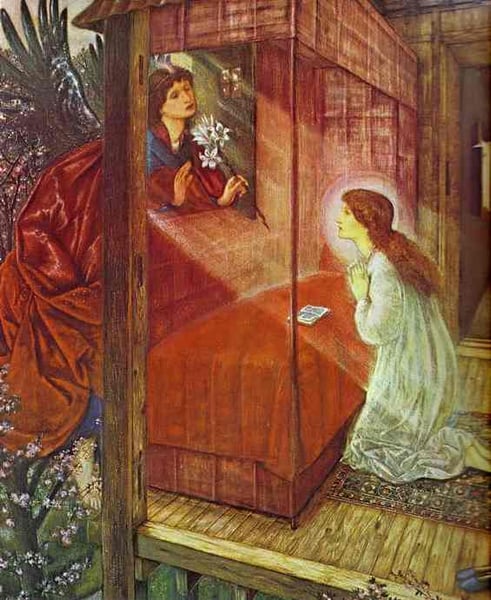
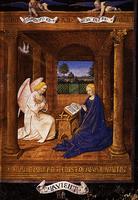
The Annunciation. The Flower of God
Dettagli
Analisi esperta di The Annunciation. The Flower of God di Edward Burne-Jones
Stile: Romanticism · Genere: religious painting
Expert Analysis: Edward Burne-Jones’s The Annunciation. The Flower of God
This painting, created within the broad framework of Romanticism, exemplifies Burne-Jones’s unique synthesis of Pre-Raphaelite intensity, medieval symbolism, and the Romantic era’s focus on spiritual longing and idealised beauty. As a religious work, it reinterprets a traditional biblical subject through a deeply emotional and symbolic lens, characteristic of Romantic art’s desire to evoke transcendence rather than mere narrative.
Significance within Romanticism and Religious Genre:
- Symbolic Floral Motif: The title itself—The Flower of God—deliberately invokes the lily, traditionally a symbol of the Virgin’s purity, but Burne-Jones amplifies its meaning. The flower becomes an emblem of divine grace and the Incarnation, grounding the supernatural event in nature’s delicate beauty—a hallmark of Romantic reverence for the natural world as a conduit to the sublime.
- Dreamlike Atmosphere: The composition’s muted, jewel-like palette and soft, flattened perspective create an ethereal, almost melancholic mood. The figures are enclosed in a hushed, intimate space, emphasising the inner, personal revelation over outward drama. This inwardness reflects Romanticism’s preoccupation with subjective experience and the viewer’s emotional response.
- Medieval Revival: Burne-Jones draws on Gothic art and early Renaissance models, evident in the angular drapery, elongated forms, and lack of naturalistic depth. This archaism aligns with Romanticism’s fascination with the Middle Ages as a spiritually purer, more poetic era. The angel’s poised serenity and Mary’s contemplative stillness elevate the scene to a timeless, visionary plane.
- Lyrical Aestheticism: The painting prioritises aesthetic harmony—line, colour, and pattern—over illusionistic realism. This approach, while rooted in Romanticism, also prefigures the Aesthetic Movement and Symbolism, establishing Burne-Jones as a bridge between Romantic emotion and later fin-de-siècle decorative spirituality.
In The Annunciation. The Flower of God, Burne-Jones transforms a canonical religious episode into a meditation on beauty, mystery, and divine love. The work’s significance lies in its ability to fuse Romantic personal piety with a refined, symbolic visual language, offering a contemplative vision that resonates as both a devotional image and a masterpiece of artistic idealism.
Museum / Gallery
Visivamente simili
20 opere con composizione e palette affini
Annunciation
Konrad Witz
The Annunciation
Dante Gabriel Rossetti
Annunciation
Filippo Lippi
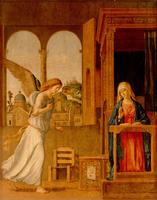
The Annunciation
Cima da Conegliano
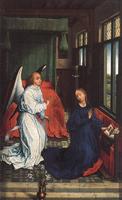
The Annunciation
Rogier van der Weyden
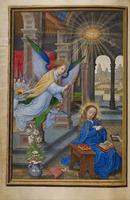
The Anunciation
Simon Bening
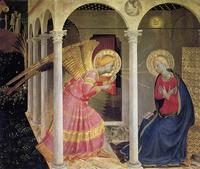
Annunciation
Fra Angelico
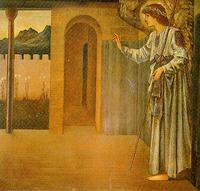
The Annunciation The Angel
Edward Burne-Jones
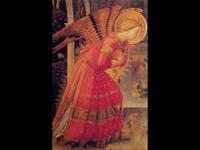
Annunciation (detail)
Fra Angelico
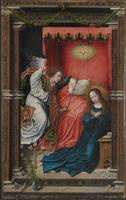
The Annunciation
Bernard Van Orley
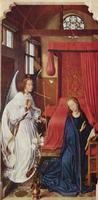
The Annunciation
Rogier van der Weyden
San Domenico Annunciation
Benozzo Gozzoli
The Annunciation
Giovanni Bellini
Annunciation
Leonardo da Vinci
Love's Altar
Walter Crane
The Annunciation
Rogier van der Weyden
The Annunciation
Gentile da Fabriano
The Childhood of Mary Virgin
Dante Gabriel Rossetti
The Annunciation
Hans Memling
The Annunciation dove
Jean Fouquet