
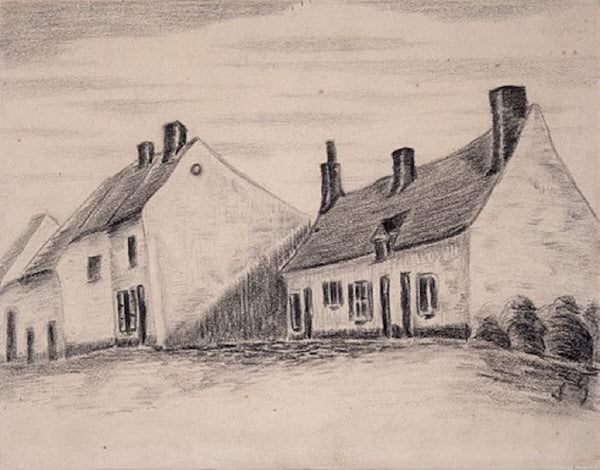
A Zandmennik house
Details
Expert analysis of Vincent van Gogh’s A Zandmennik house
Style: Realism · Genre: cityscape
Expert Analysis: "A Zandmennik House" by Vincent van Gogh
This painting occupies a pivotal place in Vincent van Gogh’s early development, serving as a bridge between his formative training in realism and the expressive, color-driven style that would later define Post-Impressionism. Executed during his Dutch period (c. 1882–1885), the work exemplifies the rigorous observation and emotional gravity that van Gogh cultivated under the influence of the Hague School and artists like Charles-Émile Jacque.
Significance within the Realist Tradition
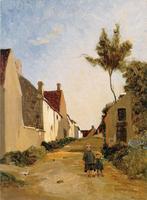
As a cityscape in a strictly realist vein, "A Zandmennik House" demonstrates van Gogh’s commitment to depicting the unvarnished lives of rural and working-class communities. Unlike the atmospheric landscapes of his contemporaries, van Gogh focuses on the humble, functional architecture of a sand-digger’s home (a "zandmennik" is a laborer who collects sand). The painting’s earthy palette—dominated by muted browns, grays, and ochres—reflects the realist mandate to capture the physical texture of a hardscrabble existence. Every brushstroke is deliberate: the rough-hewn walls, the weathered roof tiles, and the stark, unembellished windows speak to a life stripped of romanticism.
Genre and Composition
Though classified as a cityscape, the work is more accurately a study of place as social document. The composition is compressed and almost photographic, with the house pressed close to the picture plane, giving viewers a sense of intimate proximity. Van Gogh avoids the sweeping panoramas typical of cityscapes, instead isolating a single structure as if to say that the dignity of labor resides in the specific, the forgotten, the ordinary. The absence of human figures is telling: the building itself becomes a silent protagonist, bearing witness to the cycles of work and rest.
Van Gogh’s Early Realist Language
This painting is significant because it shows van Gogh mastering the realist toolkit before his radical transformation. The careful modulation of light, the use of diagonal lines to suggest both stability and decline, and the restrained palette are hallmarks of his earliest mature work. Yet subtle tensions already emerge: the slight asymmetry in the roofline and the heavy, almost tactile outlining of the eaves hint at the emotional intensity and distorted forms that would later explode in Arles. For scholars, this work is a key piece in understanding how van Gogh used realism not as an end but as a foundation—a disciplined observation of the world that he would later invert, exaggerate, and transfuse with symbolic color.
Legacy
While "A Zandmennik House" lacks the iconic status of Starry Night or Sunflowers, it is a crucial artifact of van Gogh’s artistic conscience. It anchors his early commitment to the "people of the earth"—a theme that persisted throughout his career, even as his style mutated beyond recognition. For students of Realism, it demonstrates how the movement’s principles of social truth and visual honesty could be applied to the urban periphery, documenting a vanishing way of life with both technical rigor and profound empathy. In its compact frame, we see the seeds of the artist who would soon declare, "I want to touch people with my art. I want them to say: he feels deeply, he feels tenderly."
Visually similar
20 works with related composition and palette
A house Magros
Vincent van Gogh
Route Traversant Un Village
Theophile Steinlen
Route Traversant Un Village
Theophile Steinlen
Chemineau Traversant Un Village Endormi
Theophile Steinlen
Chemineau Traversant Un Village Endormi
Theophile Steinlen
Bourg Breton Plestin
Theophile Steinlen
Village Street, Sketch
Vincent van Gogh
Route traversant village
Theophile Steinlen
Water mill
Jean-Francois Millet
Large Sheds, plate 21 from Regiunculae et Villae Aliquot Ducatus Brabantiae
Master of the Small Landscapes
A Village Road, Plate 7 from Regiunculae Et Villae Aliquot Ducatus Brabantiae
Master of the Small Landscapes
Houses in Ouessant
Maurice Utrillo
House birthplace Millet
Jean-Francois Millet
Farms, Ploughed Field in the Foreground from Praediorum Villarum Et Rusticarum Casularum Icones Elenoantissimae Ad Vivum in Apre Deformatae
Master of the Small Landscapes
La Maison A L'Entree Du Village
Theophile Steinlen
La Maison a L'Entree du Village
Theophile Steinlen
Bretagne
David Kakabadze
Stockton Walk, Whitby
William Gilbert Foster
De Witte Hoeve
Leon Spilliaert
Village Street
Frederic Bazille