
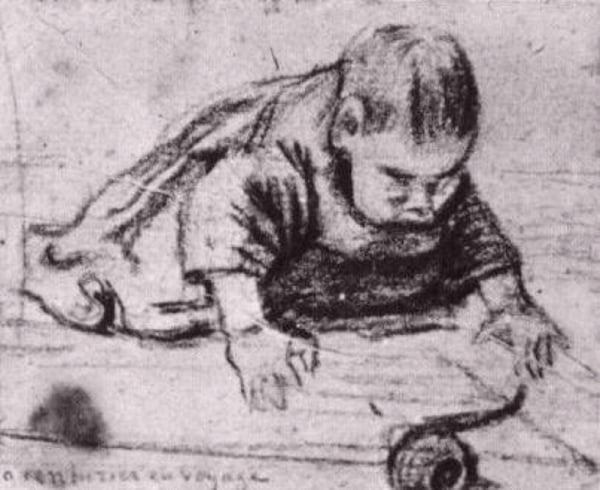
Baby Crawling
Details
Expert analysis of Vincent van Gogh’s Baby Crawling
Style: Realism · Genre: genre painting
Expert Analysis: "Baby Crawling" by Vincent van Gogh
While Vincent van Gogh is universally celebrated for his Post-Impressionist masterpieces—with their bold colors, expressive brushwork, and emotional intensity—his early work in the Realist style reveals the foundation upon which his later innovations were built. “Baby Crawling” is a genre painting (a depiction of everyday life) that exemplifies van Gogh’s deep commitment to observing and rendering the unvarnished reality of the world around him—a key tenet of Realism.
Significance within van Gogh’s oeuvre and the Realist tradition:
-
Early Realist Foundation
Before his famous stay in Paris and subsequent transformation, van Gogh was profoundly influenced by Dutch Realist painters like Rembrandt and the Hague School. Works such as “Baby Crawling” belong to his early period (c. 1881–1885), where he focused on peasants, laborers, and domestic scenes. This painting is a testament to his rigorous study of light, shadow, and human anatomy under the unidealized conditions of Realism. The act of a baby crawling—a simple, bodily milestone—is treated with the same earnestness van Gogh would later apply to sunflowers or starry nights. -
Radical Honesty in Subject Matter
Genre painting in the Realist tradition often elevated humble, everyday actions into dignified subjects. By choosing a baby in motion—rather than a posed portrait—van Gogh emphasizes the fleeting, unposed moment. The child’s struggle, focus, and physical effort become a microcosm of human perseverance. This approach aligns with Realism’s rejection of romanticized or heroic narratives in favor of authentic human experience. -
Technical Precision and Atmosphere
In “Baby Crawling,” van Gogh’s palette is subdued (characteristic of his early works), dominated by earthy browns, muted grays, and soft whites. The lighting is naturalistic, possibly derived from a window, casting soft shadows that define the baby’s rounded form and the texture of the floor or blanket. The brushwork, while more controlled than his later impasto, already shows an interest in texture—a harbinger of his tactile, expressive style. -
Emotional Resonance
Even within the strictures of Realism, van Gogh infuses the scene with a quiet tenderness. The baby’s forward gaze and outstretched hand convey determination and vulnerability. This psychological depth—finding the sublime in the ordinary—anticipates the emotional power of his later works, where even a chair or a pair of boots could resonate with human feeling. -
Contextual Significance
“Baby Crawling” is a rare example of van Gogh focusing on early childhood—a theme largely absent from his better-known oeuvre. It serves as a reminder that his artistic vision was never limited to dramatic landscapes or portraits; he was equally attuned to the quiet, universal moments of life. The painting stands as a bridge between his Dutch Realist training and the intensely personal vision that would soon follow.
In sum, “Baby Crawling” matters not only as a document of van Gogh’s Realist phase but as proof that his genius for capturing the essence of life—in all its awkward, beautiful, and transient forms—was present from the very beginning.
Visually similar
20 works with related composition and palette
Girl Kneeling
Vincent van Gogh
Peasant Woman, Kneeling, Possibly Digging Up Carrots
Vincent van Gogh
Peasant Woman, Kneeling, Seen from the Back
Vincent van Gogh
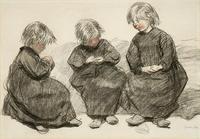
Three Seated Girls
Theophile Steinlen
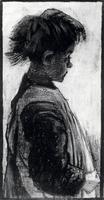
Girl with Pinafore, Half-Figure
Vincent van Gogh
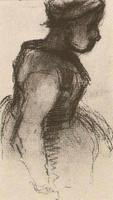
Peasant Girl, Half-Figure
Vincent van Gogh
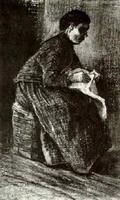
Woman Sitting on a Basket, Sewing
Vincent van Gogh
Heads: Children and a Family Group
James Charles
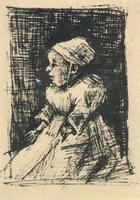
Baby
Vincent van Gogh
Peasant Woman Gleaning
Vincent van Gogh
An Apostle from the Transfiguration
Matthias Grünewald
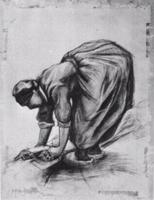
Peasant Woman, Stooping
Vincent van Gogh
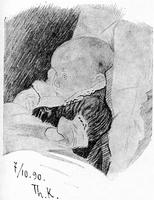
Ingrid
Theodor Severin Kittelsen
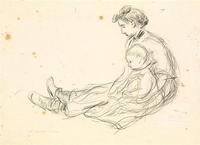
Woman and child
Theophile Steinlen
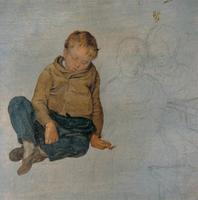
Sleeping Boy
George Harvey
Портрет сина Миколи
Микола Пимоненко
Portrait of Gaugin's daughter Aline
Paul Gauguin
Margot Wearing a Bonnet
Mary Cassatt
Girl with Black Cap Sitting on the Ground
Vincent van Gogh
Man Contempling a Skull
Salvator Rosa