
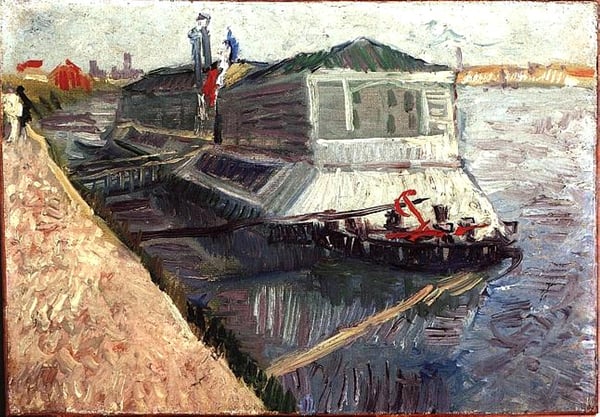
Analyse experte de Bathing Float on the Seine at Asnieres de Vincent van Gogh
Style : Neo-Impressionism · Genre : landscape
Expert Analysis: "Bathing Float on the Seine at Asnieres" by Vincent van Gogh (Neo-Impressionism)
This landscape, executed during van Gogh’s transitional period in Paris (1886–1888), is a remarkable testament to his engagement with Neo-Impressionist principles—a style he adopted after encountering Georges Seurat and Paul Signac. The work’s significance lies in its deliberate synthesis of rigorous color theory and the artist’s emerging emotional intensity.
Technical Innovation within Neo-Impressionism
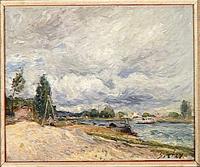
True to the Neo-Impressionist idiom, van Gogh employs a systematic application of small, independent brushstrokes (often termed “divisionism” or “pointillism”) to capture the scintillating light of the Seine. Rather than mixing pigments on a palette, he places complementary colors side by side—for instance, touches of orange and blue in the water’s reflections—to achieve optical vibrancy. The brushwork, however, already hints at van Gogh’s distinct character: the strokes are slightly thicker and more directional than Seurat’s mechanical dots, lending a subtle turbulence to the otherwise placid scene.
Subject and Context
Asnieres, a suburb northwest of Paris, was a favored leisure destination for the working class—a theme that aligns with the Neo-Impressionist interest in modern, everyday life. The bathing float itself is a humble wooden pontoon, often used by bathers, set against the calm river and a backdrop of industrial chimneys. This juxtaposition of nature and urban progress typifies the era’s social landscape, and van Gogh captures it with a luminous palette that elevates the ordinary.
Significance within van Gogh’s Oeuvre
While van Gogh is best known for his later, intensely expressionistic works (e.g., The Starry Night), Bathing Float on the Seine at Asnieres demonstrates his rigorous training in color science. It is a transitional piece that bridges his early, somber Dutch palette and the vibrant, emotionally charged hues of Arles. Here, the Neo-Impressionist technique is not merely decorative; it serves to harmonize the scene’s tranquility with a dynamic, almost vibrating surface—foreshadowing the painter’s belief that color could convey feeling directly.
In short, this painting is significant as a masterful exercise in Neo-Impressionist method, a document of van Gogh’s artistic evolution, and a luminous celebration of a fleeting, modern moment.
Museum / Gallery
Visuellement similaire
20 œuvres à la composition et à la palette proches
The Seine at Grenelle
Alfred Sisley
The Laundry Boat on the Seine at Herblay
Gustave Loiseau
Barge Garage at Saint Mammes
Alfred Sisley
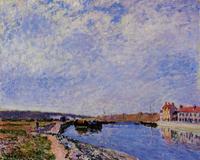
The Barge Port and Saint Mammes
Alfred Sisley
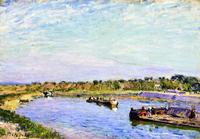
The Port of Saint Mammes, Morning
Alfred Sisley
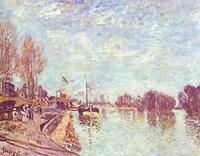
His at Suresne
Alfred Sisley
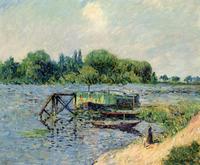
Laundry on the Seine at Herblay
Gustave Loiseau
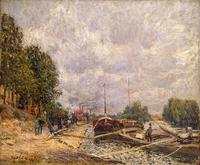
Barges at Billancourt
Alfred Sisley
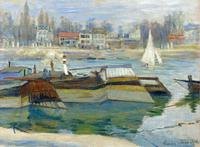
The Seine at Asnieres
Claude Monet
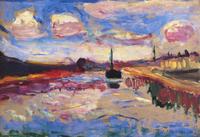
Canal Du Midi
Henri Matisse
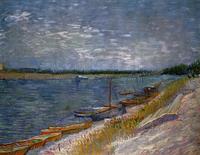
Moored Boats
Vincent van Gogh
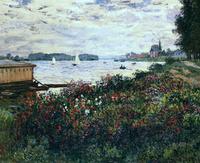
Riverbank at Argenteuil
Claude Monet
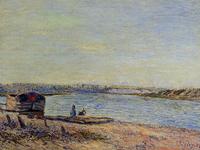
The Hills of Veneux, Seen from Saint Mammes
Alfred Sisley
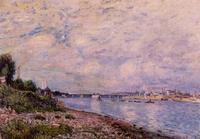
Bougival
Alfred Sisley
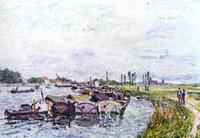
Barges at Saint Mammès
Alfred Sisley
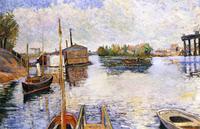
Paris, Ponton des Bains Bailet
Paul Signac
Barja
Nikola Tanev
River Loing at Saint Mammes
Alfred Sisley
Washhouse at lower meudon
Pierre-Auguste Renoir
Banks of the Seine
Alfred Sisley