
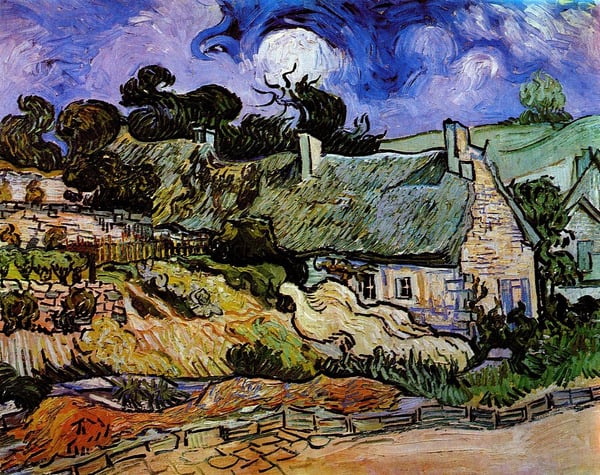
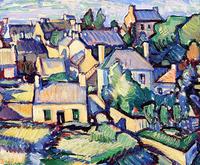
Houses with Thatched Roofs, Cordeville
Dettagli
Analisi esperta di Houses with Thatched Roofs, Cordeville di Vincent van Gogh
Stile: Post-Impressionism · Genere: landscape
Vincent van Gogh’s Houses with Thatched Roofs, Cordeville stands as a quintessential example of Post-Impressionist landscape painting, where the artist transforms a humble rural subject into a scene of intense emotional and visual energy.
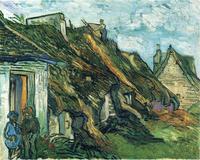
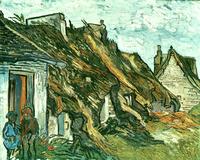
Composition and Subject: The painting depicts a cluster of cottages in the village of Cordeville, near Auvers-sur-Oise. Van Gogh elevates the ordinary—a row of thatched roofs, a winding path, and lush gardens—into a dynamic, almost vibrating composition. The low, crouching houses are rendered with thick, swirling brushstrokes that give the thatch a tactile, organic vitality, as if the roofs themselves are breathing.
Color and Light: True to his Post-Impressionist sensibility, van Gogh abandons naturalistic color for expressive, symbolic hues. The roofs are built from layers of blue, green, yellow, and orange, suggesting not just straw but the passage of time, weather, and sunlight. The bright, almost acidic greens of the foliage and the deep ultramarine of the sky create a tension that is both jubilant and restless—a hallmark of van Gogh’s mature style.
Brushwork and Texture: The significance of this work lies in its aggressive, tactile brushwork. Van Gogh applies paint in thick impasto, creating a surface that is nearly sculptural. Each stroke is a separate, deliberate mark, yet together they cohere into a pulsating whole. This technique, derived from Impressionism but pushed further, allows the artist to convey subjective emotion: the viewer feels the wind in the trees, the warmth of the sun, and the artist’s own fervent engagement with the world.
Context and Legacy: Painted in June 1890, just weeks before his death, Houses with Thatched Roofs embodies van Gogh’s late style, where even the most peaceful pastoral scene is charged with psychological intensity. Unlike the detached observations of earlier Impressionists, van Gogh’s landscape is a mirror of his inner state—turbulent, searching, and profoundly modern. The work’s significance lies in how it redefines landscape as a vehicle for raw personal expression, paving the way for Expressionism and 20th-century art’s embrace of emotional truth over optical accuracy.
Museum / Gallery
Visivamente simili
20 opere con composizione e palette affini
Houses in Auvers 2
Vincent van Gogh
A Group of Cottages
Vincent van Gogh
Thatched Houses against a Hill
Vincent van Gogh
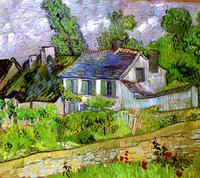
Houses in Auvers
Vincent van Gogh
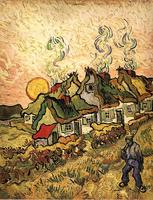
Thatched Cottages in the Sunshine Reminiscence of the North
Vincent van Gogh
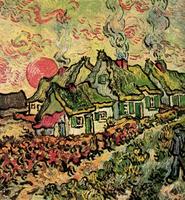
Cottages Reminiscence of the North
Vincent van Gogh
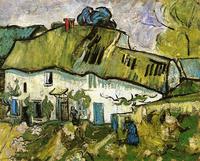
Farmhouse with Two Figures
Vincent van Gogh
Vineyards with a View of Auvers
Vincent van Gogh
Thatched Sandstone Cottages in Chaponval
Vincent van Gogh
View of Vessenots near Auvers
Vincent van Gogh
Thatched Cottages in Chaponval, Auvers-sur-Oise
Vincent van Gogh
Thatched Cottages in Jorgus
Vincent van Gogh
View of Auvers
Vincent van Gogh
Village Street and Steps in Auvers with Figures
Vincent van Gogh
Street in Auvers-sur-Oise
Vincent van Gogh
The House of Pere Pilon
Vincent van Gogh
Cottages and Cypresses: Reminiscence of the North
Vincent van Gogh
Yellow Farm at Pouldu
Paul Serusier
Street in Saintes-Maries
Vincent van Gogh
Ile de Bréhat
Samuel Peploe