
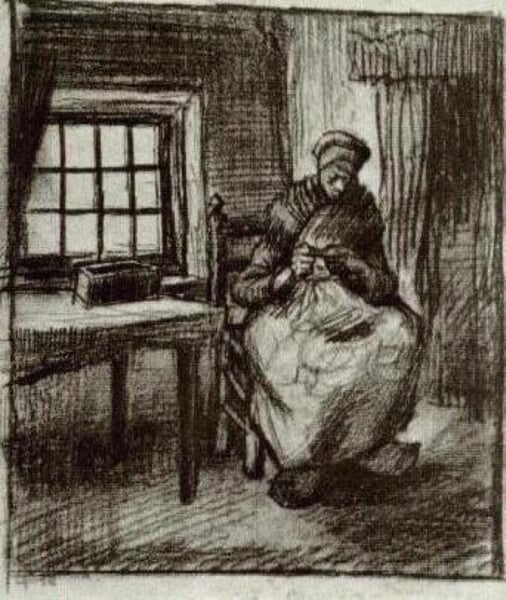
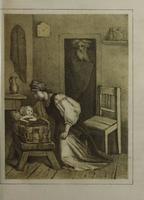
Interior with Peasant Woman Sewing
Details
Expertenanalyse zu Vincent van Goghs Interior with Peasant Woman Sewing
Stil: Realism · Genre: genre painting
Expert Analysis: "Interior with Peasant Woman Sewing" by Vincent van Gogh
Vincent van Gogh’s Interior with Peasant Woman Sewing (c. 1885) exemplifies his early commitment to Realism and the genre painting tradition, offering a profound glimpse into the daily labor of rural life. This work belongs to van Gogh’s Nuenen period (1883–1885), when he was deeply influenced by the Dutch Realist masters such as Jean-François Millet and the Hague School, who elevated the dignity of peasant existence through unidealized, intimate scenes.
Composition and Technique: The painting depicts a solitary woman absorbed in her sewing, seated in a humble interior. Van Gogh’s palette is dominated by earthy browns, muted grays, and deep shadows—a hallmark of his early style before his later, vibrant color experiments. The light is dim and directional, likely from a single window, casting soft highlights on the woman’s hands and the fabric she works on. The rough texture of the paint and loose brushwork convey the physicality of the setting, emphasizing the rawness of peasant life. The composition is compact and focused, drawing the viewer’s eye to the figure’s stooped posture and concentrated expression.
Significance within Realism and van Gogh’s Development: This painting is significant for several reasons. First, it embodies van Gogh’s deep empathy for the working class—a theme he carried throughout his career. Unlike sentimentalized depictions, van Gogh insists on an almost austere truthfulness: the room is sparse, the woman’s clothing is plain, and her task is repetitive, yet she is portrayed with quiet dignity. The work aligns with the Realist aim of recording everyday life without artifice.
Second, this piece marks a crucial technical transition. While rooted in the dark, tonal realism of artists like Rembrandt and Millet, van Gogh’s treatment of light and shadow already hints at his later emotional expressiveness. The tension between the static, enclosed interior and the concentrated activity of sewing creates a psychological depth—the woman’s stillness suggests a lifetime of such labor.
Finally, Interior with Peasant Woman Sewing is a direct precursor to van Gogh’s more famous The Potato Eaters (1885), where the same values of humility, solidarity, and the harshness of rural life are expanded into a group scene. In this smaller, quieter work, we see the seed of van Gogh’s lifelong dedication to representing the unsung heroism of ordinary people. It stands as a testament to Realism’s power to find profound meaning in the most modest human acts.
Visuell ähnlich
20 Werke mit ähnlicher Komposition und Farbpalette
Interior with Peasant Woman Sewing
Vincent van Gogh
Interior with Peasant Woman Sewing
Vincent van Gogh
Scheveningen Woman Sewing
Vincent van Gogh
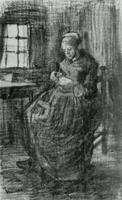
Interior with Peasant Woman Sewing
Vincent van Gogh
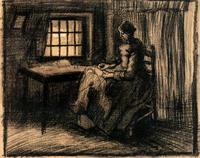
Woman Sewing
Vincent van Gogh
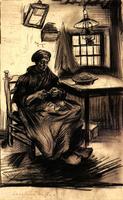
Woman Shelling Peas
Vincent van Gogh
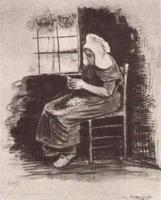
Woman Peeling Potatoes near a Window
Vincent van Gogh
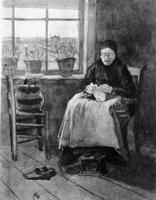
Woman at the Window, Knitting
Vincent van Gogh
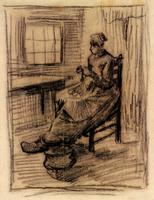
Interior with Peasant Woman Peeling Potatoes
Vincent van Gogh
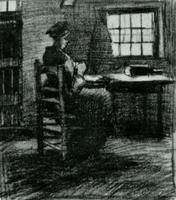
Interior with Peasant Woman Sewing
Vincent van Gogh
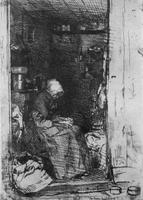
Old Woman with Rags
James McNeill Whistler
Woman With Coffee Grinder
Xavier Mellery
Child and Woman Pouring Coffee
Vincent van Gogh
Woman Peeling Potatoes
Vincent van Gogh
THE UNDERGROUND RAILWAYS
John Leech
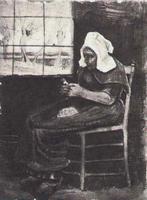
Woman Peeling Potatoes near a Window
Vincent van Gogh
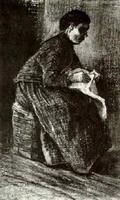
Woman Sitting on a Basket, Sewing
Vincent van Gogh
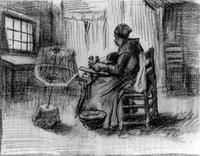
Peasant Woman Reeling Yarn
Vincent van Gogh
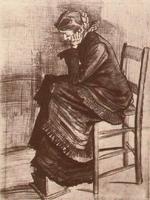
Bent Figure of a Woman
Vincent van Gogh
Hans Christian Andersen Fairy Tales
Mykola Murashko