
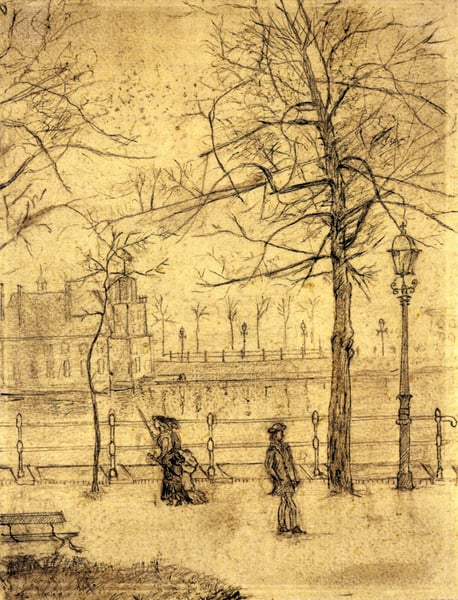
Lange Vijverberg, Hague
Ayrıntılar
Vincent van Gogh sanatçısının Lange Vijverberg, Hague eseri hakkında uzman analizi
Tarz: Realism · Tür: sketch and study
Expert Analysis of "Lange Vijverberg, Hague" by Vincent van Gogh
This work is a revealing early example of Vincent van Gogh’s transition from his initial Realist training to the expressive force that would define his later career. Classified as a sketch and study in the Realist style, it belongs to van Gogh’s formative Hague period (1881–1883), a time when he was rigorously learning the fundamentals of perspective, composition, and tonal observation under the influence of the Hague School.
Significance within Style and Period
-
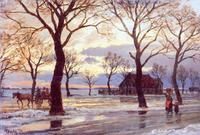
A Grounding in Realism: Unlike the vivid, expressive brushwork of his Post-Impressionist masterpieces, "Lange Vijverberg, Hague" demonstrates van Gogh’s disciplined commitment to Realist principles. The scene—a clear, structured view of a canal-side street in The Hague—is rendered with careful attention to atmospheric perspective, subtle tonal variations, and the accurate depiction of light and shadow. This adherence to observable reality was essential for van Gogh’s artistic development; it provided the technical bedrock upon which he would later build his more radical chromatic and gestural experiments.
-
Study as Essential Practice: The genre of sketch and study is crucial here. Van Gogh produced numerous such works to master the Dutch urban landscape, often working en plein air to capture the quiet, gray-toned atmosphere of the Netherlands. This piece is not a finished, marketable painting but a deliberate exercise in spatial logic—note the precise recession of the tree-lined Vijverberg, the reflection of the houses in the water, and the careful placement of passing figures. It reveals his relentless self-education and his belief that honest observation of the everyday world was the foundation of all art.
-
Precursor to a Revolutionary Vision: While restrained in palette and execution, "Lange Vijverberg, Hague" already hints at van Gogh’s future intensity. The careful, almost compulsive stroke work and the focus on a humble, almost mundane urban vista prefigure his later interest in capturing the soul of ordinary places. It stands as a vital document of the artist’s journey—a disciplined, Realist study that, in its quiet mastery of the observable, made possible the radical expressiveness that would soon follow.
Görsel olarak benzer
İlişkili kompozisyon ve renk paletine sahip 20 eser
Luxembourg Garden in Paris
Vincent van Gogh
Vicarage and Church at Etten
Vincent van Gogh
Bridge near the Schenkweg
Vincent van Gogh
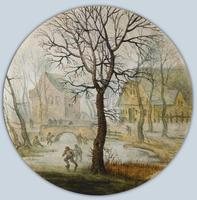
Stream
Pieter Brueghel the Younger
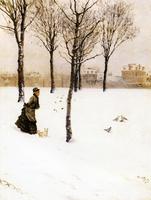
A Winter's Landscape
Giuseppe De Nittis
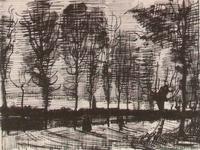
Lane with Poplars
Vincent van Gogh
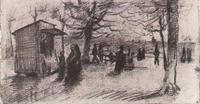
The Terrace of the Tuileries with People Walking
Vincent van Gogh
View of the Hofstede "the Klooster" from the Kleverlaan.
Cornelis van Noorde
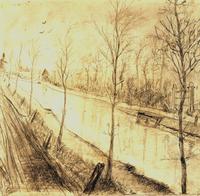
Canal
Vincent van Gogh
a Winter Scene in Kampen
Hendrick Avercamp
Farm near frozen river with skaters on the ice
Esaias van de Velde
Pond and a Village, Plate 15 from Regiunculae Et Villae Aliquot Ducatus Brabantiae
Master of the Small Landscapes
View of Diemen
Rembrandt
Bench with Four Persons
Vincent van Gogh
View of the Keizersgracht, Amsterdam, with people leaving the theatre
Reinier Vinkeles
Amusement D’hiver
Hendrick Avercamp
People Walking in Front of the Palais du Luxembourg
Vincent van Gogh
Snow Scene Moret Station
Alfred Sisley
Parsonage Garden in the Snow with Three Figures
Vincent van Gogh
Vinterscene
Hans Gude