
Expertenanalyse zu Vincent van Goghs Vicarage and Church at Etten
Stil: Realism · Genre: sketch and study
Expert Analysis: Vicarage and Church at Etten by Vincent van Gogh (Realism, Sketch and Study)
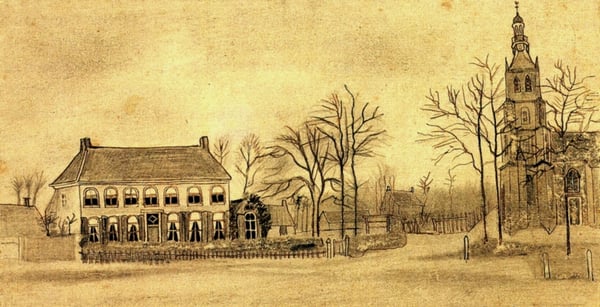
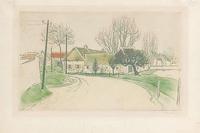
This work, created during van Gogh’s early Dutch period (circa 1881), is a vital document of his development as an artist. Stylistically anchored in Realism, it predates his later Post-Impressionist breakthroughs by several years. As a sketch and study, it reveals van Gogh’s rigorous observational practice and his deep connection to the rural, Protestant environment of his upbringing.
Significance within Realism and van Gogh’s oeuvre
- Roots in Dutch Realist tradition: The composition—a modest vicarage and church seen in stark, subdued tones—echoes the 17th-century Dutch landscape tradition of artists like Ruisdael, emphasizing plain, unidealized subject matter. Van Gogh’s focus on the ordinary, functional architecture of his father’s parish reflects Realism’s commitment to depicting everyday life without romantic exaggeration.
- Early mastery of perspective and light: Although a sketch, the work demonstrates van Gogh’s acute sensitivity to spatial recession and atmospheric effects. The careful rendering of the building’s facades and the church spire against a low horizon shows his study of natural light and shadow, a hallmark of Realist plein-air practice.
- Personal and psychological resonance: The vicarage at Etten was where van Gogh lived with his parents after his return from England and during his early attempts at an artistic career. This study carries emotional weight, marking a period of intense self-doubt and ambition. The church and vicarage become symbols of familial duty and spiritual longing, themes that would later erupt in his more expressive works.
- Bridge to later innovation: While the style is firmly Realist, the energetic, broken lines and the slight awkwardness in the handling of form hint at van Gogh’s restless, searching hand. This sketch represents a crucial laboratory for his evolving drawing technique—a precursor to the rhythmic, swirling strokes of his later masterpieces.
Conclusion
Vicarage and Church at Etten is significant not for its technical polish but for its testimony to van Gogh’s foundational Realist training and his ability to infuse a humble study with profound personal meaning. It stands as a quiet, precise record of a place that shaped his worldview, and as a crucial link between traditional Dutch Realism and the radical, expressive art that would soon follow.
Visuell ähnlich
20 Werke mit ähnlicher Komposition und Farbpalette
Vicarage at Nuenen
Vincent van Gogh
Vicarage at Etten
Vincent van Gogh
Spaarnwoude
Esaias van de Velde
Woman with Wheelbarrow at Night
Vincent van Gogh
Snowy Landscape with the Old Tower
Vincent van Gogh
Vicarage at Nuenen
Vincent van Gogh
Landscape with Hewed Trees, Plate17 from Regiunculae Et Villae Aliquot Ducatus Brabantiae
Master of the Small Landscapes
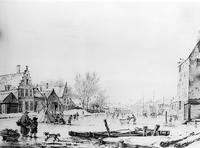
Winter Spuihaven Dordrecht
Jacob van Strij
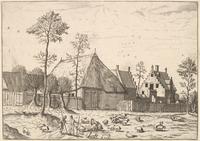
Shed with Cottage, from The Small Landscapes
Master of the Small Landscapes
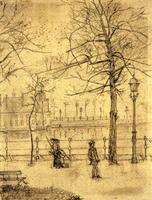
Lange Vijverberg, Hague
Vincent van Gogh
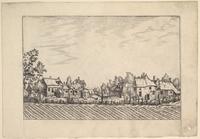
Farms, Ploughed Field in the Foreground from Praediorum Villarum Et Rusticarum Casularum Icones Elenoantissimae Ad Vivum in Apre Deformatae
Master of the Small Landscapes
Bleach field
Anton Mauve
Fields and a Road,plate 8 from Regiunculae Et Villae Aliquot Ducatus Brabantiae
Master of the Small Landscapes
Pond and a Village, Plate 15 from Regiunculae Et Villae Aliquot Ducatus Brabantiae
Master of the Small Landscapes
Stream
Pieter Brueghel the Younger
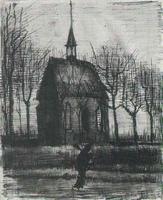
Church in Nuenen, with One Figure
Vincent van Gogh
Moret sur Loing
Alfred Sisley
Farm near frozen river with skaters on the ice
Esaias van de Velde
Farm near Vichy
Jean-Francois Millet
La Maison a L'Entree du Village
Theophile Steinlen