
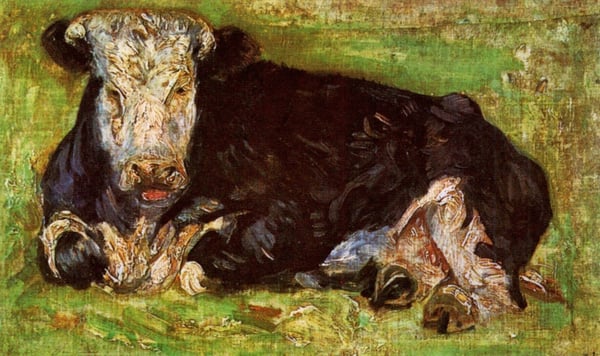
Lying Cow
Details
Expertenanalyse zu Vincent van Goghs Lying Cow
Stil: Realism · Genre: animal painting
Expert Analysis: "Lying Cow" by Vincent van Gogh
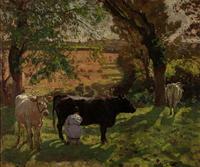
While Vincent van Gogh is celebrated as a titan of Post-Impressionism, his early work “Lying Cow” (c. 1883) anchors him firmly in the Realist tradition—a critical foundation for his later expressive breakthroughs. Painted during his Nuenen period, this animal study reveals van Gogh’s rigorous commitment to direct observation, earthy palette, and empathetic rendering of rural life, all hallmarks of the Realist movement as championed by artists like Jean-François Millet.
Significance within Realism and the Animal Painting Genre
- Mastery of humble subject matter: Realism elevated ordinary, often overlooked subjects—here, a resting cow—to the level of high art. Van Gogh treats the animal with dignity, focusing on its solid, grounded form and the subtle play of light across its hide. The cow is not idealized; it is a living creature captured in a quiet, unposed moment.
- Textural and tonal precision: Van Gogh’s brushwork is tight and descriptive, modeling the cow’s body through careful gradations of brown, black, and ochre. The shadowed underbelly and the warm sunlight on its back demonstrate a nascent understanding of atmospheric effects that would later explode into his signature vibrant impasto.
- Precursor to later empathy: Unlike many animal paintings of the era that emphasized decorative or narrative elements, van Gogh focuses purely on the animal’s presence. This quiet, almost solemn observation prefigures his deep identification with laborers and his own later subjects, where he sought to “express the love of two lovers by a marriage of two complementary colors” – but here, that love is already visible in his respect for the cow’s simple existence.
Place in van Gogh’s Evolution
“Lying Cow” belongs to a series of farm studies executed while van Gogh was honing his craft under the influence of the Hague School. The work’s Realist discipline —its muted palette, accurate anatomy, and refusal to sentimentalize—stands in instructive contrast to his later, more turbulent works. It shows that van Gogh’s revolutionary color and emotion were built on a solid foundation of careful observation. For the viewer, it provides an essential key: the same artist who would later slash swirling cypresses into vibrating ribbons first learned to look at a cow lying in a field with unwavering, loving attention. In that sense, “Lying Cow” is not just a modest animal portrait but a testament to the Realist roots that made the Post-Impressionist flowering possible.
Visuell ähnlich
20 Werke mit ähnlicher Komposition und Farbpalette
Liggende jonge stier
Anton Mauve
Leicestershire Longhorn Bull
James Ward
Study of Cows
Eugene Boudin
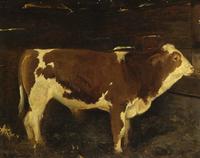
Bull
Ivan Shishkin
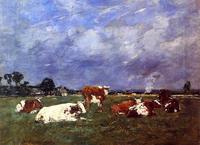
Cows in the Pasture
Eugene Boudin
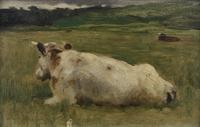
Cows Lying Down
Julien Dupré
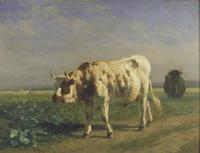
The white bull
Constant Troyon
Pasturage on the Banks of the Touques
Eugene Boudin
Cows at the Watering
Constant Troyon
Cows in a Pasture
Eugene Boudin
King of the Herd
Rosa Bonheur
Cows in a Meadow, Morning Effect
Eugene Boudin
Grazing Cow
Rudolf Koller
Hereford Cow and Calf (diptych
William Shiels
The young bull
Filippo Palizzi
Landscape with Cattle
Robert Julian Onderdonk
Landscape. Cows in the Foreground
Edgar Degas
Cows in a Landscape
Constant Troyon
Pasture at Deauville
Eugene Boudin
Freshness of Morning
Algernon Talmage