
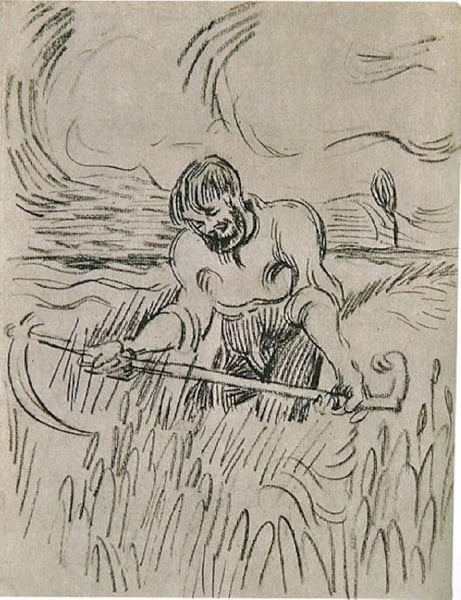
Man with Scythe in Wheat Field
Details
Expert analysis of Vincent van Gogh’s Man with Scythe in Wheat Field
Style: Post-Impressionism · Genre: sketch and study
Expert Analysis: Man with Scythe in Wheat Field by Vincent van Gogh
Context & Significance
This work, classified as a sketch and study, holds a pivotal place in van Gogh’s Post-Impressionist oeuvre. Unlike his finished canvases, this piece reveals the raw, unfiltered energy of his creative process. Studies like this one allowed van Gogh to rapidly capture the essential rhythm of rural labor—a theme he repeatedly explored in his later masterpieces (e.g., The Wheat Field with a Reaper). The scythe-wielding figure, set against a broad expanse of wheat, becomes a metonym for the cyclical nature of life, death, and harvest, a motif van Gogh invested with profound personal and existential meaning.
Stylistic Hallmarks (Post-Impressionist Lens)
- Expressive, Decisive Linework: Even as a sketch, van Gogh employs his characteristic broken, curved strokes. The scythe’s arc is rendered with swift, emphatic marks that mirror the motion of the tool itself. This foreshadows the painted swirls of his later wheat fields.
- Abbreviated Form, Maximum Impact: The figure is distilled to its essential silhouette—the hat, bent back, scythe—prioritizing posture over anatomical precision. This reduction to primal shape is a hallmark of van Gogh’s studies, where he sought the spirit of the scene.
- Contrast of Chaos and Order: The wheat stalks are suggested through dense, agitated hatchings, while the sky or background remains nearly bare, creating a visual tension between the overwhelming natural growth and the human figure’s singular, determined action.
Why It Matters
This sketch is significant not merely as a preparatory document but as a demonstration of van Gogh’s method: working directly from life, with the speed and intensity of a poet drafting a line. It reveals the artist grappling with the fundamental Post-Impressionist problem—how to convey subjective emotion through vibration of line and pattern, even in a “unfinished” state. Man with Scythe in Wheat Field stands as a testament to van Gogh’s belief that the most profound truths could be found in the humblest of rural gestures, captured in a moment of pure, unpolished observation.
Museum / Gallery
Visually similar
20 works with related composition and palette
Peasant Digging
Vincent van Gogh
The working mower
Ferdinand Hodler
Illustrations for Mikhail Stelmakh's book "In the Hedgehog's Windmill"
Hryhorii Havrylenko
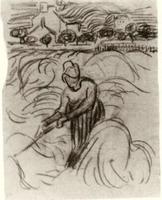
Woman Working in Wheat Field
Vincent van Gogh
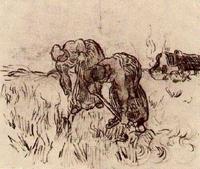
Peasant Woman Digging
Vincent van Gogh
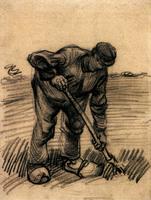
Peasant Lifting Potatoes
Vincent van Gogh
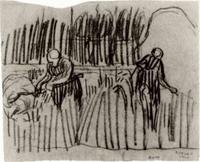
Two Women Working in Wheat Field
Vincent van Gogh
Sketch of a Peasant Working
Vincent van Gogh
Reaper
Vincent van Gogh
Sketch of Two Women
Vincent van Gogh
Reaper
Vincent van Gogh
Chansons du Peuple
Theophile Steinlen
Peasant Woman Lifting Potatoes
Vincent van Gogh
Illustrations for Mikhail Stelmakh's book "In the Hedgehog's Windmill"
Hryhorii Havrylenko
Wheat Field with Trees and Mower
Vincent van Gogh
Far Til Marken
Theodor Severin Kittelsen
Peasant with Sickle, Seen from the Back
Vincent van Gogh
The Mower
Albin Egger-Lienz
A Woman Picking Up a Stick in Front of Trees
Vincent van Gogh
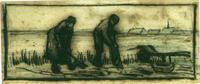
Potato Harvest with Two Figures
Vincent van Gogh