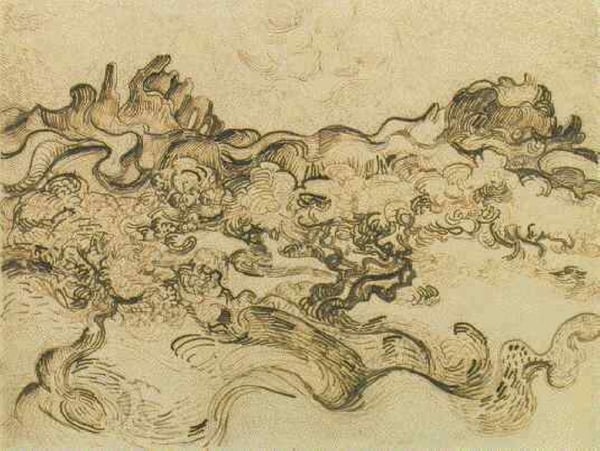
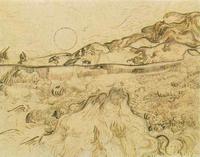
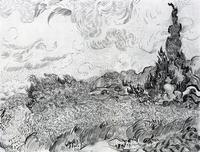
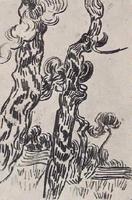
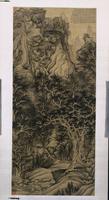
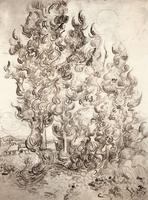
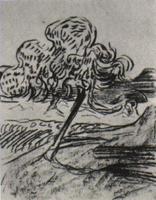
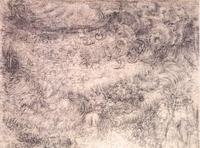
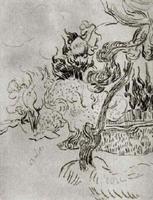
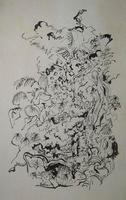
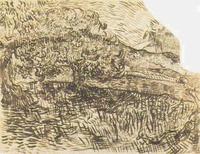
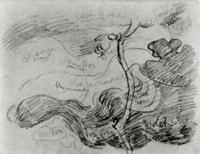
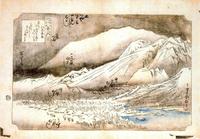
This artwork, a sketch and study in the Post-Impressionist style, captures a moment of raw creative experimentation. While lacking the finished polish of van Gogh’s larger canvases, its significance lies in how it reveals the artist’s working process and the core innovations of his mature period.
The rough, unfinished quality of the sketch emphasizes van Gogh’s revolutionary approach to drawing. Instead of precise lines, he uses swirling, undulating marks to mimic the organic growth of the olive trees and the rhythm of the mountain slopes. This is not a mere visual record, but a dynamic translation of energy and movement onto paper. The composition likely prioritizes the cypress-like, twisting forms of the olive trunks against the rolling hills, a motif van Gogh used to express the struggle and resilience of life itself.
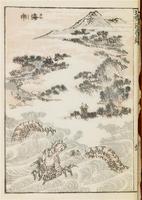
As a study, it demonstrates his method of simplifying nature into bold patterns and directional strokes—a technique that would later define his most famous paintings. The lack of color (assuming it is a plein-air drawing) forces us to focus on texture and line, highlighting his debt to Japanese woodblock prints and their use of contour and flattened perspective. This work is significant because it shows Post-Impressionism not as a finished product, but as a restless, searching process—one where the artist’s emotional response to the landscape is the true subject. It is a direct window into van Gogh’s attempt to capture the soul of the Provencal landscape through the simplest of means.