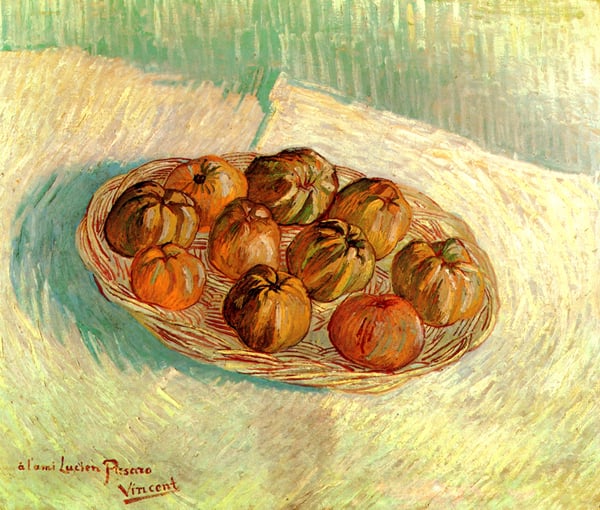
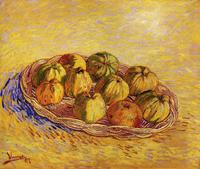
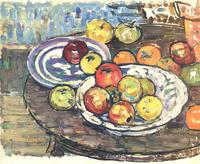
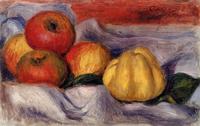
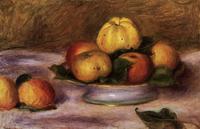
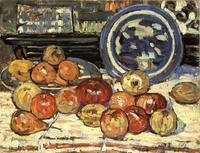
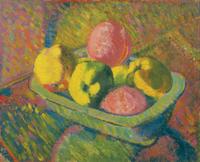
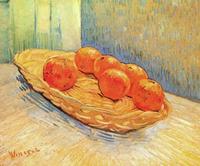
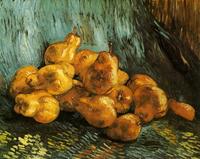
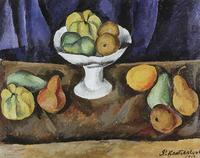
This still life, created by Vincent van Gogh and dedicated to the Neo-Impressionist painter Lucien Pissarro, marks a pivotal moment in the artist’s assimilation of avant-garde color theory. Executed in a Post-Impressionist idiom that explicitly references Neo-Impressionist methods, the work is significant for its synthesis of systematic, dotted brushwork with van Gogh’s characteristically expressive, vibrant palette. The dedication to Pissarro—a key figure in the Neo-Impressionist movement—signals van Gogh’s deliberate engagement with the scientific approach to color contrasts and optical mixing championed by Georges Seurat and Paul Signac. Yet the painting transcends mere technical exercise: the dynamic, swirling strokes around the basket of apples infuse a humble still life with emotional intensity, transforming a domestic subject into a field of psychological resonance. Within the Post-Impressionist period, this piece exemplifies how van Gogh borrowed Neo-Impressionist discipline while asserting his own idiosyncratic, emotional brushwork—a hybrid that would prove foundational to early modernism’s break from Impressionist naturalism.