Analisi esperta di Amor Carving His Bow di Parmigianino
Stile: Mannerism (Late Renaissance) · Genere: mythological painting
Artwork: Amor Carving His Bow by Parmigianino
Style: Mannerism (Late Renaissance)
Genre: Mythological painting
Expert Analysis:
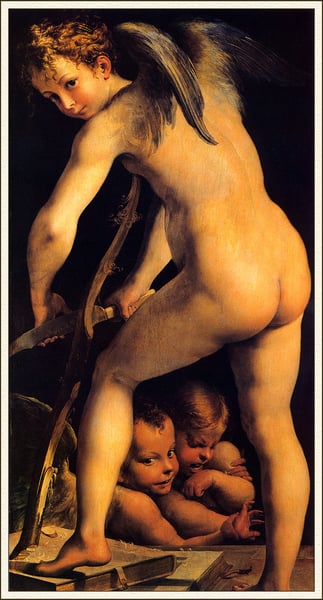
Parmigianino’s Amor Carving His Bow stands as a quintessential example of Mannerist innovation, signaling the shift from the balanced naturalism of the High Renaissance toward a more self-consciously artificial, elegant, and intellectually sophisticated visual language.
The painting’s mythological subject—the god of desire (Amor/Cupid) fashioning his bow—is handled with characteristic Mannerist flair. Rather than presenting the scene with classical restraint, Parmigianino exaggerates the figure’s proportions: Amor’s limbs are elongated, his torso subtly twisted, and his pose contorts into an elegant, serpentine line (the figura serpentinata). This deliberate distortion creates a sense of unnatural grace and refined tension, emphasizing artifice over natural observation.
The composition further embodies Mannerist priorities. The figure is pushed into the foreground, filling the picture plane with an almost sculptural presence, while the background is reduced to a dark, undefined void. This focus on the single, isolated figure—rendered with polished, cool flesh tones and smooth, enamel-like brushwork—directs the viewer’s attention entirely to Amor’s delicate, contemplative act. The bow itself becomes an emblem of the artist’s own craft: just as Amor carves his tool of desire, Parmigianino carves a refined, intellectual painting that prioritizes elegance and formal experimentation over narrative clarity or emotional immediacy.
Significantly, Amor Carving His Bow exemplifies how Mannerist artists repurposed mythological themes to explore aesthetic ideals of courtly sophistication and artistic virtuosity. Parmigianino’s treatment transforms a simple mythological trope into a meditation on beauty, desire, and the artist’s own creative power—a hallmark of the Mannerist sensibility that would influence later generations of European painters.
Museum / Gallery
Visivamente simili
20 opere con composizione e palette affini
Cupid Making His Bow
Peter Paul Rubens
Crowned love and profane Love
Guido Reni
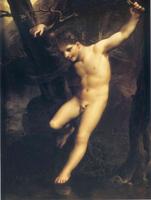
Young Zephyr balancing above water
Pierre-Paul Prud'hon
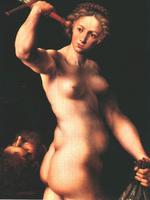
Judith
Jan van Hemessen
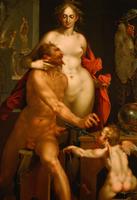
Venus in Vulcan's Forge
Bartholomeus Spranger
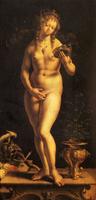
Venus and the Mirror
Mabuse
Eve, the Serpent and Death
Hans Baldung
Amor Victorioso
Orazio Riminaldi
Portrait of Cosimo I de' Medici as Orpheus
Agnolo Bronzino
Allegory of Fortune
Bartholomeus Spranger
Minerva Dressing
Lavinia Fontana
Venus Frigida
Peter Paul Rubens
A Witch with Cupids
Adam Elsheimer
The Martyrdom of St. Sebastian
Peter Paul Rubens
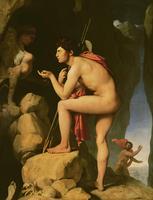
Oedipus and the Sphinx
Jean Auguste Dominique Ingres
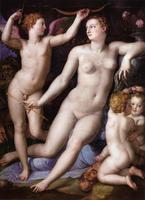
Venus, Cupid and Jealousy
Agnolo Bronzino
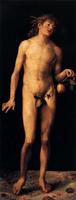
Adam (left panel)
Albrecht Durer
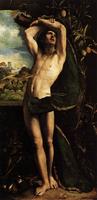
St Sebastian
Dosso Dossi
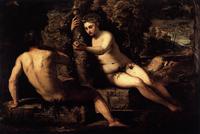
The Temptation of Adam
Tintoretto
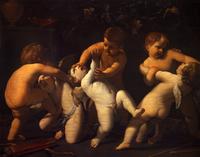
Angels
Guido Reni