Expert analysis of Parmigianino’s Madonna and Child
Style: Mannerism (Late Renaissance) · Genre: religious painting
Based on the structured facts provided, here is an expert analysis of Parmigianino's Madonna and Child, focusing on its significance within the Mannerist style.
Analysis:
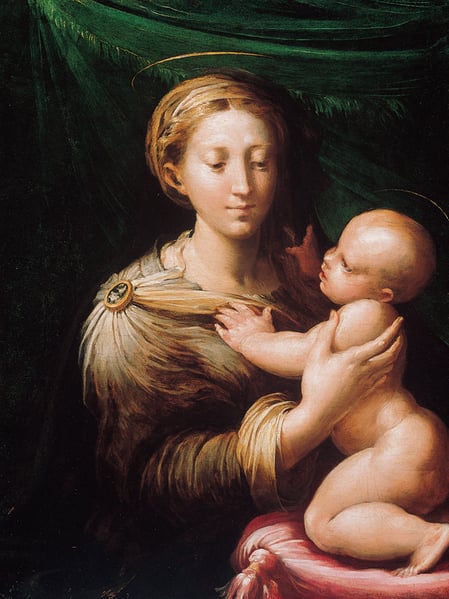
Parmigianino's Madonna and Child is a quintessential example of the Mannerist period in Late Renaissance art. The work's significance lies in its deliberate departure from the balanced, naturalistic ideals of the High Renaissance (exemplified by Raphael or Leonardo) in favor of an artificial, sophisticated elegance that defines Mannerist aesthetics.
Key Hallmarks of Mannerist Significance:
-
Elongated, Stylized Proportions: True to Mannerist vocabulary, the figures exhibit an unnatural, graceful elongation. The Madonna's neck, fingers, and overall silhouette are stretched, creating a sense of refined, otherworldly grace rather than realistic human anatomy. This elongation is a hallmark of Parmigianino's mature style—a deliberate artifice that prioritizes elegance over verisimilitude.
-
Contrapposto and S-Curve Posture: The Madonna's body is posed in an elegant, serpentine figura serpentinata, a complex, twisting S-curve. This dynamic, spiraling pose adds a sense of fluid, almost dance-like movement, contrasting with the static, stable compositions of the earlier Renaissance. It is a signature Mannerist device that showcases the artist's virtuosity in creating intricate, visually engaging forms.
-
Refined, Artificial Beauty: The painting epitomizes Mannerism's cult of grazia (grace). The Madonna's features are idealized to a degree that feels courtly and precious—a "maniera" (stylish) elegance that was highly prized in the aristocratic circles for which Parmigianino worked. The cool, polished surface and delicate handling of light further enhance this sense of artificial perfection.
-
Tension Between Spirituality and Sensuality: While a religious painting, the work imbues the sacred subject with a sophisticated, almost worldly sensuality. The Madonna's elongated, elegant form and the intimate yet aloof interaction with the Child generate a psychological tension—a hallmark of Mannerist religious art, which often prioritized aesthetic refinement over direct devotional simplicity.
In summary, Parmigianino's Madonna and Child is significant not as a faithful representation of a biblical scene, but as a masterful display of Mannerist ideals: a consciously refined, intellectually complex, and exquisitely artificial vision of beauty that challenges the harmonious naturalism of its predecessors.
Museum / Gallery
Visually similar
20 works with related composition and palette
Madonna and Child
Francesco de' Rossi (Francesco Salviati), "Cecchino"
MARIA MIT DEM KIND UND DEM JOHANNESKNABEN
Hans Rottenhammer I
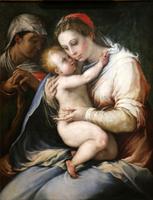
Virgin with a Child
Francesco de' Rossi (Francesco Salviati), "Cecchino"
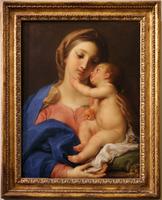
Madonna col bambino
Pompeo Batoni
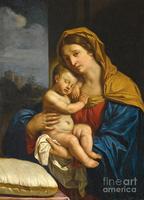
Madonna and Child
Guercino
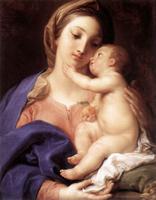
Madonna and Child
Pompeo Batoni
Madonna and Child and Saint John the Baptist
Hans Rottenhammer I
DIE MADONNA MIT DEM JESUSKNABEN
Jacopo Amigoni
Holy Family with Saint John the Baptist
Francesco de' Rossi (Francesco Salviati), "Cecchino"
Madonna and Child with Infant John the Baptist
Domenico Beccafumi
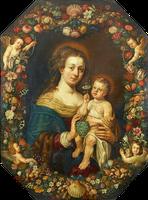
Madonna and Child in a Floral Garland
Jan Brueghel the Elder
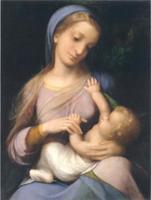
Madonna Campori
Correggio
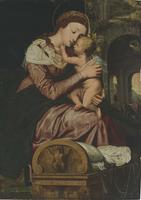
Mary with Child
Adam van Noort
Madonna and Child
Jacopo Amigoni
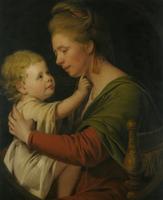
Portrait of Jane Darwin and her son William Brown Darwin
Joseph Wright
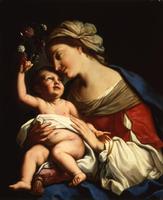
Virgin and Child
Elisabetta Sirani
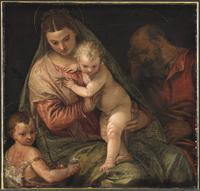
The Holy Family with the Infant St. John the Baptist
Paolo Veronese
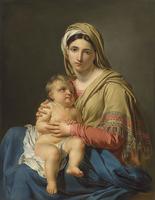
Madonna and Child
Joseph Paelinck
The Virgin of the Rosary
Bartolome Esteban Murillo
Virgin and Child
Bartolome Esteban Murillo