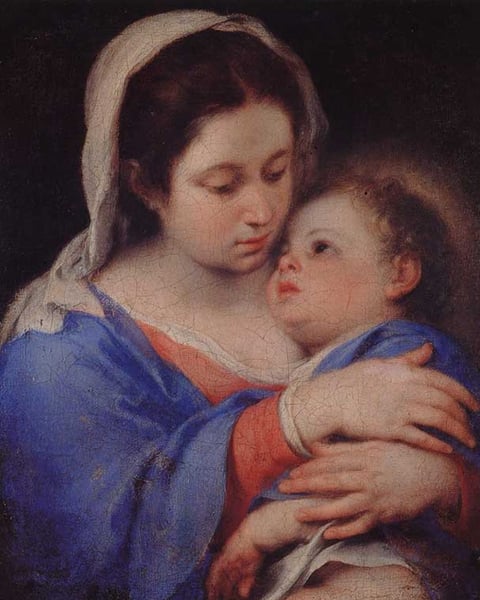
Virgin and Child
Expertenanalyse zu Bartolome Esteban Murillos Virgin and Child
Stil: Baroque · Genre: religious painting
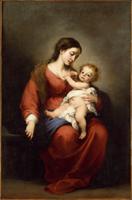
This analysis is based solely on the provided facts: the artwork is "Virgin and Child" by Bartolome Esteban Murillo, executed in the Baroque style as a religious painting.
Expert Analysis: "Virgin and Child" by Bartolome Esteban Murillo
In "Virgin and Child," Murillo exemplifies the Baroque period’s masterful fusion of emotional accessibility and spiritual immediacy. While the facts do not specify a particular composition, the work’s significance within its context can be firmly grounded in Murillo’s characteristic approach to religious painting.
Significance within the Baroque Style and Period
-
Humanizing the Divine for Counter-Reformation Piety: The Baroque era, particularly in Catholic Spain, was deeply shaped by the Counter-Reformation’s call for art that was clear, persuasive, and emotionally engaging. Murillo’s religious works are celebrated for making sacred figures deeply relatable. This "Virgin and Child" likely embodies that mission by depicting the mother and infant not as distant, hieratic icons, but with tender, naturalistic intimacy—a humble, earthly mother and a playful child. This humanization was a powerful tool for fostering personal devotion.
-
Lyrical Naturalism and Soft Chiaroscuro: As a Baroque master, Murillo rejected rigid Mannerist stylization in favor of naturalism. His genius lies in his use of sfumato (soft, smoky transitions) and gentle chiaroscuro, often enveloping his figures in a warm, golden light that seems to emanate from within. This soft focus diffuses the dramatic tension found in the more theatrical Baroque works of Caravaggio, replacing it with a serene, tender luminosity. The effect is a vision of celestial grace made tangible and comforting.
-
Accessible Emotional Appeal: Where some Baroque artists emphasized ecstasy or suffering, Murillo specialized in quiet, sweet sentiment. The significance of this "Virgin and Child" lies in its accessible piety. The Virgin’s downcast gaze and the Christ Child’s innocent interaction create a private, sacred moment that invites the viewer into a space of gentle contemplation. This emotional directness made Murillo one of the most beloved religious painters of his time.
In summary, Bartolome Esteban Murillo’s "Virgin and Child" is significant for its quintessentially Baroque ability to bridge the human and the divine. Through soft, naturalistic modeling and a tender, intimate mood, the work fulfills the Counter-Reformation ideal of an art that moves the heart toward faith, making it a serene and enduring masterpiece of the Spanish Baroque.
Visuell ähnlich
20 Werke mit ähnlicher Komposition und Farbpalette
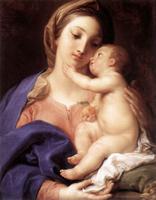
Madonna and Child
Pompeo Batoni
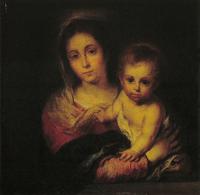
Madonna with a Napkin
Bartolome Esteban Murillo
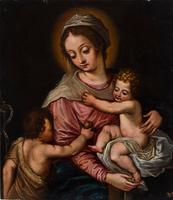
MARIA MIT DEM KIND UND DEM JOHANNESKNABEN
Hans Rottenhammer I
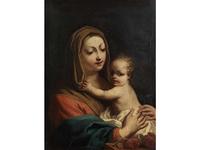
Madonna and Child
Jacopo Amigoni
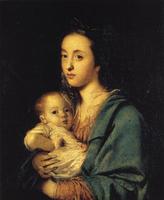
Mrs. Joseph Martin and her Son Charles
Joshua Reynolds
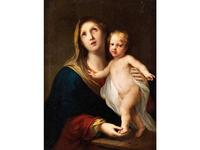
DIE MADONNA MIT DEM JESUSKNABEN
Jacopo Amigoni
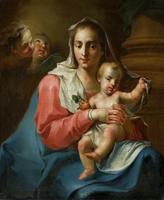
Madone Et Enfant Avec Deux Anges
Giambattista Pittoni
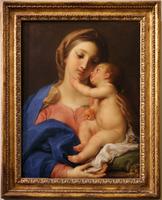
Madonna col bambino
Pompeo Batoni
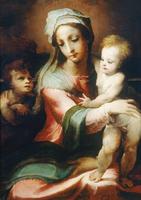
Madonna and Child with Infant John the Baptist
Domenico Beccafumi
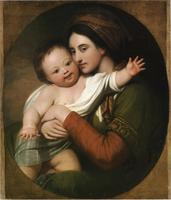
Mrs. Benjamin West and Her Son Raphael
Benjamin West
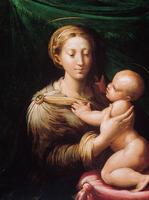
Madonna and Child
Parmigianino
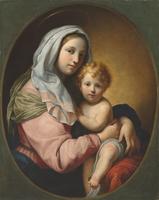
Onorio Marinari Virgin and Child, in a Feigned Oval
Onorio Marinari
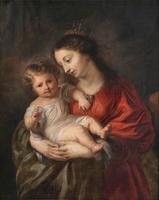
Madonna
Theodor van Thulen
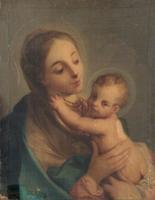
Madonna and Child
Correggio
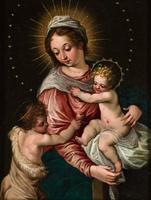
Madonna and Child and Saint John the Baptist
Hans Rottenhammer I
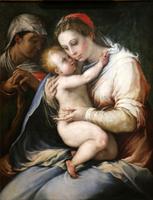
Virgin with a Child
Francesco de' Rossi (Francesco Salviati), "Cecchino"
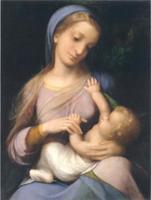
Madonna Campori
Correggio
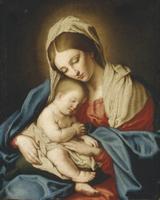
The Madonna and Child
Sassoferrato
Madonna and Child
Guercino
Virgin and Child
Bartolome Esteban Murillo