Analisi esperta di Cowherd in a Field at Eragny di Camille Pissarro
Stile: Impressionism · Genere: genre painting
Expert Analysis: "Cowherd in a Field at Eragny" by Camille Pissarro
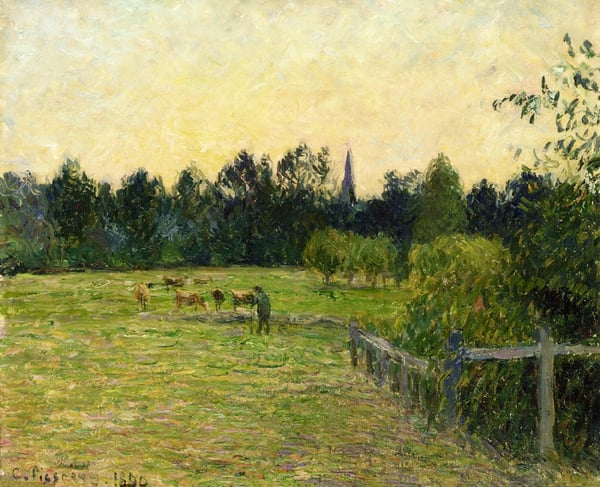
Camille Pissarro’s Cowherd in a Field at Eragny stands as a quintessential example of Impressionism’s radical redefinition of “genre painting.” Rather than depicting historical or allegorical narratives, Pissarro elevates an ordinary pastoral moment—a cowherd tending cattle in a sunlit field—to the level of profound artistic statement. What makes this work significant is its masterful synthesis of the Impressionist core principles: the direct observation of nature, the exploration of fleeting light, and the celebration of modern rural life.
Brushwork and Light: Pissarro employs the hallmark broken-color technique, with short, visible strokes of pure pigment that capture the shimmering quality of sunlight filtering through leaves and across grass. The cowherd and animals are not rigidly outlined but dissolve into patches of color, their forms built from dabs of green, ochre, and soft blue. This technique conveys the transient effects of light and atmosphere—a key innovation that distinguishes Impressionism from earlier, more polished landscape traditions.
Subject and Significance within Impressionism: As a genre painting, the work reflects the Impressionist commitment to depicting contemporary, everyday scenes without moral or sentimental overlay. Pissarro, often called the “father of Impressionism,” was uniquely dedicated to portraying the dignity of peasant labor and the rhythms of the countryside. In Cowherd in a Field at Eragny, he does not romanticize the figure; instead, the cowherd is integrated harmoniously into the landscape, suggesting a modern, unidealized view of humanity’s place in nature. The choice of Eragny—Pissarro’s home from 1884 onward—underscores his fascination with the particular, localized effects of light and season, making this work not just a generic rustic scene but a specific, intimate study of a place and time.
Composition and Perspective: The composition is deceptively simple, with a diagonal recession of fields that guides the eye toward the cowherd, who is partially obscured by the cattle. This subtle asymmetry and the lack of a single focal point mimic the way vision naturally scans a landscape. The high horizon and emphasis on the foreground meadow anchor the viewer in the immediate, sensory experience of the field—another break from traditional landscape conventions.
In summary, Cowherd in a Field at Eragny is significant because it encapsulates Pissarro’s role as a bridge between the early Impressionist fascination with light and the later focus on structured, yet still spontaneous, depictions of rural life. It exemplifies how Impressionist genre painting transformed the ordinary into a luminous celebration of direct perception, forever changing how we see the world around us.
Museum / Gallery
Visivamente simili
20 opere con composizione e palette affini
Field of Oats in Eragny
Camille Pissarro
Setting Sun, Autumn in Eragny
Camille Pissarro
Meadows at Eragny
Camille Pissarro
Landscape at Eragny
Camille Pissarro
Frost at Morgat
Maxime Maufra
Corn Field
Mihaly Munkacsy
The Ploughed Field
Vincent van Gogh
The Fields of Eragny, the Apple Tree
Camille Pissarro
In the Wheatfield at Gennevilliers
Berthe Morisot
Landscape near Valenciennes
Berthe Morisot
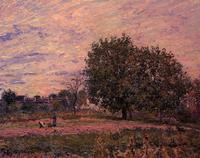
Walnut Trees, Sunset Early Days of October
Alfred Sisley
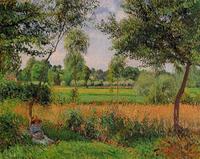
Morning, Sun Effect, Eragny
Camille Pissarro
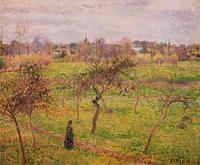
The Meadow at Eragny
Camille Pissarro
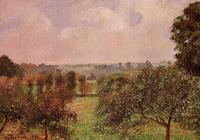
After the Rain, Autumn, Eragny
Camille Pissarro
Autumn Morning
Camille Pissarro
Flowering Apple Trees at Eragny
Camille Pissarro
Meadow at Bazincourt
Camille Pissarro
Farm in Brittany
Paul Gauguin
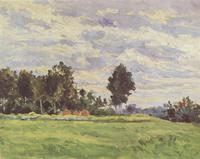
Landscape in the Ile de France
Paul Cezanne
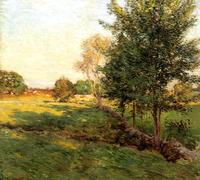
Lenghtening Shadows
Willard Metcalf