Expert analysis of Camille Pissarro’s Eragny Landscape
Style: Pointillism, Neo-Impressionism · Genre: landscape
Expert Analysis of "Eragny Landscape" by Camille Pissarro
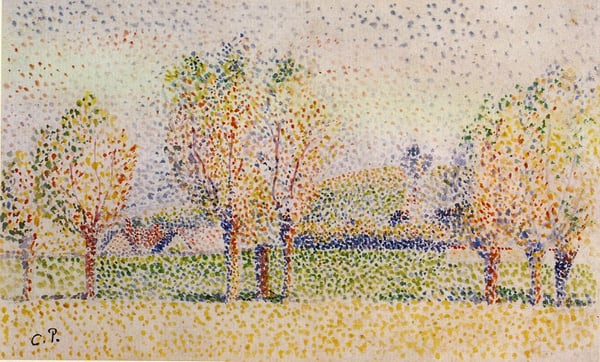
This work is significant as a pivotal example of Camille Pissarro's transition from Impressionism to Neo-Impressionism, specifically Pointillism. Painted in the rural village of Éragny, where the artist settled in 1884, the landscape embodies the core tenets of the style: a scientific approach to color and light through the application of small, distinct dots of pure pigment.
Stylistic Significance within Pointillism and Neo-Impressionism:
Pissarro was the eldest member of the Impressionist group and the only one to fully adopt Georges Seurat's pointillist technique in the late 1880s. "Eragny Landscape" demonstrates his unique adaptation of the method. Unlike Seurat's more rigid, geometrical compositions, Pissarro retained a sense of atmospheric spontaneity and pastoral warmth. The dots are applied with a looser, more varied touch, allowing the landscape—fields, trees, and sky—to retain a naturalistic vibrancy rather than a static, stylized order.
Genre and Period Context:
As a landscape, the painting reflects the Neo-Impressionist fascination with capturing the transient effects of light and air through optical mixing. Pissarro chose a simple, harmonious view of his surroundings, focusing on the interplay of complementary colors (e.g., blue-violet shadows against yellow-orange sunlight) to create luminosity. The work is significant because it proves that Pointillism could be used not only for urban or idealized scenes but also for intimate, rural landscapes, bridging the gap between scientific color theory and the Impressionist love of everyday life.
What Makes It a Landmark Work:
- Historical Role: It marks Pissarro's brief but influential engagement with Neo-Impressionism (1885–1888), which in turn inspired younger artists like Paul Signac and Vincent van Gogh.
- Technical Innovation: Pissarro's dot technique here is less systematic than Seurat's, prioritizing the overall sensation of light and breeze over rigid precision. This "broken color" approach prefigures Fauvism and early Modernist landscape painting.
- Emotional Resonance: The calm, balanced composition of fields and cottages evokes a quiet, rural harmony—a departure from the more urban or leisure-focused subjects of earlier Impressionism, emphasizing the natural world as a site of meditative observation.
In summary, "Eragny Landscape" is significant because it exemplifies how Pissarro synthesized Impressionist spontaneity with Neo-Impressionist theory, creating a luminous, structured yet organic vision of the French countryside that expanded the possibilities of modernist landscape painting.
Visually similar
20 works with related composition and palette
Poppy Field in Giverny 02
Claude Monet
The Willows
Claude Monet
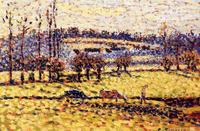
Meadow at Bazincourt
Camille Pissarro
On The Prairie
Henri Martin
Willows in Fog
Gustave Loiseau
Poplars
Dorrit Black
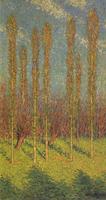
Poplars in Spring
Henri Martin
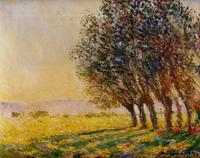
Willows at Sunset
Claude Monet
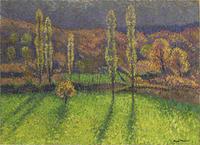
The Prairie
Henri Martin
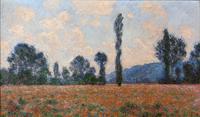
Poppy Field in Giverny 03
Claude Monet
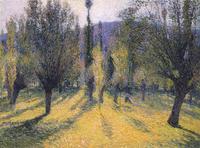
Sun through the Poplar
Henri Martin
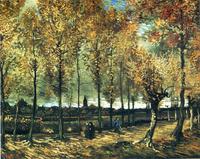
Lane with poplars near Nuenen
Vincent van Gogh
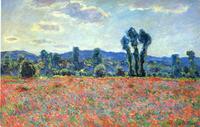
Poppy Field in Giverny
Claude Monet
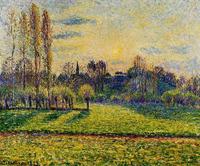
View of Bazincourt, Sunset
Camille Pissarro
Poppy Field in Giverny
Claude Monet
The Meadow
Odilon Redon
The Willow
Henri Martin
The Edge of the Forrest
Theodore Robinson
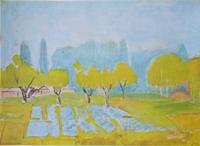
Hothouses at Mogosoaia
Alexandru Ciucurencu
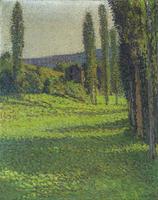
By the Fields
Henri Martin