Camille Pissarro の Farm at Montfoucault 2 の専門的な分析
スタイル:Impressionism · ジャンル:landscape
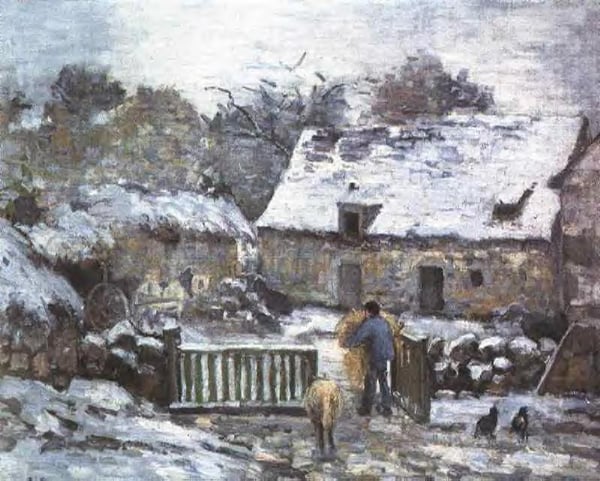
As an expert art historian, I can provide an analysis of "Farm at Montfoucault 2" by Camille Pissarro.
This work is a quintessential example of Pissarro’s contribution to Impressionism, specifically within the landscape genre. Its significance lies in how Pissarro transforms a humble, rural subject into a vibrant study of light, atmosphere, and the rhythms of agrarian life.
Context and Style: Painted during a period when Pissarro was deeply engaged with the Impressionist project (circa 1874-1875), this canvas reflects his move away from the more structured, Barbizon-influenced landscapes of his youth toward a looser, more dynamic handling of paint. The farm at Montfoucault, Normandy, was a frequent subject; Pissarro lived and worked there, and the series captures the changing seasons and times of day.
Composition and Technique: The painting is structured around a strong diagonal—likely a path or a line of trees—that draws the eye into the receding space of the farmyard. Pissarro employs the classic Impressionist broken brushstroke: short, separate dabs of color that, when viewed from a distance, blend optically to create a shimmering effect. The sky is animated with rapidly applied strokes of blue, white, and pale yellow, while the foliage and buildings are built from patches of green, ochre, and russet. Rather than outlining forms, he lets color and light define the mass of the barn, the haystacks, and the figures (often peasants at work).
Significance:
-
Depiction of Modern Rural Life: Unlike many contemporaries who romanticized the countryside or painted purely for aesthetic effect, Pissarro’s landscapes are infused with a sense of everyday labor. The farm is not a picturesque escape but a working environment. This aligns with Pissarro’s anarchist sympathies—he saw dignity in peasant labor and sought to represent it without sentimentality.
-
Mastery of Atmospheric Effect: The significance of "Farm at Montfoucault 2" also resides in its handling of transient light. Pissarro captures a specific moment—perhaps the soft glow of late afternoon or the diffused light of a cloudy day—where the boundary between earth and sky feels porous. The shadows are not black but composed of complementary colors (violets and blues), a hallmark of Impressionist color theory.
-
Influence on the Movement: Pissarro was the only painter to exhibit in all eight Impressionist exhibitions. This work demonstrates why he was considered the "fatherly" figure of the group: his technique is rigorous but not dogmatic, and his subject matter—the ordinary, the agrarian—paved the way for later artists like Cézanne (who admired Pissarro’s structural sense) and even the Neo-Impressionists (who would later systematize his broken color).
Final Assessment: "Farm at Montfoucault 2" is not merely a pretty landscape; it is a document of the Impressionist revolution in progress. Camille Pissarro takes a familiar, unglamorous subject and, through the alchemy of broken color and dynamic brushwork, elevates it into a luminous, breathing moment—a testament to the beauty of the everyday and the enduring significance of the Impressionist vision.
Museum / Gallery
視覚的に類似
構図やパレットが近い作品 20 件
A Street in Auvers (Thatched Cottage and Cow)
Camille Pissarro
Snow at Montfoucault
Camille Pissarro
Cottages in the Snow
Maxime Maufra
Winter at Montfoucault 2
Camille Pissarro
The village path - thatched cottages in Valhermeil
Camille Pissarro
A Village Street in Winter
Alfred Sisley
Cottages in the Snow
Maxime Maufra
Village in the snow
Paul Gauguin
The Mill, Saint-Cenery
Eugene Boudin
Cottages at Auvers, near Pontoise
Camille Pissarro
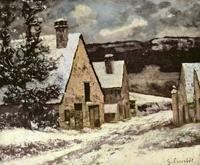
Village Street in Winter
Gustave Courbet
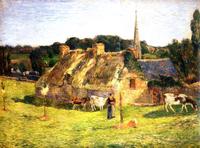
Lollichon's Field and the Church of Pont-Aven
Paul Gauguin
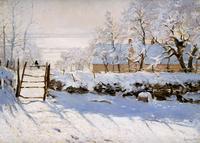
The Magpie
Claude Monet
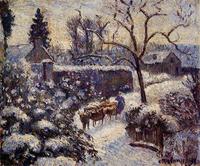
The Effect of Snow at Montfoucault
Camille Pissarro
A blue roof (Farm in Pouldu)
Paul Gauguin
Landscape
Pierre-Auguste Renoir
First Snow in Louveciennes
Alfred Sisley
The Farm at Pouldu
Paul Serusier
Garden in Louveciennes in the Snow
Alfred Sisley
The Barnyard
Albert Pinkham Ryder