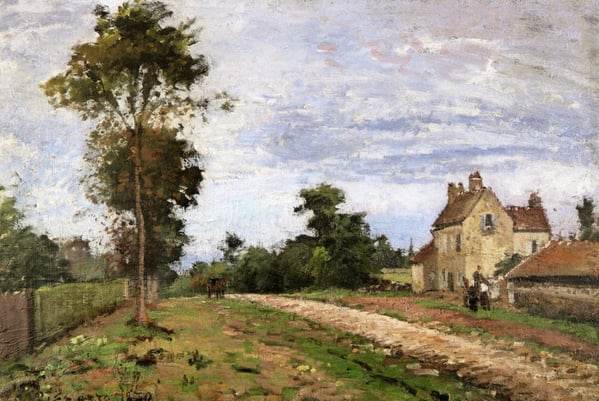
The House of Monsieur Musy, Louveciennes
Details
Expertenanalyse zu Camille Pissarros The House of Monsieur Musy, Louveciennes
Stil: Impressionism · Genre: landscape
Expert Analysis: "The House of Monsieur Musy, Louveciennes" by Camille Pissarro
As a key figure of the Impressionist movement, Camille Pissarro’s The House of Monsieur Musy, Louveciennes exemplifies the core principles that defined this revolutionary style. Painted during a period when Pissarro was living in the rural village of Louveciennes (about 1869–1872), the work captures a quiet, unassuming suburban landscape—a typical Impressionist subject that elevates everyday life to the level of high art.
Significance within Impressionism
-
Emphasis on Light and Atmosphere – Pissarro’s hallmark is his meticulous observation of natural light. In this scene, the house and surrounding foliage are rendered with broken, dappled brushstrokes that suggest the shifting effects of sunlight and shadow. This technique dissolves solid forms into patches of color, allowing the viewer to experience the fleeting moment—a core Impressionist goal.
-
Suburban Modernity – Louveciennes, a village west of Paris, was rapidly becoming a retreat for the bourgeoisie. By depicting “Monsieur Musy’s” house—likely a modest, modern dwelling—Pissarro documents the encroachment of suburban life into the countryside. This aligns with Impressionism’s interest in the contemporary world, contrasting with the historical or mythological subjects of academic painting.
-
Color Palette and Chromatic Harmony – Pissarro favored a high-keyed, luminous palette. Here, soft greens, pale ochres, and muted blues are balanced with touches of white and warm earth tones. He often worked outdoors (en plein air) to capture the true colors of the moment, a practice that freed him from studio conventions and influenced younger artists like Cézanne and Gauguin.
-
Brushwork and Structure – Unlike the more gestural strokes of Monet, Pissarro’s brushwork is methodical yet lively. The house’s walls are built from short, horizontal dashes, while the trees and sky are composed of small dabs. This creates a sense of unity and texture, inviting the eye to move across the canvas. The composition is balanced but not rigid, with the house set slightly off-center, leading the viewer’s gaze along a path or garden.
Why This Work Matters
The House of Monsieur Musy, Louveciennes is significant because it encapsulates Pissarro’s dual role as both a dedicated practitioner of Impressionism and a mentor to later post-Impressionists. It demonstrates how the movement’s focus on light, color, and everyday subject matter could transform a modest suburban house into a poetic meditation on modern life. For art historians, the painting also serves as a document of the social and environmental changes occurring in the French countryside during the late 19th century—a quiet but profound record of a world in transition.
Museum / Gallery
Visuell ähnlich
20 Werke mit ähnlicher Komposition und Farbpalette
Road to Racquencourt
Camille Pissarro
Road from Osny to Pontoise, Hoar Frost
Camille Pissarro
Street in Rouen
Paul Gauguin
The road up
Paul Gauguin
Road to Versailles
Gustave Loiseau
The Path Leading to the House
Camille Corot
Landscape at Pontoise
Camille Pissarro
Après la pluie
Armand Guillaumin
Road to Saint Germain, Louveciennes
Camille Pissarro
Strong Winds, Pontoise
Camille Pissarro
Landscape, Louveciennes
Camille Pissarro
The diligence
Camille Pissarro
A Path in Louveciennes
Alfred Sisley
The Road to Versailles at Louveciennes
Camille Pissarro
The Road from Versalles to Saint Germain at Louveciennes
Camille Pissarro
The Farm
Pierre-Auguste Renoir
A Road in Louveciennes
Camille Pissarro
The Road from Versailles to Saint Germain, Louveciennes. Snow Effect
Camille Pissarro
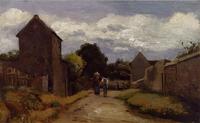
Male and Female Peasants on a Path Crossing the Countryside
Camille Pissarro
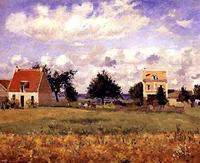
The Red House
Camille Pissarro