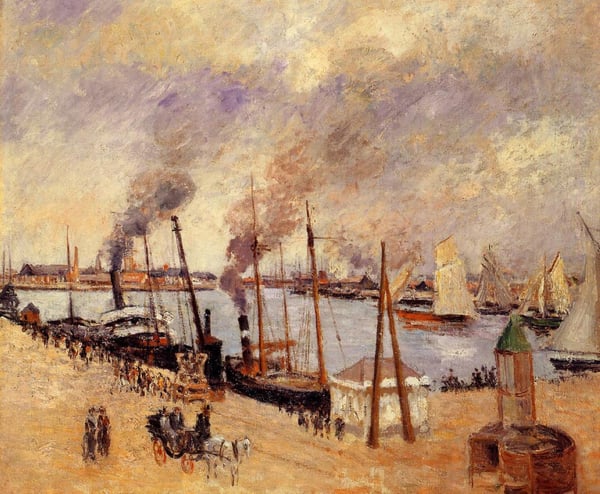
Expert analysis of Camille Pissarro’s The Port of Le Havre 2
Style: Impressionism · Genre: cityscape
Expert Analysis of "The Port of Le Havre 2" by Camille Pissarro
As a cornerstone of Impressionism, Camille Pissarro’s The Port of Le Havre 2 exemplifies the movement’s revolutionary approach to capturing modern life through light, color, and atmosphere. The work’s significance lies in three key areas: its subject matter, its technical execution, and its place within Pissarro’s broader oeuvre.
Subject and Modernity
The cityscape of Le Havre—a bustling industrial port on the French coast—was a quintessentially modern subject for the 1870s and 1880s. Pissarro, unlike many Impressionists who focused solely on rural scenes, frequently turned his eye to the urban and industrial landscape. Here, the harbor with its ships, cranes, and warehouses is not merely a backdrop but a dynamic stage for the interplay of natural and man-made elements. By depicting the port’s commerce and movement, Pissarro aligns Impressionism with the realities of contemporary life, celebrating the energy of the industrial age without romanticizing or condemning it.
Technical Execution
True to Impressionist principles, Pissarro employs broken brushwork and a high-key palette to render the transient effects of light on water, sky, and stone. The painting likely captures a specific time of day—perhaps early morning or late afternoon—when reflections shimmer on the water’s surface and mist softens the outlines of ships and buildings. The absence of sharp contours and the use of complementary colors (e.g., blues and oranges) create a vibrant, unified optical experience. The composition is carefully balanced: the vertical masts and smokestacks contrast with the horizontal quays and water, guiding the viewer’s eye into the depth of the harbor.
Significance within Pissarro’s Career and Impressionism
Pissarro was the only artist to exhibit in all eight Impressionist exhibitions (1874–1886), and his work often served as a bridge between the movement’s early radicalism and its later, more structured approaches. The Port of Le Havre 2 reflects his mature style, where he synthesized free brushwork with a subtle sense of order—a precursor to his Neo-Impressionist experiments in the 1880s. This painting also demonstrates his commitment to plein air observation, a core Impressionist practice, and his ability to find poetry in the prosaic. For viewers today, the work is a vivid document of a moment when art turned its gaze from history and mythology to the fleeting, everyday spectacle of the modern city.
Museum / Gallery
Visually similar
20 works with related composition and palette
The Port of Le Havre
Camille Pissarro
Outer harbour of Le Havre
Camille Pissarro
Port Valencia
Joaquín Sorolla
The Isle of Wight
Berthe Morisot
Canal de la Guidecca, Venice
Henri-Edmond Cross
Entrance to the Port of Le Havre
Eugene Boudin
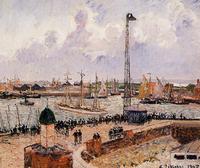
The Inner Harbor, Havre
Camille Pissarro
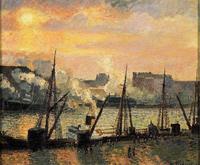
Quay in Rouen Sunset
Camille Pissarro
Arkhangelsk
Konstantin Korovin
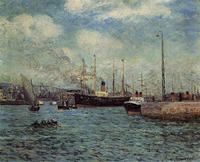
The Port of Havre
Maxime Maufra
Le port de Londres
Eugene Lawrence Vail
Departure of a Cargo Ship
Maxime Maufra
The Sea at Amsterdam
Claude Monet
The Trouville Basin
Eugene Boudin
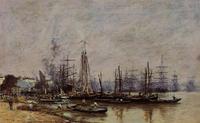
Bordeaux, the Port
Eugene Boudin
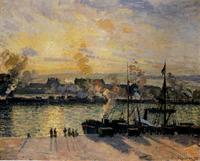
Sunset, The Port of Rouen (Steamboats)
Camille Pissarro
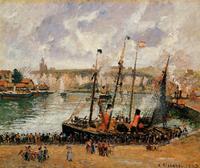
The Inner Harbor, Dpeppe, High Tide, Morning, Grey Weather
Camille Pissarro
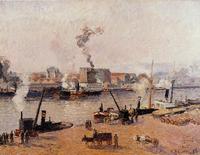
Foggy Morning, Rouen
Camille Pissarro
New York Harbor
John Henry Twachtman
Rotterdam sun
Wassily Kandinsky