Analisi esperta di Carnations di Henri Fantin-Latour
Stile: Realism · Genere: flower painting
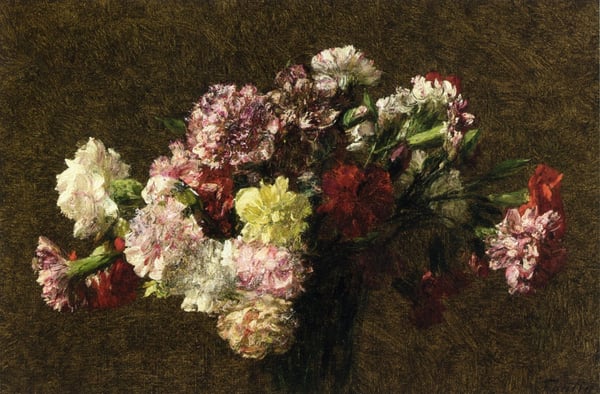
Henri Fantin-Latour’s Carnations exemplifies the artist’s masterful command of still-life realism, a genre in which he achieved extraordinary technical precision and emotional subtlety. Painted during the height of his career, this work belongs to the Realist tradition, yet it quietly anticipates the intimate, almost meditative quality that would later influence Symbolist aesthetics.
Significance within Realism:
Fantin-Latour rejected the grand historical or mythological narratives favored by the Academy, instead elevating the humble bouquet to a subject of profound focus. In Carnations, each petal, stem, and leaf is rendered with painstaking accuracy—the soft translucency of white and pink blooms, the crisp green foliage, and the subtle play of light across the porcelain vase. This hyper-observed naturalism aligns with Realism’s core value: depicting the world as it is, without idealization. Yet, Fantin-Latour’s approach is notably more refined and lyrical than the gritty urban scenes of Courbet or Daumier, carving a unique niche for floral still lifes as a vehicle for quiet contemplation.
Distinctive Characteristics:
- Compositional balance: The arrangement of carnations is neither perfectly symmetrical nor chaotic; instead, it achieves a natural, asymmetrical harmony that feels both spontaneous and deliberate.
- Atmospheric treatment: Fantin-Latour often painted flowers against muted, neutral backgrounds, allowing the blossoms to emerge in soft focus—a technique that imbues the work with a sense of ephemeral beauty. The carnations appear to breathe within a still, luminous space, evoking a moment frozen in time.
- Textural nuance: He captures the velvety softness of petals and the waxy surface of leaves with remarkable brushwork, avoiding the photo‑realistic stiffness that lesser practitioners might produce. Instead, his touch retains a painterly freshness.
Historical and Market Importance:
Fantin-Latour’s flower paintings became immensely popular among English collectors, who admired their bourgeois elegance and technical finesse. Carnations reflects this cross‑Channel appeal: it combines French Realist rigor with a taste for domestic beauty that resonated in Victorian England. Moreover, the work stands as a counterpoint to the contemporary rise of Impressionism. While Monet and Renoir dissolved form in light and color, Fantin‑Latour maintained a disciplined draftsmanship, proving that realist observation could coexist with a sensitive, almost poetic vision.
In sum, Carnations is significant not only as a virtuoso display of still-life technique but also as a bridge between the objective scrutiny of Realism and the evanescent lyricism that would define later symbolist and modernist flower paintings. It remains a testament to Fantin‑Latour’s belief that even the most ordinary subject—a bunch of carnations—can yield enduring art when rendered with clarity, restraint, and deep reverence for nature.
Museum / Gallery
Visivamente simili
20 opere con composizione e palette affini
Carnations
Henri Fantin-Latour
Carnations
Henri Fantin-Latour
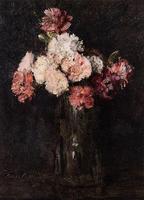
Carnations in a Champagne Glass
Henri Fantin-Latour
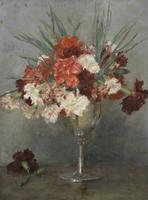
Carnations - a Study
Henry Scott Tuke
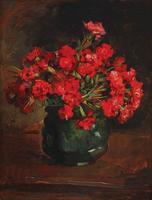
Carnations
Nicolae Vermont
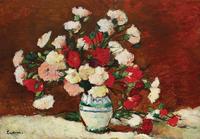
Carnations
Stefan Luchian
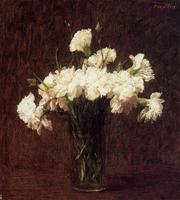
White Carnations
Henri Fantin-Latour
Flowers in Vase
Wojciech Weiss
Carnations
Joaquín Sorolla
Vase with Carnations
Stefan Luchian
Pinks
Charles Rennie Mackintosh
Vase with White and Red Carnations
Vincent van Gogh
Carnations and baby's breath in a green pitcher
Odilon Redon
Vase with Carnations
Vincent van Gogh
Vase with Carnations
Vincent van Gogh
Vase with Roses and Chrysanthemums
Ipolit Strambu
White Flowers and Apples
Ion Pacea
Peonies
Samuel Peploe
Still life with flowers in copper bowl
Giorgio de Chirico
Flowers
Giorgio Morandi