Analisi esperta di Portrait of an unknown woman in a turban di Orest Kiprensky
Stile: Romanticism · Genere: portrait
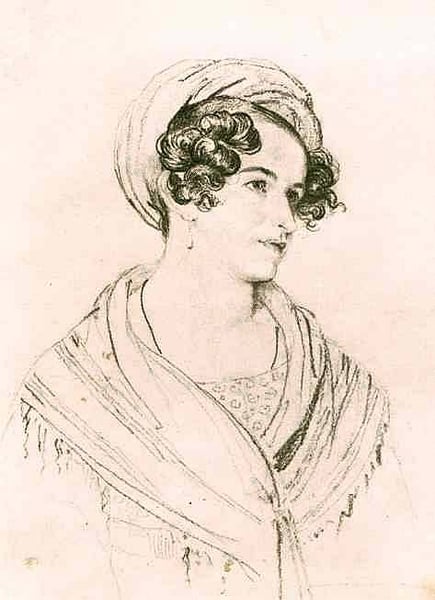
Expert Analysis of Portrait of an Unknown Woman in a Turban by Orest Kiprensky
This work belongs to the Romantic movement, a period that prized emotional depth, individualism, and the allure of the exotic. Kiprensky’s portrait exemplifies these ideals through its deliberate ambiguity and psychological intensity.
Exoticism and the Romantic Imagination
The turban is a key Romantic signifier—an Orientalist accessory that lifts the sitter out of the mundane present and into a realm of fantasy and mystery. For a Russian artist of the early 19th century, such a headdress evokes distant cultures and suggests a free-spirited, unconventional identity. It aligns with Romanticism’s fascination with the “other,” the unknown, and the imaginative escape from bourgeois reality.
The Power of the Unknown
The title itself—Portrait of an Unknown Woman—is inherently Romantic. Rather than celebrating a known patron or aristocrat, Kiprensky focuses on a sphinx-like individual whose name is lost. This anonymity invites the viewer to project a narrative onto her pensive gaze and slightly parted lips. She is not a document of social status but a vessel for emotion, a quality prized in Romantic portraiture that values inner life over external fact.
Kiprensky’s Contribution to Romantic Portraiture
Orest Kiprensky was a leading Russian Romantic painter, renowned for capturing psychological complexity. In this portrait, the subdued palette—soft earth tones against a dark background—directs attention to the sitter’s face and the luminous white of the turban. The slight asymmetry of her features and the subtle tension in her expression convey a fleeting mood, as if she is caught mid-thought. This deliberate incompleteness is a hallmark of Romanticism: the artwork suggests more than it states.
Significance
This portrait stands out for how it marries Romantic exoticism with a deeply intimate, almost modern sense of subjectivity. It transcends mere likeness to become a meditation on identity, memory, and the unseen stories that art can only hint at. In the context of Kiprensky’s oeuvre, it demonstrates his mastery of turning a simple commission into a timeless psychological study—a core achievement of Romantic portraiture.
Visivamente simili
20 opere con composizione e palette affini
Damenportrait
Moritz von Schwind
Portrait of Anna Olenina
Orest Kiprensky
Schepkina Yelena
Vasily Tropinin
Portrait of Ekaterina Petrovna Rostopchina
Orest Kiprensky
Portrait of Alexandra Lanskaya
Orest Kiprensky
Portrait of miss Bonnard
Jean Auguste Dominique Ingres
Fanny Mendelssohn Bartholdy
Wilhelm Hensel
Fanny Mendelsohn
Wilhelm Hensel
Gumersinda Goicoechea, Goya's Daughter in Law
Francisco Goya
Barbara Ushakova
Orest Kiprensky
Sketch-Portrait of Charlotte Emden Moscheles (15 August 1837)
Henri Lehmann
Madame Louis François Godinot, born Victoire Pauline Thiolliere de L'Isle
Jean Auguste Dominique Ingres
Miss Elizabeth Williamson
John Singer Sargent
Portrait of a lady
Rudolf von Alt
Mrs. George Swinton
John Singer Sargent
Portrait of a Lady
John Absolon
Portrait of Margaret of Brandenburg Ansbach
Albrecht Durer
Spanish Opera Singer María Manuela Oreiro Lema
Rosario Weiss Zorrilla
Lady William Henry Cavendish Bentinck, born Lady Mary Acheson I
Jean Auguste Dominique Ingres
Portrait de femme
Charles Gleyre