
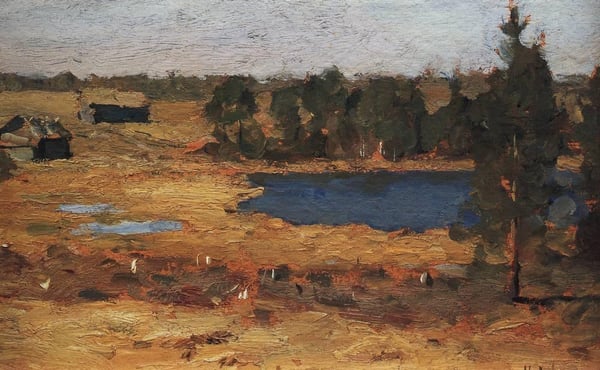
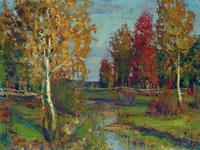
Lake. Barns at the forest edge.
Dettagli
Analisi esperta di Lake. Barns at the forest edge. di Isaac Levitan
Stile: Realism · Genere: landscape
Expert Analysis of "Lake. Barns at the forest edge" by Isaac Levitan
Style: Realism | Genre: Landscape
Isaac Levitan, a master of Russian Realism, transforms a humble rural scene into a profound meditation on nature and human presence. In "Lake. Barns at the forest edge," the artist employs the core tenets of Realism—faithful observation, unidealized subject matter, and a focus on everyday life—while infusing the landscape with a deeply poetic, almost melancholic atmosphere that is distinctly his own.
Significance within Realism:
-
Truth to Nature: Levitan captures the specific, unglamorous truth of the Russian countryside. The barns are modest, functional structures set at the forest’s edge, with a placid lake reflecting the muted sky. This is not a romanticized wilderness but a working landscape, observed with acute sensitivity to light, weather, and seasonal mood. The damp air, the stillness of the water, and the dense tree line are recorded with a naturalist’s precision, yet the overall effect is one of quiet emotional resonance—a hallmark of Levitan’s ability to elevate Realist observation into lyrical expression.
-
Emotional Depth Through Simplicity: Unlike some Realist works that focus on social critique, Levitan’s landscapes often evoke a sense of longing and transience. Here, the barns—man-made yet absorbed by the forest—suggest a fragile coexistence with nature. The lake’s calm surface and the overcast light create a subdued, introspective mood, inviting the viewer to pause and feel the silence of the scene. This psychological depth, achieved through straightforward Realist techniques (muted palette, soft edges, careful composition), marks a significant contribution: Levitan proves that even the most ordinary corner of the world can carry profound emotional weight when rendered with authentic perception.
-
Synthesis of Detail and Atmosphere: Levitan balances meticulous detail (the texture of wooden barns, the reflection of trees in the lake) with a broader atmospheric unity. The horizon line is low, giving prominence to the water and sky, while the forest edge creates a dark, enclosing border. This compositional choice emphasizes the tension between open space and enclosure, a motif that resonates with the Russian Realist concern for capturing both the physical and spiritual essence of place.
In summary, "Lake. Barns at the forest edge" is a quintessential example of Levitan’s contribution to Realism: it transforms a modest rural motif into a timeless, emotionally charged landscape, demonstrating that the truest realism is not merely a copy of nature, but a deep, empathetic response to it.
Visivamente simili
20 opere con composizione e palette affini
The Lake. Barns at the edge of forest.
Isaac Levitan
Last Rays
Victor Puzyrkov
Пейзаж
Vitold Byalynitsky-Birulya
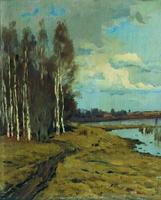
Landscape
Isaac Levitan
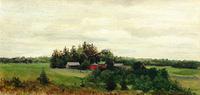
Farm
Efim Volkov
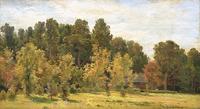
Forest edges
Ivan Shishkin
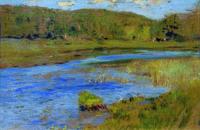
Windy day
Isaac Levitan
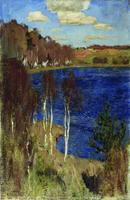
Lake. Spring.
Isaac Levitan
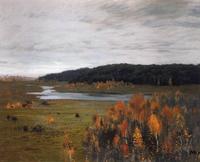
Valley of the River. Autumn.
Isaac Levitan
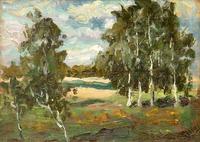
Landscape with Birches
Konstantin Yuon
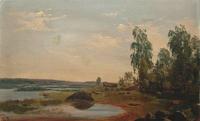
Distance
Ivan Shishkin
Field after Harvest.
Isaac Levitan
Afternoon Shadows
William Merritt Chase
Fields
Isaac Levitan
Evening shadows
Isaac Levitan
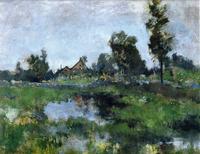
Connecticut Landscape
John Henry Twachtman
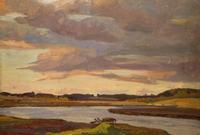
River Avon
Algernon Talmage
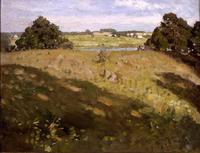
July Afternoon
Edward E. Simmons
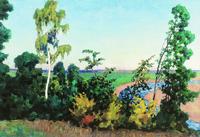
Radiant Morning
Igor Grabar
Autumn
Isaac Levitan