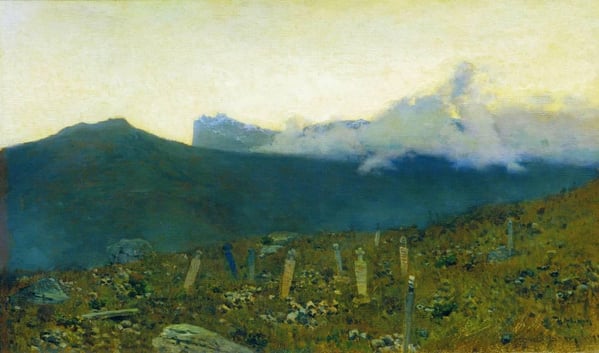
Tatarian cemetery. Crimea.
Details
Expert analysis of Isaac Levitan’s Tatarian cemetery. Crimea.
Style: Realism · Genre: landscape
Expert Analysis: "Tatarian Cemetery. Crimea." by Isaac Levitan
Isaac Levitan’s “Tatarian Cemetery. Crimea.” stands as a poignant exemplar of Russian Realist landscape painting, demonstrating how the movement transcended mere topographical accuracy to become a vehicle for profound emotional and cultural resonance. Executed in the latter half of the 19th century, this work captures a quiet, melancholic corner of the Crimean landscape, focusing on a Tatar burial ground.
Significance within Realism and Levitan’s Oeuvre
Levitan is celebrated for infusing his landscapes with an almost lyrical sense of mood—often a gentle, contemplative sorrow. In this painting, he applies the core tenets of Realism (meticulous observation of light, atmosphere, and natural forms) not to document an exotic locale, but to evoke themes of transience, memory, and cultural heritage. The “Tatarian cemetery” is not a dramatic ruin; it is a humble, weathered site, integrated into the surrounding earth and sky.
Key Artistic Choices:
-
Atmosphere as Subject: Levitan softens the edges of forms, using a muted palette of ochres, grays, and pale blues. The diffused light suggests either a late autumn afternoon or early spring—seasons of quiet decay and renewal. This handling of atmosphere is a hallmark of his realism: nature is not idealized but presented as a living, breathing presence that shares the emotional weight of the scene.
-
Cultural Specificity: By choosing a Tatar cemetery (an ethnic minority with deep roots in Crimea), Levitan subtly acknowledges the region’s layered history—Islamic, Ottoman, Crimean—within the Russian Empire. The tilting headstones and sparse vegetation are rendered with strict fidelity, yet they acquire a universal quality: a meditation on how all cultures mark their dead and how nature reclaims even sacred spaces.
-
Compositional Balance: The horizon is placed relatively low, emphasizing the open sky and the isolation of the graveyard. A few stark trees or scattered markers break the horizontal lines, guiding the eye slowly across the canvas. This quiet rhythm invites prolonged contemplation, a characteristic of Levitan’s landscapes that helped elevate Russian Realism from documentary reportage to a form of philosophical painting.
Placement in Art History
Levitan was the foremost landscape painter of the Peredvizhniki (The Wanderers), a group that championed socially conscious realism. While many Wanderers focused on narrative scenes of peasant life, Levitan proved that landscape itself could carry a deeply human message. “Tatarian Cemetery. Crimea.” exemplifies this transition: it is a realist painting that observes the world with scientific precision, yet it ultimately speaks to the intangible—the passage of time, the quiet dignity of forgotten places, and the dialogue between human culture and the natural world.
In sum, this work is significant because it demonstrates how Realism, in Levitan’s hands, became a poetic language. It preserves a specific cultural geography while touching on universal truths, and it cements Levitan’s reputation as a painter who could find profound beauty in life’s most solitary and reflective corners.
Museum / Gallery
Visually similar
20 works with related composition and palette
Burial in the Carpathian Mountains
Laszlo Mednyanszky
Site of the Battle Fought on July 18, 1877 in front of the Krishin Redoubt near Plevna
Vasily Vereshchagin
Landscape. Edge of a wood
Ivan Shishkin
Edge of a Forest with Crosses
Laszlo Mednyanszky
Untitled
Zdzislaw Beksinski
Untitled
Zdzislaw Beksinski
Ossian’s Grave
John MacWhirter
Mountain Mist
Albert Bierstadt
Mountain landscape (Carnic Alps)
Albert Zimmermann
A Hayfield near East Bergholt at Sunset
John Constable
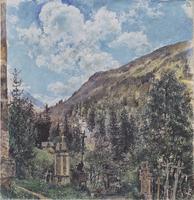
The cemetery in Gastein
Rudolf von Alt
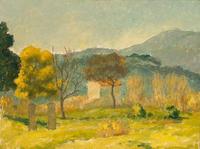
Cemetery, south of France
Rupert Bunny
Killed soldier. Near the village of Mechka.
Vasily Polenov
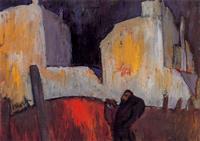
Houses at night
Albert Bloch
Seaside Cemetery
Adolf Hirémy-Hirschl
The Two Guides
Winslow Homer
Apiary
Isaac Levitan
Wordsworth's Grave
Laslett John Pott
Fra Jæren
Kitty Lange Kielland
Rocky Landscape
Theodore Rousseau