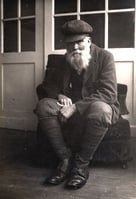
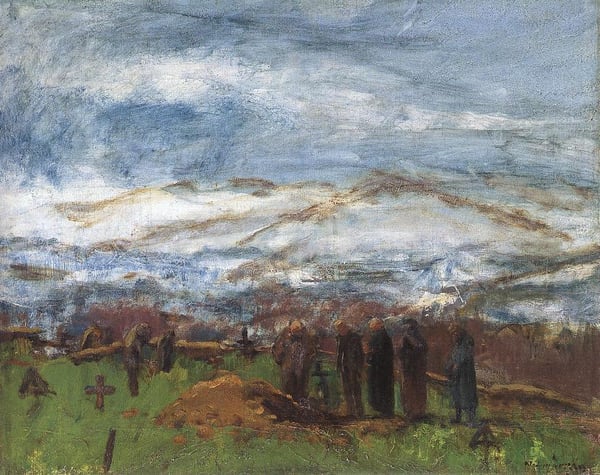
Expert analysis of Laszlo Mednyanszky’s Burial in the Carpathian Mountains
Style: Expressionism · Genre: landscape
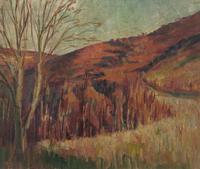
Analysis of "Burial in the Carpathian Mountains" by László Mednyánszky
László Mednyánszky (1852–1919) occupies a pivotal position in Central European painting, merging late-19th-century Naturalism with early Expressionist sensibilities. Burial in the Carpathian Mountains exemplifies this transitional moment, where a traditional landscape genre becomes a vehicle for profound emotional and existential expression.
Significance within Expressionism & Period Context:
Though Mednyánszky is often categorized as a Post-Impressionist or Symbolist, this work powerfully anticipates Expressionist concerns. The painting’s significance lies in how the artist transforms a remote alpine scene into a psychological and spiritual drama. The “burial” is not merely a genre incident; it is a metaphor for human mortality set against the overwhelming, indifferent vastness of the Carpathian landscape. Mednyánszky’s treatment—likely using a somber, restricted palette (muted greens, deep browns, and dusky blues) and agitated, expressive brushwork—shifts attention from topographical accuracy to inner feeling. The mourners, if visible, are subsumed into the terrain, reinforcing a sense of isolation and the sublime terror of nature.
What Makes This Work Stand Out:
- Emotional Landscape: Where earlier landscape painters sought harmony or the picturesque, Mednyánszky uses the Carpathian peaks as a stage for grief. The mountains themselves seem to press down, echoing the weight of loss. This aligns with Expressionism’s core mission: to project the artist’s (and humanity’s) inner turmoil onto the external world.
- Transitional Style: The work retains a descriptive naturalism in its rendering of rock and foliage, but the mood—the elegiac, almost claustrophobic atmosphere—pushes toward the more radical distortions of later Expressionists like Edvard Munch or Emil Nolde.
- Cultural Resonance: Mednyánszky’s Hungarian heritage and his frequent depictions of the Carpathians lend regional specificity to universal themes. This burial scene becomes a meditation on the fate of soldiers, peasants, or the artist’s own melancholic spirit—a recurring motif in his oeuvre during a period of European social and political upheaval.
In summary, Burial in the Carpathian Mountains is significant because it demonstrates how Expressionism could emerge not from urban angst or complete abstraction, but from a deep engagement with nature and tradition, reshaping the landscape into a mirror of the human soul. Mednyánszky’s work remains a crucial, underrecognized link between the pathos of Romanticism and the psychological intensity of early modernism.
Visually similar
20 works with related composition and palette
Site of the Battle Fought on July 18, 1877 in front of the Krishin Redoubt near Plevna
Vasily Vereshchagin
A Field with Figure
Henri Martin
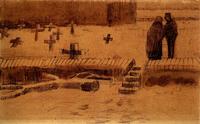
Churchyard in Winter
Vincent van Gogh
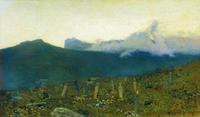
Tatarian cemetery. Crimea.
Isaac Levitan
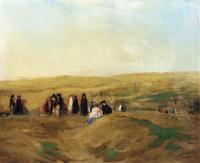
Procession in Spain (also known as Spanish Landscape with Figures)
Robert Henri
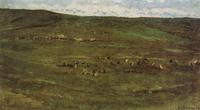
A herd of horses in Baraba steppes
Vasily Surikov
Churchyard
Zinaida Serebriakova
Landscape in Moonlight
Henry Ossawa Tanner
Edge of a Forest with Crosses
Laszlo Mednyanszky
Tyrolean Landscape. Study for Der Sämann
Albin Egger-Lienz
The Path
Pierre-Auguste Renoir
Fruit Trees
Laszlo Mednyanszky
The return from the fields
Léon Augustin Lhermitte
Dark Path
Jakub Schikaneder
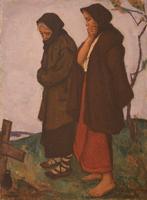
A Cross on the Hill
Stefan Dimitrescu
Gathering Clouds
Benjamin Brown
Landscape Auvers sur Oise
Pierre-Auguste Renoir

Seaside Cemetery
Adolf Hirémy-Hirschl
Old Mark's Field, Coldharbour, Surrey
Lucien Pissarro
Woods
Harry Phelan Gibb