Analisi esperta di Disputation of the Holy Sacrament (detail) di Raphael
Stile: High Renaissance · Genere: religious painting
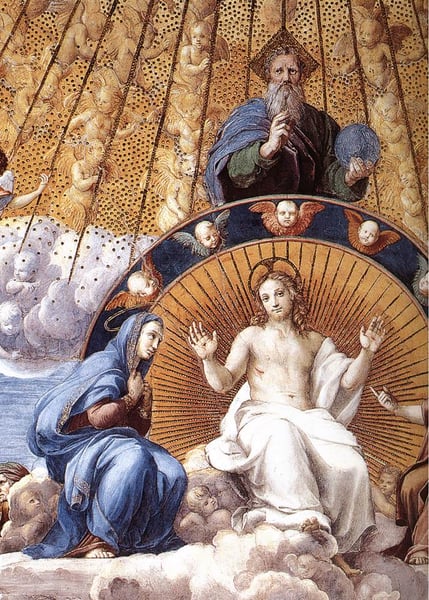
The Disputation of the Holy Sacrament, a fresco in the Vatican’s Stanza della Segnatura, is one of Raphael’s masterpieces and a quintessential example of High Renaissance religious painting. Even in a detail, the work reveals the period’s core ideals: clarity, harmony, and intellectual order fused with spiritual transcendence.
Artistic Significance:
- Synthesis of Theology and Humanism: Raphael organizes the scene into two registers — the celestial (Christ, the Virgin, John the Baptist, and saints) and the terrestrial (Church fathers, theologians, and popes debating the Eucharist). This layered composition mirrors the Neoplatonic concept of a cosmic hierarchy, where earthly knowledge is illuminated by divine truth.
- Idealized Naturalism: The figures are rendered with lifelike proportions and individualized expressions, yet they are perfected — symmetrically balanced, serene, and dignified. This idealization, derived from classical antiquity, raises the human to the divine, a hallmark of Raphael’s style.
- Mastery of Perspective and Space: The fresco uses a centralized vanishing point (the Host on the altar) to draw the eye upward, creating visual unity. The semicircular arrangement of both earthly and heavenly figures echoes a triumphal arch, reinforcing the sense of ordered, monumental space.
- Symbolic Detail: Even in a fragment, details such as the gestures of pointing, debate, and contemplation convey the intellectual rigor of theology. The golden light and clear, vibrant colors (an innovation of Raphael’s Roman period) evoke the divine presence without losing naturalism.
Why It Matters: This work defines the High Renaissance’s ambition: to reconcile faith with reason, beauty with truth, and classical form with Christian doctrine. Raphael’s ability to portray a complex theological dispute — the nature of the Eucharist — as a calm, harmonious assembly of intellect and grace marks a peak of visual eloquence. The “detail” encapsulates the era’s belief that art could make the sacred visible through perfect order.
Museum / Gallery
Visivamente simili
20 opere con composizione e palette affini
La Venida De La Virgen Del Pilar a Zaragoza
José Luzán
Pala di Sant Agostino (Lord Blessing)
Pietro Perugino
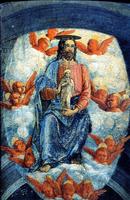
Christ with the soul of the Virgin
Andrea Mantegna
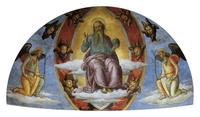
Lord in Glory with Angels. Annunciation
Pietro Perugino
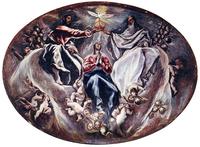
Coronation of the Virgin
El Greco
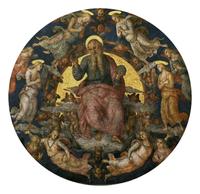
Room Torre Borgia
Pietro Perugino
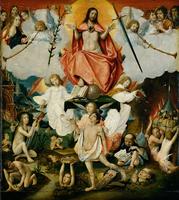
The Last Judgment
Jan Provoost
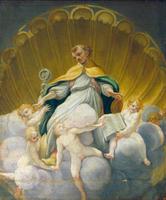
Saint Hilary Surrounded by Angels (copy of the fresco in the cupola of Parma Cathedral)
Correggio
Polyptych of St. Peter (Eternal Blessing with cherubs and angels)
Pietro Perugino
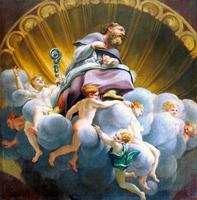
Saint Bernard Surrounded by Angels (copy of the fresco in the cupola of Parma Cathedral)
Correggio
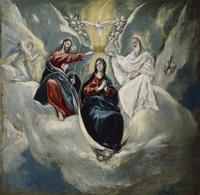
Coronation of the Virgin
El Greco
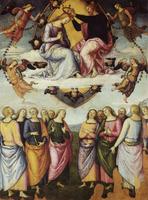
Pala di San Francesco al Monte (The Coronation of the Virgin)
Pietro Perugino
Ecclesia Surrounded by Angels Holding the Instruments of the Passion
Bernardo Strozzi
God the Father with the Dove, Two Putti and a Nimbus of Cherubim
Palma Vecchio
The coronation of the Virgin
Annibale Carracci
Mary with the Child Venerated by St Marc and St Luke
Tintoretto
Translation of the Holy House
Annibale Carracci
The Coronation of the Virgin
Guido Reni
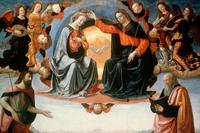
The Coronation of the Virgin
Domenico Ghirlandaio
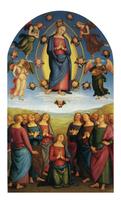
Pala di Corciano (Assumption of Mary)
Pietro Perugino