Analisi esperta di The Transfiguration (detail) di Raphael
Stile: High Renaissance · Genere: religious painting
Expert Analysis: Raphael’s The Transfiguration (detail)
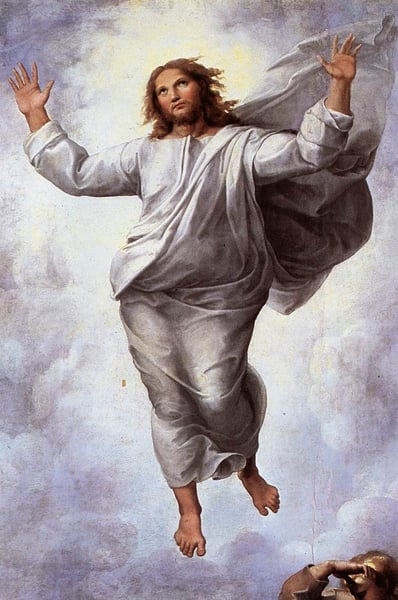
As a defining work of the High Renaissance, Raphael’s The Transfiguration (1516–1520) represents the pinnacle of his artistic achievement and a culmination of the period’s ideals—harmonious composition, psychological depth, and spiritual grandeur. This painting, his last before his untimely death, uniquely fuses two biblical episodes in a single, dynamic scene: Christ’s radiant transfiguration on Mount Tabor above, and the desperate attempt by the apostles to heal a possessed boy below.
Significance within the High Renaissance:
- Synthesis of classical and spiritual: Raphael marries the balanced, rational order of High Renaissance composition—seen in the clear division of the celestial and terrestrial realms—with intense emotional realism. The upper half is serene, symmetrical, and bathed in golden light, echoing the divine order of a Masaccio or Leonardo; the lower half is chaotic, asymmetrical, and deeply human, anticipating the dynamism of Mannerism.
- Mastery of chiaroscuro and color: The detail sharpens Raphael’s innovative use of contrasting light: the blinding radiance of Christ’s white robe versus the shadowy turmoil below. This not only heightens the miraculous but creates a visual hierarchy that guides the eye through the narrative.
- Psychological realism: While the full painting is renowned for its dual action, the detail focuses on individual figures—Peter, James, and John shielding their eyes from the divine light, and the anguished boy’s contorted pose—revealing Raphael’s deep study of human emotion and gesture, a hallmark of the High Renaissance’s turn toward naturalism.
Legacy:
Painted during Raphael’s final years, The Transfiguration was left unfinished on his easel; it became a symbol of unfulfilled potential and a bridge between the High Renaissance’s equilibrium and the expressive, elongated forms of the early Baroque. Its influence resonated for centuries, inspiring artists from Caravaggio to Ingres. In this detail, we see Raphael at his most technically perfect and emotionally complex—a testament to the era’s belief in art as a vehicle for both earthly truth and divine revelation.
Museum / Gallery
Visivamente simili
20 opere con composizione e palette affini
The Trinity
Lorenzo Lotto
The Assumption of the Virgin
Philippe de Champaigne
Assumption of Mary
Guido Reni
The Pillar of Fire
Tintoretto
The Ascension
John Singleton Copley
Immaculate Conception
Francisco de Zurbaran
The Assumption of the Virgin
Bartolome Esteban Murillo
St. Peter
El Greco
The Glory of St Dominic
Giovanni Battista Tiepolo
Assumption of the Virgin
El Greco
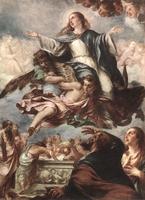
Assumption of the Virgin
Juan de Valdes Leal
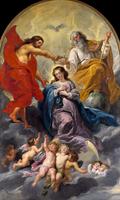
The Coronation of the Virgin
Peter Paul Rubens
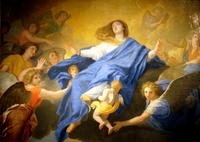
L'assomption De La Vierge
Charles Le Brun
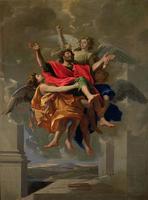
The Vision of St. Paul
Nicolas Poussin
Assumption of the Virgin
Charles Le Brun
Assumption of the Virgin
Guido Reni
Coronation of the Virgin
Paolo Veronese
Apparition De La Vierge Et De L’enfant-jésus À Saint Antoine
Simon Vouet
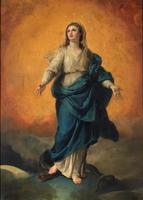
The Immaculate Conception
Anton Raphael Mengs
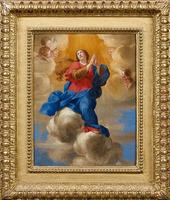
L'Assomption
Giovanni Francesco Romanelli