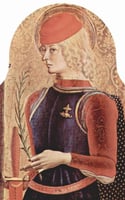
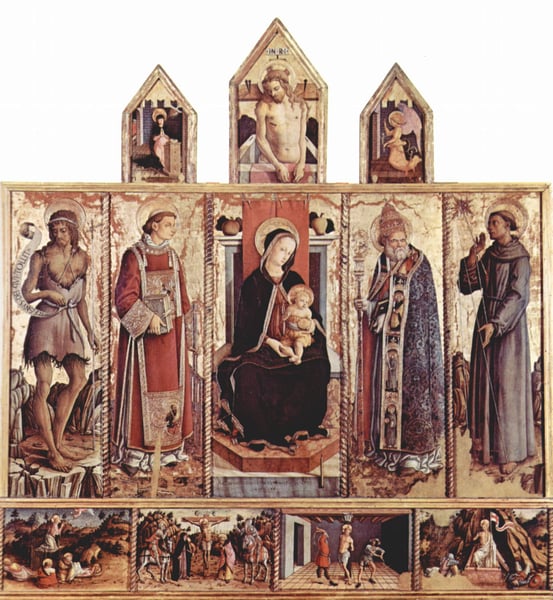
Expert analysis of Carlo Crivelli’s Enthroned Madonna
Style: Early Renaissance · Genre: religious painting
Analysis of "Enthroned Madonna" by Carlo Crivelli
Carlo Crivelli’s Enthroned Madonna stands as a compelling testament to the enduring fusion of late Gothic decorative splendor with Early Renaissance formal innovation. Executed in the late 15th century, this religious painting exemplifies Crivelli’s distinctive position within the Early Renaissance—an artist who, while working primarily in the Marche region, rejected the classicizing simplicity of Florentine contemporaries in favor of an intensely ornate, emotive vision.
Significance within the Early Renaissance
-
Ornamental Opulence and Gold Ground
Unlike many of his Tuscan peers who were moving toward naturalistic landscapes and atmospheric perspective, Crivelli retained the traditional gold ground of Byzantine and Gothic icons. In Enthroned Madonna, the lavish use of gold leaf—on the Virgin’s throne, halo, and decorative details—creates a shimmering, otherworldly effect. This technique, far from being archaic, was consciously employed to underscore the sacredness of the scene, making the divine light tangible. It reflects a regional preference for sumptuous altarpieces that appealed to both civic pride and devotional piety. -
Exquisite Detail and Textural Realism
Crivelli’s hallmark is his obsessive attention to surface detail: the brocaded fabrics, delicate lace, carved fruit, and the Virgin’s jeweled crown. These elements are rendered with almost microscopic precision, demonstrating a Northern Renaissance-like fascination with texture. The Enthroned Madonna thus bridges the International Gothic love of rich pattern with Early Renaissance empirical observation, giving ordinary objects a luminous, tactile presence that rewards close viewing. -
Linear Perspective and Spatial Tension
While Crivelli adopted Renaissance advances in linear perspective—note the foreshortened throne and the architectural framing—he deliberately employed a shallow, compressed space. The Virgin and Child are pushed forward, nearly breaking the picture plane, while the throne’s elaborate backrest fills the background. This spatial tension heightens the sense of intimate immediacy; the viewer is not invited to step into a deep, rational space but rather confronted by a sacred, hieratic presence. It is a uniquely Crivellian solution to the Renaissance problem of unifying figure and setting. -
Emotional Directness and Iconographic Invention
Crivelli’s Madonna is not the serene, idealized mother of Raphael but a more melancholic, intense figure. Her long, slender fingers, pointed chin, and downcast eyes convey tender sorrow, while the Child often reaches for a symbolic fruit or finch (signifying the Passion). The Enthroned Madonna includes typical Crivelli motifs such as the cucumber (a symbol of resurrection) and the draped cloth of honor, which add layers of theological meaning. This emotional realism, combined with exquisite ornament, makes the work a potent object of contemplation.
Conclusion
Carlo Crivelli’s Enthroned Madonna is significant precisely because it resists the mainstream Florentine narrative of the Early Renaissance. Instead, it represents a vibrant alternative: an art that marries medieval splendor with Renaissance structure, local tradition with international elegance. Through its meticulous detail, gold luminosity, and intimate emotional charge, the painting achieves a devotional intensity that remains uniquely Crivelli’s—a master of the sacred surface.
Visually similar
20 works with related composition and palette
St. Juvenal Triptych
Masaccio
Triptych of Camerino
Carlo Crivelli
Madonna of the Snow Altarpiece
Il Sassetta (Stefano di Giovanni)
St. Peter Martyr Altarpiece
Fra Angelico
Triptych of the Sedano Family
Gerard David
Perugia Altarpiece
Fra Angelico
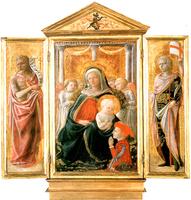
Madonna of Humility with Angels and Donor
Filippo Lippi
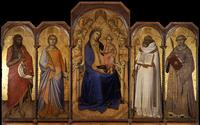
Virgin and Child with Saints
Luca di Tommé
Virgin and Child with Saints
Luca di Tommé
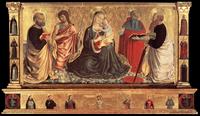
Madonna and Child with Sts John the Baptist, Peter, Jerome, and Paul
Benozzo Gozzoli
Triptych
Mariotto Albertinelli
Altar of Saints John the Baptist and John the Evangelist
Hans Memling
Adoration of the Magi (The Dombild Altarpiece, central part)
Stefan Lochner
The Virgin and Child with Saints and Donors (The Donne Triptych)
Hans Memling
Madonna and Child with Angels
Il Sassetta (Stefano di Giovanni)
Triptych of the Sedano Family
Gerard David
Triptych
Hans Memling
Virgin and Child, Saint Catherine and Saint Barbara
Quentin Matsys
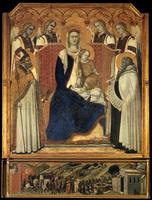
Madonna with Angels Between St Nicholas and Prophet Elijah
Pietro Lorenzetti
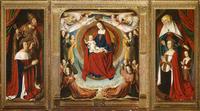
The Bourbon Altarpiece (The Moulins Triptych)
Jean Hey