Expertenanalyse zu Hans Memlings Christ at the Column
Stil: Northern Renaissance · Genre: religious painting
Expert Analysis: "Christ at the Column" by Hans Memling
Style: Northern Renaissance | Genre: Religious painting
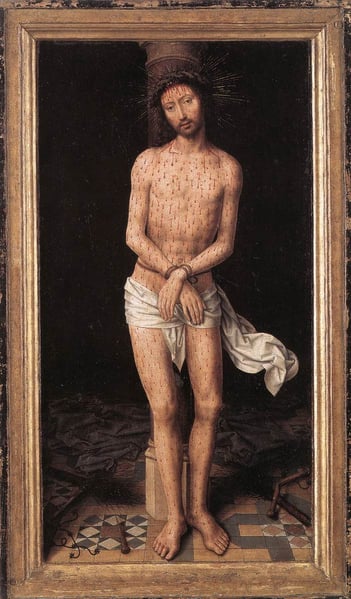
Hans Memling’s Christ at the Column exemplifies the Northern Renaissance’s commitment to intimate devotion, meticulous naturalism, and emotional restraint. Within the context of this period, the painting’s significance lies in how it transforms a traditionally violent scene—the Flagellation—into a meditative, almost serene image of suffering.
Composition and Symbolism
Memling places Christ at the center, bound to a low column, his body subtly illuminated against a dark, undefined background. This stark focus directs the viewer’s attention solely to the figure’s physical and spiritual agony, a hallmark of Northern Renaissance devotional art designed to inspire personal piety. The column itself, a common symbol of Christ’s humiliation, is rendered with precise stonework—typical of the era’s fascination with detailed textures—yet it remains secondary to the pale, bruised flesh. Memling softens the brutality: the tormentors are partially cropped or blurred, their actions implied rather than graphic, encouraging contemplation over shock.
Emotional and Technical Significance
Unlike earlier depictions that emphasized narrative drama, Memling’s Christ displays a quiet, resigned expression, his eyes downcast. This psychological depth—achieved through subtle modeling of the face and the delicate handling of blood drops and tears—reflects the Northern Renaissance’s shift toward humanizing sacred figures. The luminous oil technique, with its translucent glazes, creates a porcelain-like skin tone that contrasts with the dark background, heightening the sense of vulnerability. Every fold of the loincloth, every strand of hair, is rendered with almost microscopic precision, a Nordically characteristic blend of realism and symbolism that transforms a historical event into a timeless object of veneration.
Legacy within the Northern Renaissance
Christ at the Column is significant as a pure distillation of Memling’s mature style, where Flemish attention to detail meets a quiet, devotional gravity. It stands apart from more aggressive flagellation scenes by earlier artists (such as the Isenheim Altarpiece) and instead aligns with the emerging trend of private devotional panels meant for personal chapels or prayer books. The work thus embodies the Northern Renaissance ideal: using acute naturalism not to showcase skill alone, but to bridge the divine and the human through an almost tactile sense of presence.
Museum / Gallery
Visuell ähnlich
20 Werke mit ähnlicher Komposition und Farbpalette
Man of Sorrows
Hans Memling
Man of Sorrow
Pietro Lorenzetti
Saint Sebastian
Bernardino Luini
Chtist as the Man of Sorrows
Lucas Cranach the Elder
Cristo in pietà fra due angeli
Ambrogio Bergognone
Crucifixion of Christ
Lucas van Leyden
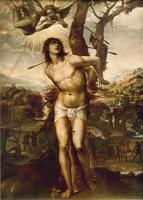
St Sebastian
Il Sodoma
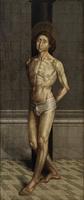
St. Vincent Tied to Column
Nuno Gonçalves
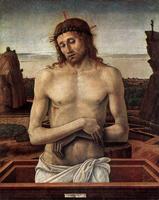
Dead Christ in the Sepulchre
Giovanni Bellini
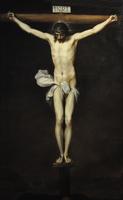
The Crucifixion
Alonzo Cano
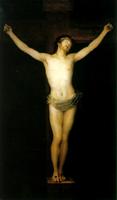
Crucified Christ
Francisco Goya
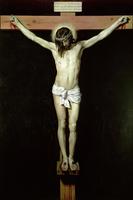
Christ on the Cross
Diego Velazquez
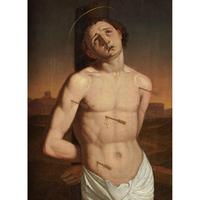
DER HEILIGE SEBASTIAN
Franz Anton Zeiller
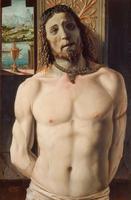
Christ at the Column
Donato Bramante
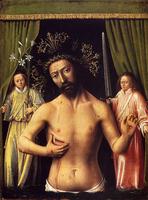
The Man of Sorrows
Petrus Christus
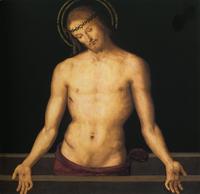
Christ on the sarcophagus
Pietro Perugino
Sebastian
Sandro Botticelli
St. Sebastian
Pietro Perugino
The Crucifixion 3 (detail)
Matthias Grünewald
Crucifixion Diptych
Rogier van der Weyden