Analisi esperta di St. Sebastian di Pietro Perugino
Stile: Early Renaissance · Genere: religious painting
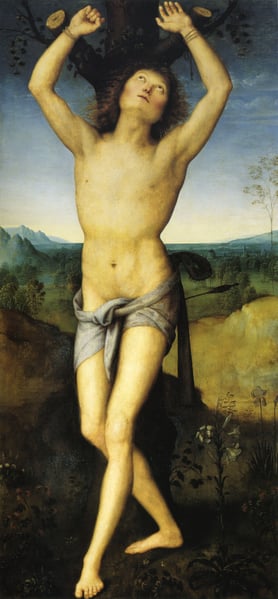
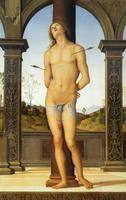
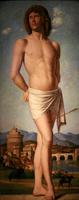
Pietro Perugino’s St. Sebastian stands as a masterful embodiment of Early Renaissance ideals—a work that balances spiritual solemnity with the era’s growing passion for naturalism and harmonious composition. As a religious painting, it transforms the martyrdom of Saint Sebastian into a study of serene grace rather than graphic suffering, which was a hallmark of Perugino’s style and a key influence on his pupil Raphael.
Significance within the Early Renaissance:
-
Harmonious Composition: Perugino organizes the figure of Sebastian with classical poise, using a subtle contrapposto that conveys both vulnerability and composure. The saint’s body is rendered with anatomical precision yet idealized to avoid raw violence, reflecting the Renaissance pursuit of disegno (design) and balance.
-
Atmospheric Landscape: True to the Umbrian School, the background is a soft, luminous landscape—a gentle expanse of rolling hills, pale blue mountains, and a fading sky. This setting envelops the saint in a tranquil, almost pastoral atmosphere, shifting focus from martyrdom to a meditative, timeless spirituality.
-
Emotion through Restraint: Unlike later Baroque depictions of agony, Perugino’s Sebastian has a calm, upward gaze that suggests divine acceptance rather than pain. The arrows are depicted with clean, minimal wounds, and the figure’s pale skin and gentle contrapposto emphasize an otherworldly detachment—a fusion of human beauty and sacred piety that defined High Renaissance ideals.
-
Influence on Raphael: Perugino’s St. Sebastian directly prefigures Raphael’s own St. Sebastian and his later Madonnas in its soft modeling, balanced composition, and sweet, seraphic facial type. It represents a crucial step toward the classicism that would dominate central Italian painting in the early 16th century.
In short, this work is significant for its quiet redefinition of a martyr saint—not as a victim, but as an emblem of grace, harmony, and the artist’s mastery over line, space, and light.
Museum / Gallery
Visivamente simili
20 opere con composizione e palette affini
St. Quintinus
Jacopo Pontormo
St Sebastian
Il Sodoma
St. Sebastian tied to a Column
Pietro Perugino
San Sebastián
Juan Carreno de Miranda
Saint Sebastian
Bernardino Luini
St. Sebastian
Guido Reni
St. Sebastian
Lorenzo Lotto
Saint Sebastian
John Graham-Gilbert
Saint Sebastian
Ludovico Carracci
St Sebastian
Palma il Giovane
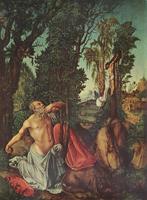
The Penitence of St. Jerome
Lucas Cranach the Elder
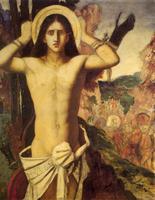
Saint Sebastian
Gustave Moreau
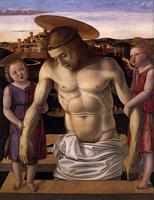
Dead Christ Supported by Two Angels
Giovanni Bellini
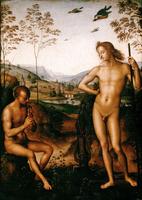
Apollo and Marsyas
Pietro Perugino
Deux anges apportant une couronne à saint Sébastien
Louis Jean Francois Lagrenee
Adam and Eve
Mabuse
Baptism of Christ
Pietro Perugino
Dead Christ in the Sepulchre
Giovanni Bellini
Saint Sebastian
Cima da Conegliano
Venus with Cupid the Honey Thief
Lucas Cranach the Elder