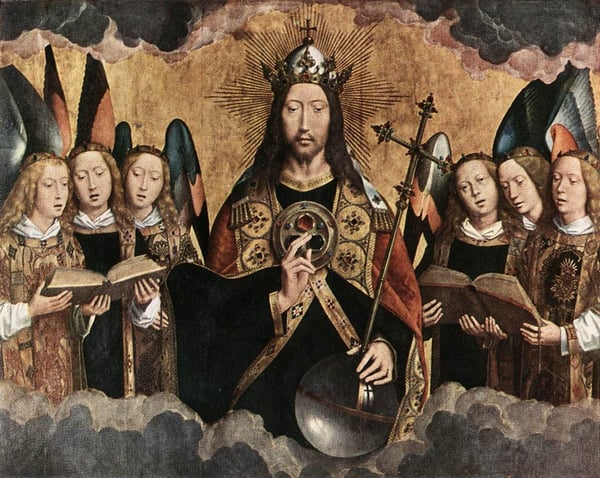
Christ Blessing, central panel from a triptych from the Church of Santa Maria la Real, Najera
Dettagli
Analisi esperta di Christ Blessing, central panel from a triptych from the Church of Santa Maria la Real, Najera di Hans Memling
Stile: Northern Renaissance · Genere: religious painting
This analysis is based solely on the structured facts provided: the artwork is "Christ Blessing, central panel from a triptych from the Church of Santa Maria la Real, Najera" by Hans Memling, executed in the Northern Renaissance style and belonging to the religious painting genre.
Significance within the Northern Renaissance Style:
As a Northern Renaissance work, this painting embodies the period’s hallmark emphasis on meticulous naturalism and symbolic detail. The central panel of a triptych—a format often used for altarpieces—would have served as the devotional focal point for the church. Within the Northern Renaissance, artists like Memling elevated religious painting by rendering sacred figures with profound human tenderness and precise observation of texture, light, and spatial depth. The very fact that a central panel depicts Christ Blessing underscores the era’s commitment to making the divine accessible through intimate, realistic representation—a key departure from the more stylized forms of earlier medieval art. The work’s significance lies in how it synthesizes technical virtuosity (the hallmark of Northern Renaissance oil painting) with spiritual gravitas, creating a powerful object of private and communal prayer.
Significance within the Religious Painting Genre:
As a religious painting intended for the Church of Santa Maria la Real, Najera, this panel would have been part of a larger altarpiece (a triptych) designed to guide the faithful in contemplation. The subject—Christ Blessing—is a direct visual statement of salvation and divine authority. In the context of the Northern Renaissance, such an image was not merely decorative but served as a vehicle for theology: Christ’s blessing hand, his serene expression, and the careful rendering of his features would have been understood as both a literal gesture of grace and a reminder of the Eucharist. The panel’s placement at the center of a triptych reinforces its role as the theological and compositional anchor, with side panels likely depicting saints or donors. Its significance thus stems from its ability to merge iconic religious symbolism with the deeply humanistic and empirical approach that defines Northern Renaissance art, making the divine both immediate and awe-inspiring for the worshipper.
Genere
Stile
Visivamente simili
20 opere con composizione e palette affini
The Trinity, the Virgin and Two Saints
Luca Signorelli
The Ghent Altar (detail)
Jan van Eyck
Bênção de Santa Auta em Lisboa
Cristovao de Figueiredo
Virgin and Child Enthroned with Saints
Carlo Crivelli
Presentation of Christ in the Temple
Stefan Lochner
The Virgin of the Milk
Bernard Van Orley
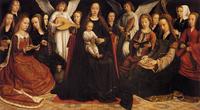
Madonna with Angels and Saints
Gerard David
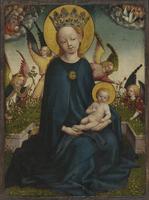
Maria mit dem Jesuskind vor der Rasenbank
Stefan Lochner
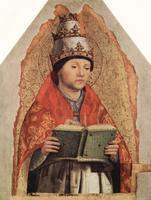
St. Gregory
Antonello da Messina
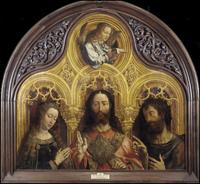
Deesis
Mabuse
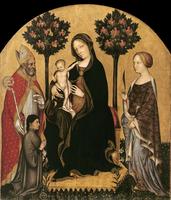
Mary Enthroned with the Child, Saints and a Donor
Gentile da Fabriano
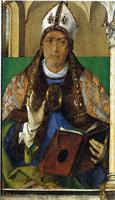
Ambrosio
Justus van Gent
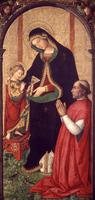
Madonna with Writing Child and Bishop
Pinturicchio
Madonna with Child and St.Catherine, St.Nicolas and Donor Gentile da Fabriano
Gentile da Fabriano
The Annunciation
Bernard Van Orley
Madonna and Child
Fra Angelico
Saints Margaret and Apollonia
Rogier van der Weyden
The Ghent Altarpiece, The Virgin Mary
Jan van Eyck
Saint Catherine of Alexandria
Carlo Crivelli
Triptych with the Virgin in the Garden of Paradise
Stefan Lochner