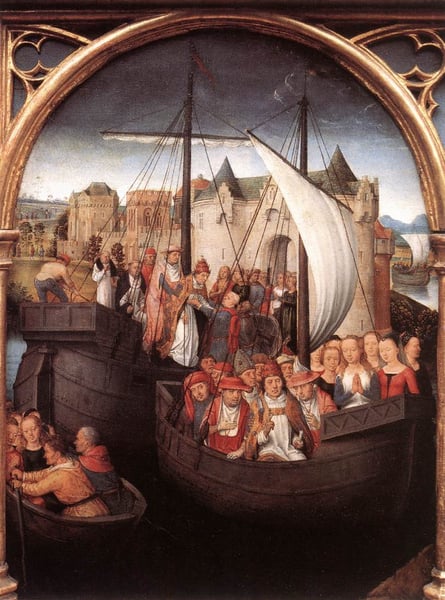
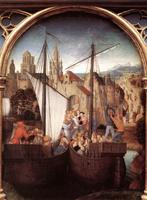
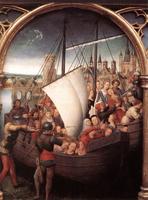
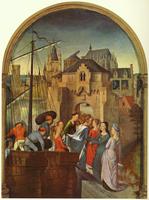
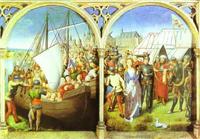
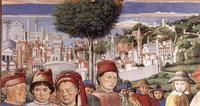
The panel The Departure of Saint Ursula from Basle, by Hans Memling, is a masterwork of the Northern Renaissance, distinguished by its exquisite narrative detail, luminous color, and serene spatial clarity. As part of the Reliquary of St. Ursula—a painted wooden shrine created around 1489 for the Hospital of St. John in Bruges—this work exemplifies Memling’s ability to synthesize devotional function with sophisticated pictorial storytelling. The scene depicts the saint and her companions departing the city of Basle on their ill-fated pilgrimage to Rome. Memling’s meticulous attention to dress, architecture, and landscape reflects the Northern Renaissance fascination with empirical observation and symbolic realism. The composition balances a densely populated foreground with a distant, atmospheric vista, while the calm, almost courtly grace of the figures imbues the sacred narrative with human tenderness. This panel is significant not only for its technical refinement—evident in the handling of light on silk garments and the delicate faces of the virgins—but also for its role within a larger reliquary that bridges late medieval Gothic artistry and the emerging naturalism of the Renaissance. Memling’s work here elevates a crafted object into a vehicle for intimate, emotional devotion, making the legend of St. Ursula vividly accessible to contemporary viewers.