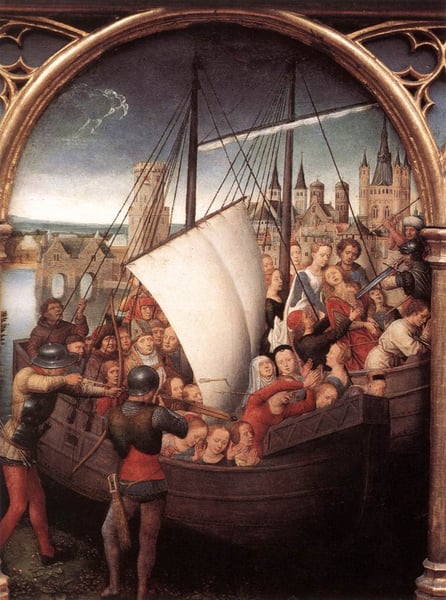
The Martyrdom of Saint Ursula and her companions at Cologne, from The Reliquary of St. Ursula
Dettagli
Analisi esperta di The Martyrdom of Saint Ursula and her companions at Cologne, from The Reliquary of St. Ursula di Hans Memling
Stile: Northern Renaissance · Genere: religious painting
Expert Analysis of Hans Memling's "The Martyrdom of Saint Ursula and Her Companions at Cologne"
Hans Memling’s The Martyrdom of Saint Ursula and Her Companions at Cologne is a masterwork of the Northern Renaissance, distinguished not only by its exquisite technical execution but also by its integration into the larger Reliquary of St. Ursula—a functional object of veneration. Painted around 1489, the panel exemplifies the period’s fusion of religious narrative with meticulous naturalism and symbolic complexity.
Significance within the Northern Renaissance:
-
Narrative Precision and Emotional Restraint: Unlike earlier Gothic depictions of martyrdom that emphasized graphic violence and emotional excess, Memling presents the scene with characteristic Northern Renaissance calm. The archers are poised and orderly; the victims show little overt anguish. This restraint reflects the period’s shift toward contemplative piety, inviting the viewer to meditate on sanctity rather than horror.
-
Integration of Architecture and Space: Memling uses a detailed, cityscape backdrop—identifiable as Cologne—to ground the sacred event in a recognizable, contemporary setting. This technique, common in Netherlandish painting, bridges the earthly and the divine, reinforcing the reliquary’s function as a tangible connection to the saint’s historical reality.
-
Exquisite Detail and Symbolism: The reliquary panels are painted with luminous, jewel-like colors and minute details (such as the ornate costumes and abundant archers), showcasing the Flemish tradition of oil glazes. The composition also encodes symbolic meaning: the eleven thousand arrows (often represented by a dense cluster) allude to Saint Ursula’s legend without overwhelming the composition, while the serene central figures echo Memling’s ideal of gentle grace.
-
Functional Art as High Art: The fact that this scene was painted on a gilded and jeweled reliquary—a container for sacred relics—demonstrates the Northern Renaissance’s elevation of craft. Memling’s ability to infuse a utilitarian devotional object with the same compositional sophistication and emotional depth as an altarpiece marks the era’s breakdown of the hierarchy between fine and applied arts.
In sum, Memling’s Martyrdom is significant for its serene piety, meticulous realism, and pioneering fusion of narrative painting with sacred object-making—hallmarks that define the Northern Renaissance’s contribution to European art.
Museum / Gallery
Genere
Stile
Visivamente simili
20 opere con composizione e palette affini
The Departure of Saint Ursula from Basle, panel from The Reliquary of St. Ursula
Hans Memling
St. Ursula and her companions landing at Basel, from the Reliquary of St. Ursula
Hans Memling
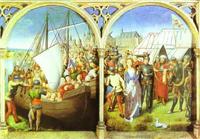
The Martyrdom of St. Ursula's Companions and The Martyrdom of St. Ursula. From the Shrine of St. Ursula
Hans Memling
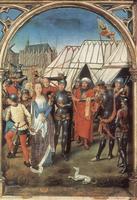
The Reliquary of St. Ursula
Hans Memling
The Story of St. Nicholas: St. Nicholas saves the ship
Fra Angelico
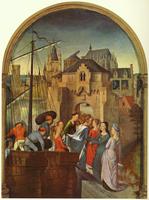
St. Ursula and her companions landing at Cologne, from the Reliquary of St. Ursula
Hans Memling
Martírio de Santo Hipólito
Cristovao de Figueiredo
St. Augustine Departing for Milan (detail)
Benozzo Gozzoli
Back in England Isabella of France
Jean Fouquet
Massacre of the Innocents
Fra Angelico
Carrying the Cross
Jean Fouquet
Justice of the Emperor Otto: The Execution of the Innocent Count
Dirk Bouts
The Arrival of Charles V (1337-80) in Paris, 28th May 1364
Jean Fouquet
Quaratesi Altarpiece, St.Nicholas saves a storm tossed ship
Gentile da Fabriano
Hugh Capet seized the fortresses of Artois
Jean Fouquet
Charlemagne Builder
Jean Fouquet
Entry of Emperor Charles IV in Cambrai
Jean Fouquet
The Martyrdom of St. James the Great
Jean Fouquet
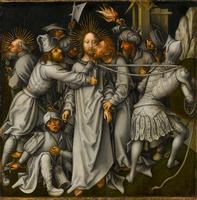
The Kiss of Judas (Grey Passion-2)
Hans Holbein the Elder
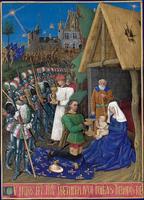
The Adoration of the Magi
Jean Fouquet