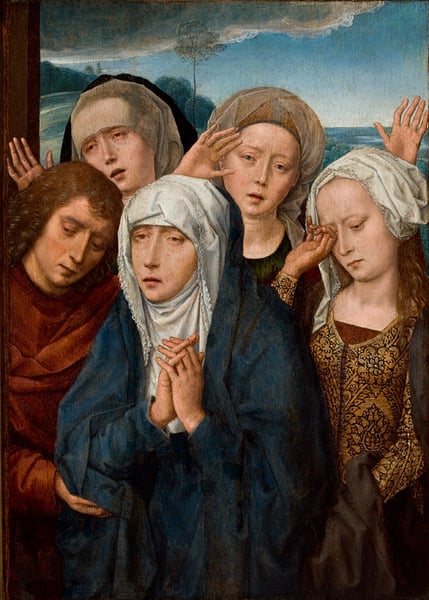
The Mourning Virgin with St. John and the Pious Women from Galilee
Details
Expertenanalyse zu Hans Memlings The Mourning Virgin with St. John and the Pious Women from Galilee
Stil: Northern Renaissance · Genre: religious painting
This analysis focuses solely on the provided facts: the artwork The Mourning Virgin with St. John and the Pious Women from Galilee by Hans Memling, classified under the Northern Renaissance style and religious genre.
Expert Analysis: Significance within the Northern Renaissance
Hans Memling’s The Mourning Virgin with St. John and the Pious Women from Galilee stands as a quintessential example of Northern Renaissance religious painting, distinguished by its masterful fusion of detailed naturalism with profound spiritual emotion. While Memling worked in the thriving artistic center of Bruges, his interpretation of this traditional Lamentation scene departs from the more dramatic, angular compositions of his Netherlandish contemporaries, offering instead a serene, meditative quietude that marks a high point of the period.
1. Emotional Restraint and Humanist Piety: Unlike the intense, often graphic depictions of grief found in earlier or contemporaneous Flemish works, Memling focuses on a controlled, inward sorrow. The Madonna’s pale, sorrowful face, St. John’s gentle support, and the pious women’s reverent stillness create a tableau of dignified mourning. This restraint reflects the Northern Renaissance emphasis on private, personal devotion—the viewer is invited to contemplate the grief rather than be overwhelmed by it. The humanization of sacred figures, a key Northern Renaissance innovation, is achieved through subtle, individualized expressions rather than overt theatricality.
2. Meticulous Observation and Symbolic Detail: As a master of the Northern Renaissance, Memling employs his celebrated technique of rendering textures and surfaces with near-hyperrealistic precision. The crisp folds of linen, the soft sheen of silk robes, and the delicate translucency of the Virgin’s skin all showcase the Flemish obsession with optical truth. This attention to detail serves a symbolic purpose: the luxurious fabrics and calm landscape are not mere decoration but reflect the divine order and beauty underlying the tragic event. The small, meticulously painted flowers or distant cityscape (common in Memling’s work) would have carried specific symbolic meanings for a 15th-century viewer, grounding the holy narrative in a recognizable, contemporary world.
3. Compositional Harmony and Spatial Innovation: Memling arranges the compact group in a gentle, pyramidal formation, foregrounding the emotional core while setting them against a detailed landscape. This balanced, almost symmetrical composition is a hallmark of his style, creating a sense of stability and timelessness. The landscape—a hallmark of Northern Renaissance painting—is not a mere backdrop but an integral part of the narrative, its peacefulness offering a stark contrast to the human tragedy and suggesting the promise of redemption. Memling’s skill in unifying figures and environment demonstrates the period’s sophisticated understanding of atmospheric perspective and spatial coherence.
Significance in Context: This painting exemplifies why Hans Memling is considered a pivotal figure of the Northern Renaissance. He synthesized the minute realism of Jan van Eyck with the lyrical, devotional tenderness of Rogier van der Weyden, producing works of exceptional emotional clarity and technical refinement. The Mourning Virgin with St. John and the Pious Women from Galilee functions as both a devotional icon for private prayer and a showcase of the artist’s ability to convey the sacred through the tangible—a central ambition of Northern Renaissance religious art. Its significance lies in its serene distillation of grief into a moment of transcendent, quiet faith, setting a standard for emotive yet restrained religious painting that would influence generations.
Visuell ähnlich
20 Werke mit ähnlicher Komposition und Farbpalette
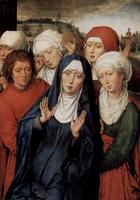
Granada diptych, right wing, the holy women and St. John
Hans Memling
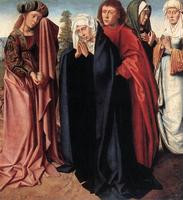
The Holy Women and St. John at Golgotha
Gerard David
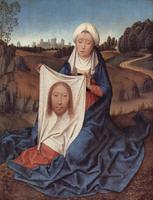
St. Veronica
Hans Memling
The Virgin of the Nativity
Filippino Lippi
The Visitation
Dirk Bouts
Triptych of Willem Moreel, right wing, the founder Barbara van Vlaenderbergh, wife of Willem Moreel, the daughters and the St. Barbara
Hans Memling
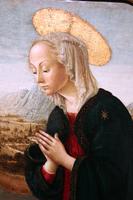
Adorazione del bambino
Francesco Botticini
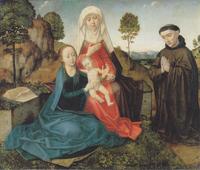
Virgin and Child With St. Anne and a Franciscan donor
Hugo van der Goes
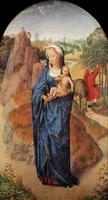
Virgin and Child in a Landscape
Hans Memling
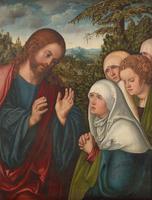
Christ taking leave of his mother
Lucas Cranach the Elder
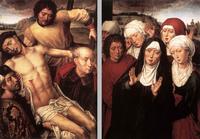
Diptych with the Deposition
Hans Memling
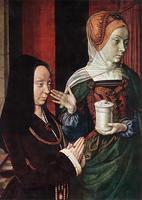
Madeleine of Bourgogne presented by St. Mary Magdalene
Jean Hey
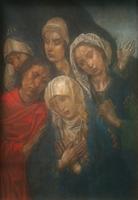
Deposition Diptych (Small Deposition, right wing)
Hugo van der Goes
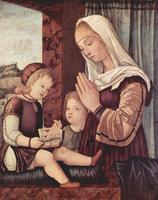
Virgin Mary and John the Baptist, praying to the child Christ
Vittore Carpaccio
Pentecost
Jan Joest
Haneton Triptych (left wing)
Bernard Van Orley
The Marriage at Cana (detail)
Gerard David
The Holy Family
Andrea Mantegna
The Holy Family with Saint Mary Magdalen
Andrea Mantegna
The Virgin and Child Adored by Angels
Jean Hey