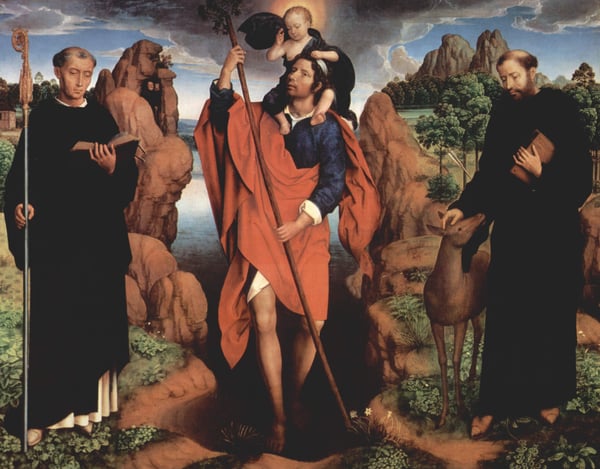
The triptych of Willem Moreel, middle panel Saint Christopher with Saint Maurus of Glanfeuil and Saint Giles
Details
Expertenanalyse zu Hans Memlings The triptych of Willem Moreel, middle panel Saint Christopher with Saint Maurus of Glanfeuil and Saint Giles
Stil: Northern Renaissance · Genre: religious painting
This triptych, created by Hans Memling around 1484, is a masterwork of the Northern Renaissance, period notable for its meticulous realism, rich symbolism, and the integration of devotional intimacy with public display. The middle panel, which you describe, presents Saint Christopher carrying the Christ Child, flanked by Saint Maurus and Saint Giles. The work's significance lies in how Memling blends the sacred with the secular, using the triptych format typical of Netherlandish altarpieces to anchor a private family commission within a universal religious narrative.
Key elements of significance:
-
Technical virtuosity and naturalism: Memling's handling of oil paint achieves a luminous clarity and microscopic detail—from the texture of Saint Christopher's cloak to the reflections in the river. This extreme precision, a hallmark of the Northern Renaissance, creates a tangible, almost tangible sacred space that invites contemplation. The landscape background, with its panoramic view and atmospheric perspective, demonstrates the period's fascination with observed nature.
-
Symbolic layering: Saint Christopher, the giant who carries the Christ Child across a river, symbolizes the Christian's burden of faith. The Christ Child holds an orb (the world) and blesses, reinforcing Christ's dominion. Saint Maurus (left) was a Benedictine abbot, often invoked against illness, while Saint Giles (right) was a hermit and patron of cripples and beggars. Together, they form a protective triad for the donor. The inclusion of the donor, Willem Moreel (likely depicted in the now-lost outer wings or side panels, but implied by the triptych's commission), anchors the heavenly scene to earthly piety—a signature Northern Renaissance practice of integrating portraits of patrons as witnesses or participants.
-
Composition and hierarchy: Memling organizes the saints with clear hierarchical clarity. Christopher dominates the center, his massive form counterbalanced by the smaller figures of Maurus and Giles, who respectfully turn inward toward the central mystery. The subtle gestures and gazes create a quiet, devotional rhythm. The triptych structure itself—with the central panel as the theological focus and the wings (if extant) extending the narrative or containing donors—exemplifies the period's use of polyptychs to structure both space and meaning.
-
Cultural and religious context: This work was painted for the church of Saint James in Bruges, reflecting the city's prosperity and the Burgundian court's taste for refined, accessible piety. Memling's style, often called the "Bruges Madonna," merges the severe realism of Jan van Eyck with a softer, more lyrical grace. Here, the balance between earthly detail (the river, the staff, the garments) and the supernatural (the halos, the blessing, the floating orb) makes the divine approachable. It represents the Northern Renaissance ideal of a faith made visible through art, where every fold of fabric and blade of grass is a testament to God's creation.
Museum / Gallery
Visuell ähnlich
20 Werke mit ähnlicher Komposition und Farbpalette
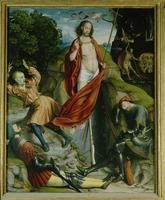
Resurrection of Jesus
Jan Joest
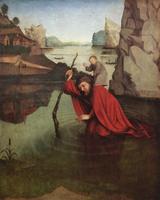
St. Christopher
Konrad Witz
St. Christopher
Hans Memling
The right wing of The Pearl of Brabant: Saint Christopher
Dirk Bouts
Baptism of Christ, St. John Altarpiece
Giovanni Bellini
The Ghent Altar (detail)
Jan van Eyck
Saint John the Baptist
Francesco del Cossa
Third Appearance of Christ
Dirk Bouts
Ecce agnus Dei
Dirk Bouts
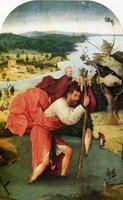
Saint Christopher
Hieronymus Bosch
St. Jerome
Hans Memling
Saint Jerome
Ambrogio Bergognone
Moses
Jan Joest
Noli me tangere
Hans Holbein the Younger
St. Barbara
Giovanni Antonio Boltraffio
Baptism of Christ
Pietro Perugino
St Christopher
Quentin Matsys
Pala di Sant Agostino (Baptism of Christ)
Pietro Perugino
John the Baptist
Antoniazzo Romano
Law and Grace
Lucas Cranach the Elder