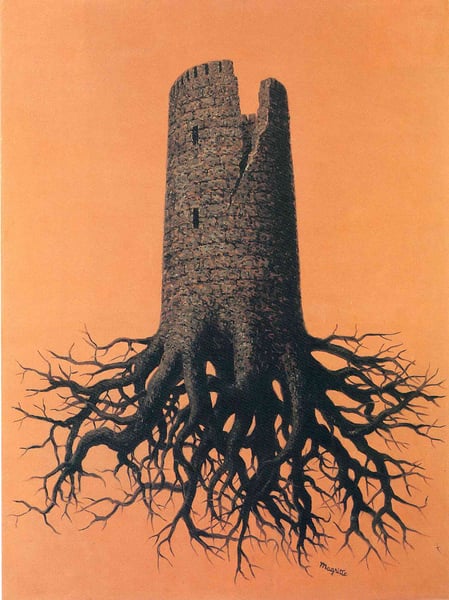
Almayer's folly
Dettagli
Analisi esperta di Almayer's folly di Rene Magritte
Stile: Surrealism · Genere: symbolic painting
In René Magritte’s 1951 masterpiece, Almayer's Folly, the Belgian Surrealist masterfully employs his signature technique of visual metamorphosis to destabilize our understanding of the physical world. Set against an unnervingly flat, luminous apricot background, the central motif commands immediate attention: a ruined medieval stone tower that seamlessly transforms at its base into a sprawling, intricate network of gnarled tree roots. Magritte paints this impossible hybrid with a deadpan, meticulous realism. The rough-hewn texture of the masonry, complete with narrow arrow slits and a jagged fissure of decay, transitions so organically into the dark, reaching roots that the viewer’s eye accepts the illusion before the logical mind can reject it. This subversion of reality through hyper-realistic rendering is a definitive hallmark of Magritte’s mature period.
The painting operates as a profound symbolic meditation on the tension between human civilization and the relentless forces of nature. The tower, a traditional emblem of human defense, architectural ambition, and permanence, is entirely subverted by its foundation. Rather than resting on solid ground, the structure is uprooted, floating suspended in an ethereal void. The roots, which typically anchor life and draw sustenance from the earth, here grasp at nothing but empty space. This visual paradox asks a compelling question: is the tower organically growing out of the roots, suggesting that human constructs are merely an extension of natural biology, or is nature slowly reclaiming and consuming the decaying remnants of human endeavor?
The artwork’s title provides a crucial key to its deeper historical and literary resonance. Borrowed from Joseph Conrad’s 1895 debut novel, Almayer's Folly, the title references a tragic protagonist whose grandiose dreams of wealth and a magnificent, uncompleted house ultimately collapse into ruin and despair. Magritte, who frequently relied on his intellectual circle to help title his works, uses Conrad’s narrative as an associative, poetic layer rather than a literal illustration. The painting becomes a striking visual metaphor for the hubris of human ambition—the "folly" of believing our monumental constructions can escape the organic cycle of decay. Uprooted, isolated, and fracturing, Magritte’s tower stands as a haunting monument to the fragility of human legacy.
Visivamente simili
20 opere con composizione e palette affini
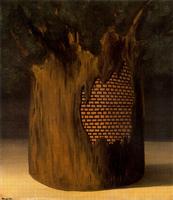
Threshold of forest
Rene Magritte
Queen Anna's tower
Nicholas Roerich
Mordor Nights
Jacek Yerka
Italian plaza with a red tower
Giorgio de Chirico
Sheet 'B' from the album 'Ukrainian alphabet'
Heorhiy Narbut
Untitled
Zdzislaw Beksinski
Vignette for book "N. K. Roerich"
Nicholas Roerich
Tower Ruins with Dragon
Carl Blechen
Narnia
Jacek Yerka
Untitled
Zdzislaw Beksinski
My friend Agustin Lazo
Remedios Varo
Enigmatic Elements in the Landscape
Salvador Dali
Surrealist Poster
Salvador Dali
The Sign of Anguish
Salvador Dali
The Tower
Salvador Dali
Fayoum Aka. Fayoum Ruins
Abdul Mati Klarwein
Death Awaiting his Family
Yves Tanguy
The task
Remedios Varo
Amphitheatre of Verona
Giovanni Battista Piranesi
The Red Tower
Giorgio de Chirico