
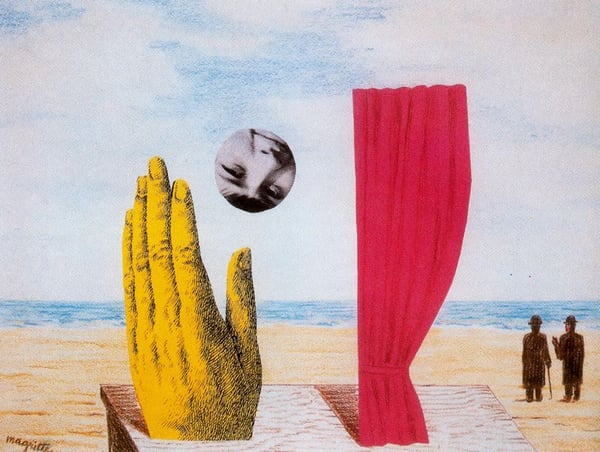
Expertenanalyse zu Rene Magrittes Collage
Stil: Surrealism · Genre: symbolic painting
Expert Analysis: "Collage" by René Magritte
René Magritte’s Collage exemplifies the Surrealist commitment to disrupting everyday logic through precise, almost clinical arrangements of familiar objects. Although the artist is best known for his meticulously painted canvases, his work in collage—a medium favored by many Surrealists for its ability to combine disparate realities—allowed him to create jarring, poetic juxtapositions with direct, cut-out immediacy.
Significance within Surrealism:
Magritte’s collages are crucial for understanding how Surrealism moved beyond automatic painting into a more conceptual, symbol-laden visual language. Unlike the more biomorphic or dreamlike abstractions of Miró or Masson, Magritte’s collages maintain a deadpan realism. By pasting together recognisable fragments (e.g., a bowler hat, a cloudy sky, a domestic interior), he creates a new, uncanny reality where the ordinary becomes strange. This aligns with the Surrealist goal of “resolving the contradictory states of dream and reality into an absolute reality, a surreality.”
Symbolic Painting & Thematic Depth:
As a symbolic painting, Collage is not meant to be decoded like a rebus, but rather to provoke a dislocation of meaning. Magritte’s symbols (windows, apples, faces, curtains, etc.) repeatedly question the relationship between an object and its representation. In collage form, the physical cut edge itself becomes a symbol—a literal boundary between one reality and another. The work likely plays with the idea of the painted picture as a “window” onto a different world, then subverts that window by inserting alien elements (e.g., a giant stone floating in a room, a face obscured by an apple).
Why It Matters:
Collage is a key artifact of Magritte’s shift from the flamboyant Surrealist generation of the 1920s to the more philosophical, “word-and-image” investigations of the 1930s–1960s. It reveals that even in a cut-and-paste medium, Magritte maintained his signature restraint: no expressive brushwork, no emotion, only a cool invitation to question what we see. This work thus stands as a bridge between Dada collage and Magritte’s later, iconic oil paintings—reminding us that his most powerful symbols were born from the act of cutting and re-placing fragments of the real world.
Genre
Stil
Visuell ähnlich
20 Werke mit ähnlicher Komposition und Farbpalette
Gioconda
Rene Magritte
Beautiful world
Rene Magritte
Vaszary János, Strand 1930
Vaszary János
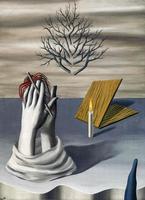
The dawn of Cayenne
Rene Magritte
The decorated world
Soltan Soltanlı
The Feeling of Becoming
Salvador Dali
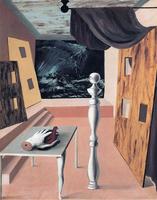
The difficult crossing
Rene Magritte
Composition on a seashore
Rene Magritte
The fair captive
Rene Magritte
Portrait of Katharina Cornell
Salvador Dali
Surrealist Composition with Invisible Figures
Salvador Dali
Arrival
Enrico Pinardi
La Mort
Jean Hugo
The Enigma of the Oracle
Giorgio de Chirico
Intermission
Rene Magritte
Anima
Enrico Pinardi
Study for a Backdrop
Salvador Dali
Nocturne
Rene Magritte
Untitled (The Great Masturbator Appears Behind Arcades)
Salvador Dali
Enrique Enn Ser
Enrique Enn