Salvador Dali の Study for a Backdrop の専門的な分析
スタイル:Surrealism · ジャンル:sketch and study
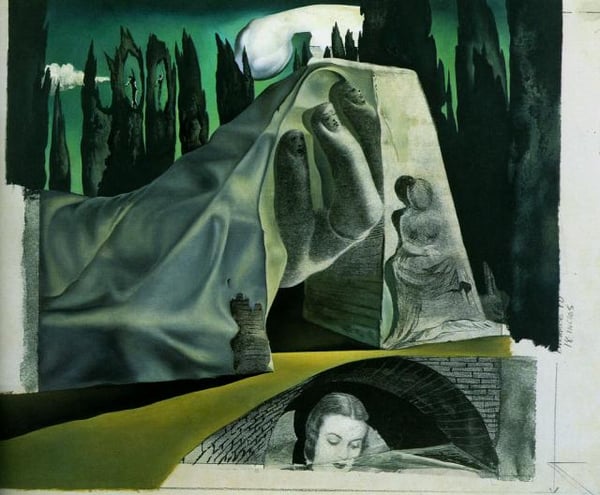
Artwork Analysis: "Study for a Backdrop" by Salvador Dalí
This work belongs to Dalí’s Classic Period (1941–1989), a phase marked by his return to Catholicism, a fascination with atomic physics, and a renewed commitment to Renaissance-inspired draftsmanship. As a sketch and study, it offers a rare glimpse into Dalí’s preparatory process—a key to understanding how he translated his visionary, often delirious imagery into finished paintings and theatrical designs.
Significance within Surrealism and Dalí’s oeuvre:
-
Bridge between Surrealism and Classical Technique
While still rooted in Surrealism’s dream-logic and impossible juxtapositions, the “study” format reveals Dalí’s rigorous academic training. Unlike the automatism prized by fellow Surrealists, Dalí insisted on “hand-painted dream photographs.” This sketch exemplifies his meticulous planning: precise perspective, dramatic chiaroscuro, and anatomical accuracy, even in a preparatory state. It demonstrates that his most fantastical images were built on a solid foundation of traditional drawing. -
Theatrical and Architectural Ambition
As a “backdrop” study, this work likely stems from Dalí’s extensive work in stage and film design (e.g., for the ballet Labyrinth or the dream sequence in Hitchcock’s Spellbound). Such studies were not mere doodles but functional blueprints for transforming Surrealist space into lived, performable environments. The sketch captures Dalí’s obsession with illusionistic depth—a hallmark of his classic period—where the backdrop becomes a portal to a hyperreal, metaphysical landscape. -
Classic Period’s “Nuclear Mysticism”
Created after Dalí’s 1944 manifesto “Mystical Manifesto,” his classic period fused religious iconography with scientific theory (e.g., atomic disintegration, DNA helices). Even in a humble study, one might detect the quiet dissolution of solid forms or a horizon that simultaneously recedes and fractures. The sketch’s unfinished quality highlights the tension between permanence (the classical draft) and flux (the surreal subject), a central theme in Dalí’s later work. -
Significance of the “Study” Genre
In art history, studies by masters like Dalí are particularly valuable because they strip away the polish of the finished work, revealing the artist’s raw decision-making. Here, we see Dalí experimenting with composition, light, and symbolism before committing to paint. For a movement that often celebrated the irrational and spontaneous, this disciplined preparation underscores Surrealism’s dual nature: chaos rigorously controlled.
Conclusion:
“Study for a Backdrop” is a microcosm of Dalí’s genius. It is significant not for being a finished masterpiece, but for being a schematic of one—showing how Surrealism could be both wildly imaginative and classically grounded. It affirms Dalí’s role as a meticulous craftsman who used the sketch as a laboratory for his most iconic, mind-bending visions.
ジャンル
スタイル
視覚的に類似
構図やパレットが近い作品 20 件

Margin of Silence
Kay Sage
The Three Glorious Enigmas of Gala
Salvador Dali
Wedding Travelling in Space
Sabin Balasa
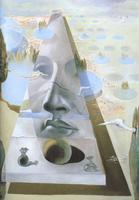
Apparition of the Visage of Aphrodite of Cnidos in a Landscape
Salvador Dali
Landscape
Salvador Dali
Enigma (unfinished version of 'The Three Glorious Enigmas of Gala')
Salvador Dali
Female Bather
Salvador Dali
Metaphysical Triangle
Giorgio de Chirico
Design for the set of the film 'Spellbound'
Salvador Dali
The Three Ages
Salvador Dali
The Feeling of Becoming
Salvador Dali
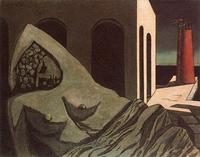
Ariana, the silent statue
Giorgio de Chirico
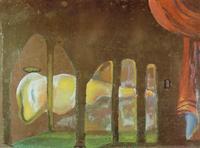
Untitled (The Great Masturbator Appears Behind Arcades)
Salvador Dali

The Dream Approaches
Salvador Dali
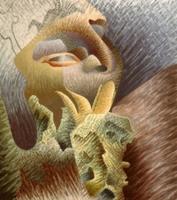
Plant and Face
Godfrey Blow
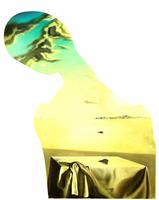
Couple with Clouds in Their Heads (Woman)
Salvador Dali
The City I Dream
Victor Brauner
Imperial Monument of Woma-Child. Gala (Utopian Fantasy)
Salvador Dali
Compoisition surréaliste ou La main
Leon Arthur Tutundjian
Dolor de mediodía
Angel Planells