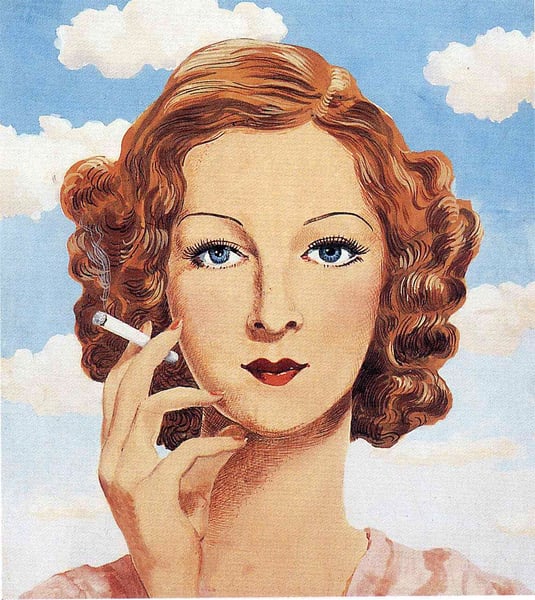
Georgette Magritte
Details
Expert analysis of Rene Magritte’s Georgette Magritte
Style: Surrealism · Genre: portrait
Expert Art Historical Analysis: "Georgette Magritte" by René Magritte
Style: Surrealism
Genre: Portrait
Period: Brussels pre-war and war years
Significance Within the Surrealist Period
René Magritte’s portrait of his wife and frequent model, Georgette Magritte, occupies a crucial place within his Brussels pre-war and war years—a period marked by both the maturation of his signature surrealist vocabulary and his radical stylistic shifts in response to World War II. Created between the late 1930s and early 1940s, this work exemplifies Magritte’s ability to transform the conventional portrait into a site of psychological tension and perceptual paradox, while also reflecting his wartime experimentation with the so-called “Renoir” style (c. 1943–1947).
1. Subversion of the Traditional Portrait
Unlike conventional portraiture that aims for likeness or character revelation, Magritte’s depiction of Georgette deliberately frustrates easy reading. He often isolates her face or body against a mundane, dreamlike background—or obscures her features with everyday objects (e.g., a bird, an apple, or a curtain). This displacement foregrounds the surrealist goal of making the familiar strange, forcing the viewer to question the relationship between appearance and reality. In this work, Georgette is likely rendered with a repetitive, flattened treatment (e.g., multiple profiles or a mirrored reflection), echoing Magritte’s fascination with doubling and the unreliability of sight.
2. The “Renoir” Period and Wartime Context
The war years in Brussels were a time of extreme hardship and Nazi occupation. Magritte responded by abandoning his earlier austere, pictographic style for a luminous, impressionistic palette inspired by Pierre-Auguste Renoir. In portraits of Georgette from this period (such as The Earth of the Plow or The Black Flying Cup), he used soft, broken brushstrokes and warm pastel colors to create an almost idyllic, “anti-war” aesthetic. This stylistic rupture was itself a surrealist gesture: by painting in a manner associated with 19th-century pleasure and light, Magritte defied the grim reality of occupation, while simultaneously parodying the idea of art as escape. The resulting portrait of Georgette becomes both a tender intimate study and a subversive commentary on the artist’s own practice.
3. Thematic Significance: The Artist’s Muse as Enigma
Georgette Magritte appears in over 50 of Magritte’s works, often as a silent, impassive figure whose very recognizability is undermined. In this portrait (likely created between 1938 and 1945), she may be shown with a veil, a mirror, or a partial face, resisting clear identification. This aligns with Magritte’s broader surrealist investigation of the tableau-objet (painting-as-object): the portrait does not simply represent a person, but becomes a philosophical proposition about the limits of representation. For Magritte, Georgette was not a psychological subject but a visual anchor for his ideas—a constant human presence that he could manipulate to test the boundaries of illusion.
4. Legacy and Surrealist Portraiture
This work is significant because it encapsulates Magritte’s unique contribution to surrealist portraiture. Unlike Dalí’s hallucinatory metamorphoses or Ernst’s collaged automatism, Magritte’s portraits retain a cool, hyper-realistic finish that makes their strangeness all the more unsettling. The painting of Georgette stands as a precursor to later conceptual portraiture, where the identity of the sitter is dissolved into a conceptual puzzle. It also demonstrates how a single artist’s response to historical trauma can redefine an entire genre—transforming the portrait from a record of likeness into a silent, philosophical riddle.
In sum, Magritte’s Georgette Magritte is not merely a portrait of his wife; it is a key document of surrealism’s wartime evolution, a manifesto against literal representation, and a testament to the enduring power of the everyday made strange.
Visually similar
20 works with related composition and palette

Jane Russell
Alberto Vargas
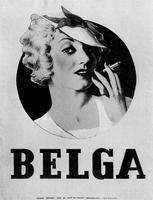
Poster for cigarettes "Belga"
Rene Magritte
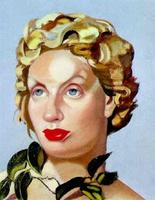
Portrait of Kizette Adult I
Tamara de Lempicka
Portrait of an Actress
Diego Rivera
Retrat Femení
Carmen Osés Hidalgo
Dark Haired Girl In Black Skirt And Turquoise Blouse On A Floral Sofa
Gerda Wegener
I'm Forever Thinking of You
Rolf Amstrong
The Saturday Evening Post
J. C. Leyendecker
Anne-Marie Crowet
Rene Magritte
Sylvania Electric, Calendar Pin-Up, December 1962
Haddon Sundblom
Untitled (Joan Crawford says...)
James Rosenquist
Taylor Swift Blue
Diana Ringo
Lady in Red
Paul Jacoulet
Eva Heramb
Gerda Wegener
Sipping her Coca-Cola, Advertisement
Haddon Sundblom
Fräulein Mulino von Kluck
Christian Schad
Sun women
Raphael Kirchner
Girl in Love
Salvador Dali
Memories of Olive
Alberto Vargas
Nurse
Roy Lichtenstein