
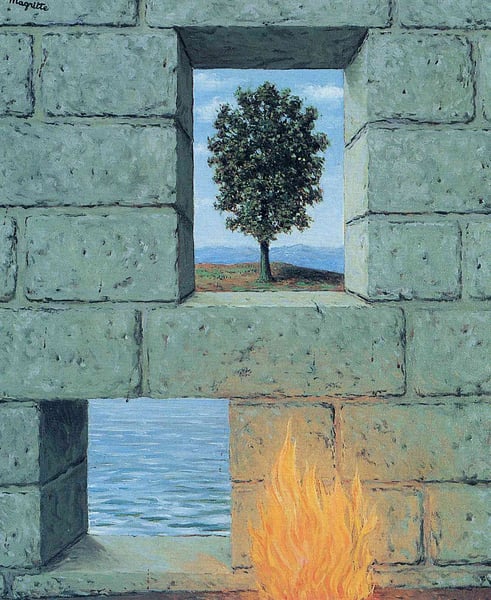
Mental complacency
Details
Expertenanalyse zu Rene Magrittes Mental complacency
Stil: Surrealism · Genre: allegorical painting
Expert Analysis of "Mental Complacency" by René Magritte
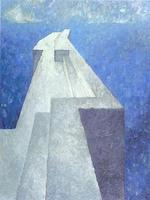
René Magritte’s “Mental Complacency” is a quintessential example of his mature Surrealist period, an allegorical painting that uses precise, dreamlike imagery to probe the nature of human consciousness. The work’s significance lies in how it distills the core Surrealist project—the disruption of everyday reality—into a pointed commentary on intellectual and emotional stasis.
As an allegorical painting, the work operates on multiple levels. True to Magritte’s mature phase, it likely depicts familiar, mundane objects rendered with photographic clarity but placed in jarring, irrational contexts. The allegory of “mental complacency” suggests a state of smug, unquestioning acceptance—a theme that Magritte often explored by contrasting hidden or obstructed realities (e.g., faces obscured by apples or curtains) with the viewer’s desire for clarity. The painting’s composition probably uses visual paradoxes to embody the very idea of a mind that is content with illusion, refusing to see beyond the surface.
Within the Surrealist style, “Mental Complacency” is significant for its cool, detached technique. Unlike the automatic, chaotic imagery of early Surrealism, Magritte’s mature work relies on meticulous realism to make the impossible seem plausible. This contrast between precise rendering and absurd juxtaposition forces the viewer to question perceptual and intellectual habits—exactly the kind of complacency the title condemns. The painting thus becomes a meta-critique: it uses Surrealism’s tools to expose a psychological and philosophical trap.
Belonging to Magritte’s Mature Period (roughly 1940s–1960s), the work reflects his deepened interest in language, representation, and the relationship between objects and their names. During this time, Magritte’s allegories grew more conceptual and less overtly Freudian. “Mental Complacency” likely employs his signature devices—the bowler-hatted man, the window onto a sky, or the stone trapped in a room—to depict a mind that is comfortably trapped within its own limited logic. The painting’s significance is thus twofold: it is a masterful synthesis of Surrealist aesthetics and philosophical inquiry, and it stands as a mature statement on the dangers of intellectual inertia, a theme that resonates with Surrealism’s broader challenge to reason and convention.
Visuell ähnlich
20 Werke mit ähnlicher Komposition und Farbpalette
The age of enlightenment
Rene Magritte
The Creation Of Water
Jacek Yerka
External view of the front door of the tomb aforesaid
Giovanni Battista Piranesi
Untitled
Zdzislaw Beksinski
The endearing truth
Rene Magritte
The spot on the map
Rene Magritte
La dimora della luna
Felice Pedretti
Composition surréaliste
Victor Brauner
Barber Saddened by the Persistence of Good Weather (The Anguished Barber)
Salvador Dali
Ball Game
Jeffrey Smart
Untitled
Gunther Gerzso
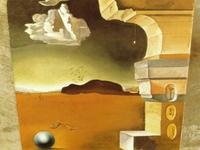
Mural Painting for Helena Rubinstein (panel 2)
Salvador Dali
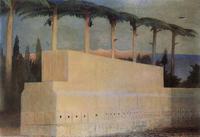
Sacrificial Stone in Baalbek
Tivadar Kosztka Csontvary
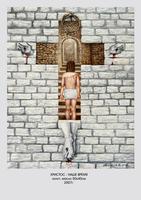
Христос . Наше Время
Vlad Avanesov
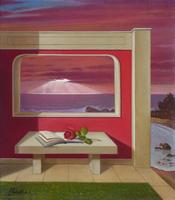
L'attesa
Felice Pedretti
Green Donkey
Sandor Bortnyik
Nocturne
Rene Magritte
Persistence of Fair Weather
Salvador Dali
Ruin with Head of Medusa and Landscape
Salvador Dali
Untitled
Fernando Lanhas