Expert analysis of Tivadar Kosztka Csontvary’s Sacrificial Stone in Baalbek
Style: Post-Impressionism · Genre: cityscape
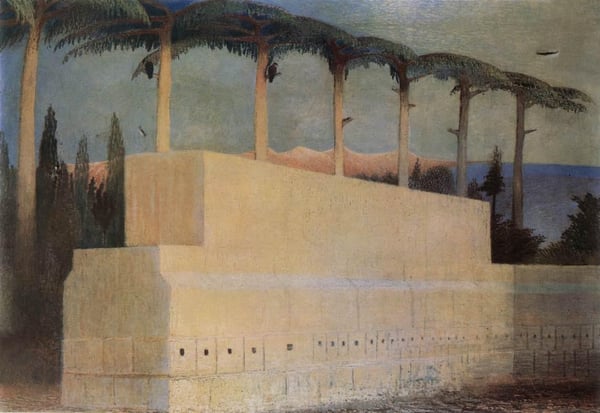
An expert analysis of Tivadar Kosztka Csontváry's Sacrificial Stone in Baalbek reveals a work that stands at the nexus of Post-Impressionist color theory and a deeply personal, symbolist vision. Painted in the early 20th century, this cityscape transforms an archaeological site into a monumental meditation on timelessness and human spirituality.
Significance within Post-Impressionism:
Csontváry, a Hungarian master working outside mainstream European art centers, infused Post-Impressionism with a unique, almost hallucinatory intensity. In this painting, he employs the movement’s hallmark of arbitrary, emotionally charged color—here, a stark, sun-bleached palette of ochres, azures, and deep umber—not to replicate the actual Roman ruins of Baalbek, but to evoke their mystical weight. The composition is deliberately flattened and compressed, with the eponymous sacrificial stone dominating the foreground like a primordial altar, while the distant temples recede under a sky saturated with swirling, almost Expressionist energy. This approach moves beyond Cézanne’s structural logic or van Gogh’s brushwork into a realm where architecture becomes a vessel for psychological revelation.
Genre Transformation:
As a cityscape, Sacrificial Stone in Baalbek rejects documentary accuracy in favor of symbolic geography. Csontváry, deeply influenced by his own prophetic visions and travels, treats Baalbek not as a mere locale but as a threshold between ancient ritual and modern alienation. The massive stone—arguably the famed "Stone of the Pregnant Woman"—is rendered with exaggerated scale and a brooding, introspective quality that transforms an archaeological relic into a sublime, almost disturbing presence. The few tiny human figures (if present) would further emphasize the overwhelming power of the place, a common Post-Impressionist device to convey existential solitude.
Why It Matters:
This work is significant because it demonstrates how Post-Impressionism could absorb and rewrite non-Western or ancient subjects through a distinctly personal, emotive lens. Csontváry’s Sacrificial Stone is not a touristic view; it is a vision of a sacred site that speaks to the artist’s lifelong obsession with the unity of nature, history, and divine energy. It anticipates the Symbolist and early Modernist fascination with primitivism and the spiritual, while remaining firmly rooted in the broken brushwork and bold color contrasts that define the Post-Impressionist quest for subjective truth. For these reasons, it stands as a key work in Csontváry’s oeuvre and a compelling outlier in the broader story of early 20th-century European painting.
Genre
Style
Visually similar
20 works with related composition and palette
The Isle of the Dead
Arnold Böcklin
Il viaggio
Felice Pedretti
Landscape with Mysterious Details
Salvador Dali
Morphological Echo'
Salvador Dali
A Pine by the Sea
Carlo Carra
Gala in a Patio Watching the Sky, Where the Equestrian Figure of Prince Baltasar Carlos and Several Constellations (All) Appear, after Velazquez
Salvador Dali
Night Landscape. Egypt.
Martiros Sarian
Enchantment of the Sun
Martiros Sarian
The Demon
Mikalojus Konstantinas Ciurlionis
Persistence of Fair Weather
Salvador Dali
Cemetery among the cypress
Vasily Polenov
The Isle of the Dead
Arnold Böcklin
Bathing at Alfortville
Henri Rousseau
View of the Fortifications
Henri Rousseau
Surrealist Object Gauge of Instantaneous Memory
Salvador Dali
Statue in a Cemetery
Endre Balint
Flying Bomb Depot (recto)
Graham Sutherland
Autumn Oaks
Grant Wood
New Horizons
Jose Manuel Capuletti
The Isle of the Dead
Arnold Böcklin