Expert analysis of Rene Magritte’s Modern
Style: Cubism · Genre: genre painting
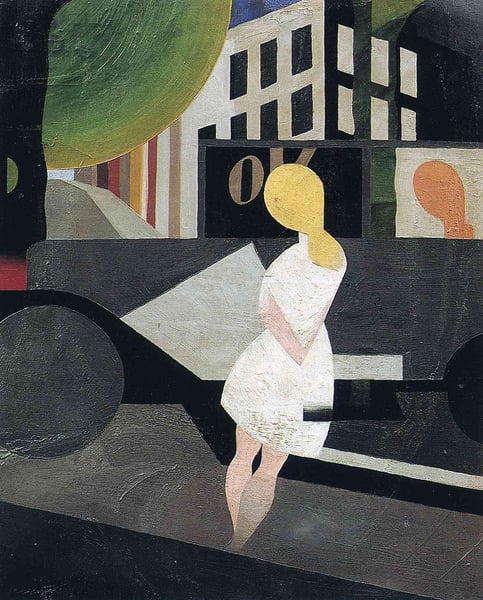
Expert Analysis: "Modern" by René Magritte
While René Magritte is universally celebrated as a master of Surrealism, the structured facts place this work—titled "Modern"—within his Cubist phase during his Early years. This designation is significant because it reveals a foundational period in which Magritte experimented with the formal vocabulary of Cubism before fully developing his signature uncanny, dreamlike style.
Cubist Context & Significance: As a Cubist work, "Modern" deliberately fractures perspective and simplifies form into geometric planes, echoing the innovations of Picasso and Braque. However, Magritte’s Cubism is not merely imitative—it already hints at his later preoccupation with the tension between representation and reality. Here, the genre painting subject (likely an everyday interior or human figure) is stripped of narrative warmth, rendered instead as a cool, analytical arrangement of shapes. The early Cubist period allowed Magritte to build a disciplined structural foundation that he would later deliberately deconstruct in his Surrealist works.
Significance of the Early Period: This painting is crucial for understanding Magritte’s artistic development. In his early years (roughly 1916–1925), he absorbed multiple avant-garde styles—Impressionism, Cubism, Futurism—before arriving at his own voice. "Modern" documents a moment when Magritte was still searching for a personal identity. Its Cubist handling shows his willingness to engage with the most radical art of his time, while the choice of a genre scene suggests an emerging interest in the ordinary, which he would later transform into the extraordinary.
What Makes It Notable:
- A rare Cubist window into Magritte’s mind: Most viewers know Magritte for floating apples and bowler hats; "Modern" proves his technical proficiency in non-Surrealist modes.
- Early evidence of conceptual play: Even within Cubist constraints, one can sense Magritte testing the boundaries of how a “modern” painting should look—the title itself announces a self-conscious awareness of avant-garde identity.
- Foothold for his later innovations: The flat, ambiguous spaces and muted palette of this work prefigure the deadpan clarity of his Surrealist canvases, where objects are rendered with similar geometric precision but placed in impossible contexts.
In summary, "Modern" is a key transitional work. Its significance lies not in being a typical Magritte, but in demonstrating that the artist first mastered the formal language of Cubism—including its genre-painting conventions—before deliberately abandoning it to invent a new, more mysterious visual poetry. Without this Cubist foundation, his later breakthroughs would have lacked the structural rigor that makes them so unsettling.
Visually similar
20 works with related composition and palette
Walking Woman with Dog
Ernst Ludwig Kirchner
The Truck
Mario Sironi
La Bugatti
Charles Lapicque
Death on the Ridge Road
Grant Wood
OUR FORD, HIGHHEAD
Edwin Dickinson
Untitled
Sonaly Gandhi
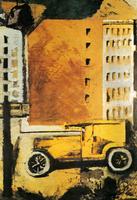
The yellow truck
Mario Sironi
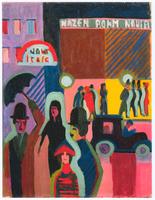
Store in the Rain
Ernst Ludwig Kirchner
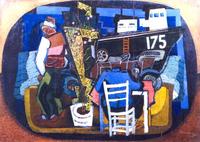
Danube water levels
M. H. Maxy
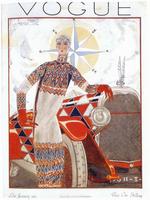
Vogue Cover
Sonia Delaunay
Rene Descartes and a Moving Matter
Alexander Roitburd
The Fall
Alan Stephens Foster
Work disgraces
Georg Scholz
RAI
Cassandre
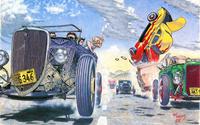
Hot Rod Race
Robert Williams
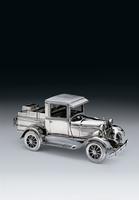
Jim Beam—Model A Ford Pick-up Truck
Jeff Koons
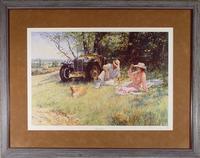
The Four of Us
Alan Fearnley
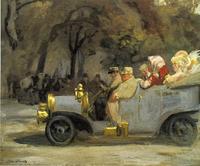
Gray and Brass
John French Sloan
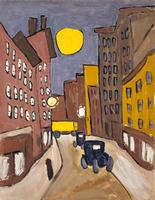
Harlem Street Scene with Full Moon
William H. Johnson
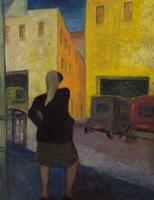
WOMAN CROSSING THE ROAD
Gerard Sekoto