Expertenanalyse zu M. H. Maxys Danube water levels
Stil: Cubism · Genre: genre painting
Expert Analysis: "Danube Water Levels" by M. H. Maxy (c. 1920s)
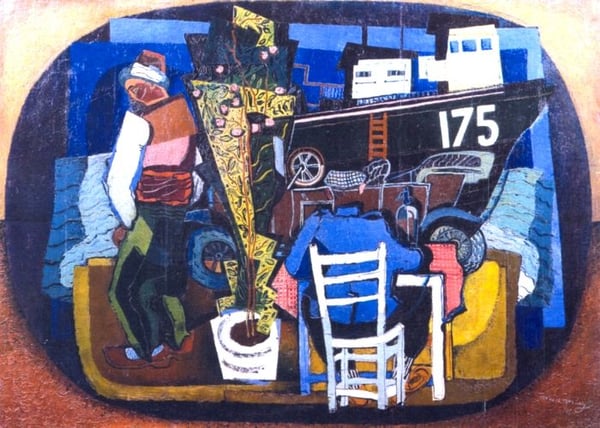
M. H. Maxy’s Danube Water Levels stands as a compelling example of how Cubist principles were adapted to Eastern European modernism, merging the formal innovations of the movement with a distinctly local, everyday subject. As a genre painting—a depiction of ordinary life—the work reimagines the Danube River not as a romantic, picturesque landscape but as a dynamic, fragmented system of geometric planes and shifting perspectives.
Significance within Cubism:
Maxy applies the core Cubist tenets of multiple viewpoints, faceted forms, and the flattening of pictorial space to a subject that is inherently fluid and temporal—the changing water levels of a river. Rather than depicting a single moment, he synthesizes the river’s movement, its reflections, and the surrounding topography into a unified, analytical structure. The “levels” themselves become a visual metaphor: horizontal strata of color and shape oscillate between the water’s surface, the embankment, and the sky, dissolving the boundary between object and environment. This reflects Cubism’s ambition to represent not just what the eye sees but the mind’s understanding of form in constant flux.
Context and Innovation:
As a Romanian avant-garde artist active in Bucharest’s Contimporanul circle, Maxy infuses his Cubist vocabulary with a local sensibility. The Danube—a vital economic and cultural artery for Romania—is stripped of narrative or sentimental cliché. Instead, its utilitarian measurement (water levels) becomes a modernist icon: a tool to explore abstraction while retaining a connection to empirical reality. The painting thus bridges the gap between high European modernism (Picasso, Braque) and the regionalist concerns of interwar Eastern Europe, where artists sought to modernize national identity through avant-garde means.
Visual Analysis:
The composition is built from overlapping, angular planes of muted earth tones, blues, and grays, typical of Synthetic Cubism’s palette. A rhythmic interplay of diagonal and horizontal lines suggests the river’s currents and the measuring markers along its banks. Light and shadow are treated as sculptural facets, evoking the shimmer of water without resorting to naturalistic representation. The fragmented perspective—almost as if the viewer sees the river from above, from the side, and from a distance simultaneously—creates a sense of time compressed into a single canvas, mirroring the continuous fluctuation of the water level itself.
Legacy:
Danube Water Levels is significant because it demonstrates that Cubism was not merely a French phenomenon but a trans-European language adaptable to local themes. Maxy’s work embodies the avant-garde’s desire to reframe everyday reality through intellectual, geometric rigor, making the mundane monumental. It challenges the viewer to see a river—a subject of countless traditional landscapes—through the lens of modern perception: as a set of relationships between volumes, lines, and spaces, where meaning is constructed rather than inherited.
Genre
Stil
Visuell ähnlich
20 Werke mit ähnlicher Komposition und Farbpalette
Breakdown
William H. Johnson
The Truck
Mario Sironi

Flashing Motorists
Raphael Kirchner

Work disgraces
Georg Scholz
Modern
Rene Magritte
Gray and Brass
John French Sloan

The Fall
Alan Stephens Foster
La Bugatti
Charles Lapicque
The yellow truck
Mario Sironi
Spring
Philip Evergood
The poster Bilbol
Akseli Gallen-Kallela
Berény Róbert, Coach with Ignotus 1912
Berény Róbert

Oklahoma Dust Bowl Refugees, San Fernando, California
Dorothea Lange

Broke, Baby Sick, and Car Trouble!
Dorothea Lange
Garage No. 1
Stuart Davis

Mercedes Benz automobile parade, Mannheim, Germany
Martin Munkácsi
OUR FORD, HIGHHEAD
Edwin Dickinson

Model T
Maud Lewis
The Windshield
Henri Matisse
Walking Woman with Dog
Ernst Ludwig Kirchner