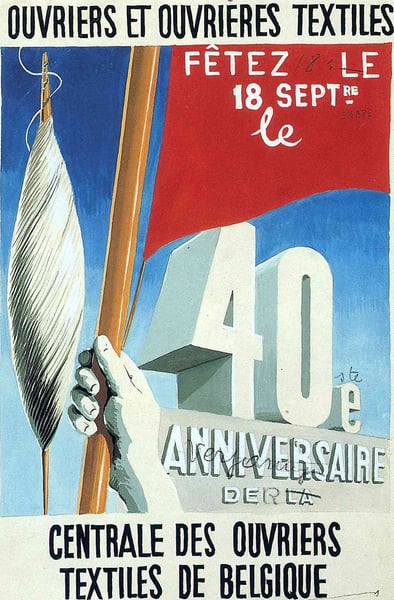
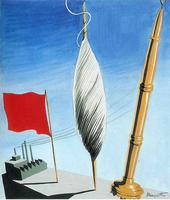
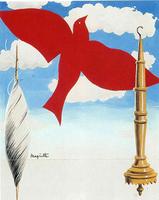
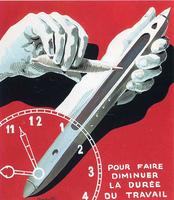
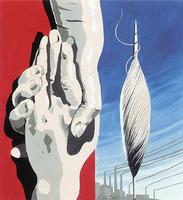
This poster exemplifies René Magritte’s ability to inject Surrealist dislocation into a functional, public-facing format. Created during his Brussels pre-war and war years—a period when he increasingly explored the tension between ordinary objects and their unsettling contexts—the work transforms a mundane political announcement into a visual puzzle.
The poster’s significance lies in its subversion of genre: while a typical trade-union event poster would rely on heroic or didactic imagery, Magritte instead applies his signature “object-without-its-usual-association” technique. The composition likely features familiar items (e.g., a bowler hat, a window, or a floating stone) rendered with hyper-realistic detail, then placed in an illogical arrangement that undermines the rational purpose of the notice. This deliberate estrangement forces the viewer to question the very act of celebrating labor—turning a prosaic date (“18th September”) into a doorway to the uncanny.
As a Surrealist poster, it is doubly radical: it hijacks a mass-market medium to smuggle dream logic into public consciousness, and it demonstrates Magritte’s conviction that even the most mundane commission could become a site for philosophical reflection. The work thus stands as a crucial artifact of his pre-war output, showing how he used commercial assignments to refine the visual vocabulary—juxtaposition, defamiliarization, and the mute presence of objects—that would define his later masterpieces.