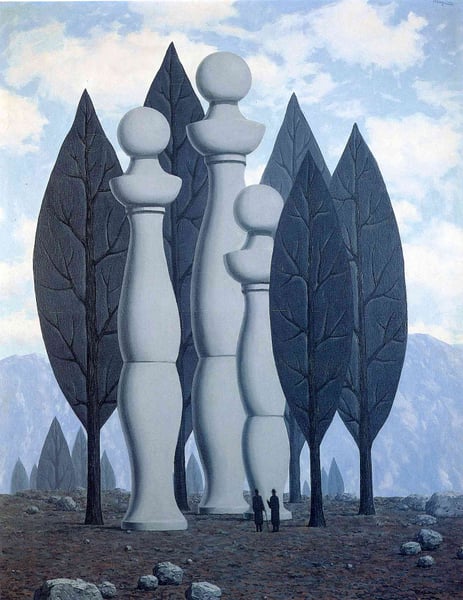
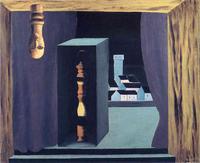
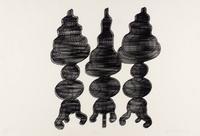
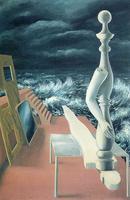
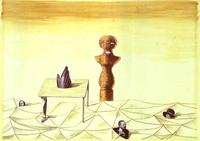
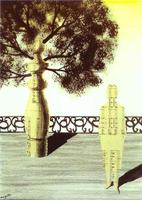
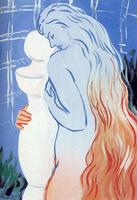
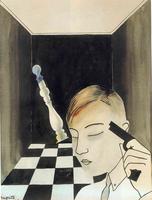
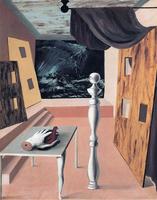
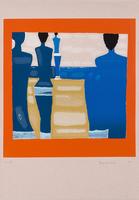
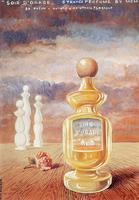
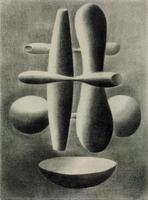
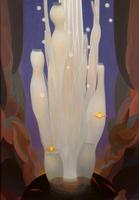
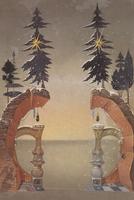
"The Art of Conversation" by René Magritte is a significant work within the Surrealist movement and the artist's Mature Period. As a symbolic painting, it exemplifies Surrealism's core mission to challenge rational perception by placing ordinary objects in unexpected, dreamlike contexts. Magritte’s mature style is renowned for its precise, almost clinical rendering of familiar subjects—such as stones, clouds, or architectural forms—which are then juxtaposed to create visual paradoxes. Here, the title suggests a thematic focus on language and connection, yet the imagery (as typical of Magritte) likely subverts conventional expectations, prompting viewers to question the nature of communication, reality, and representation. The work’s significance lies in its ability to embody Surrealist principles through symbolic ambiguity: it transforms a mundane concept ("conversation") into a mysterious, intellectually provocative scene that refuses easy interpretation. This aligns with Magritte’s broader mature-period goal of revealing the hidden meanings behind everyday appearances, making the painting a key example of how Surrealism used symbolic painting to explore the subconscious and the limits of visual logic.