The fair captive
Dettagli
Analisi esperta di The fair captive di Rene Magritte
Stile: Surrealism · Genere: symbolic painting
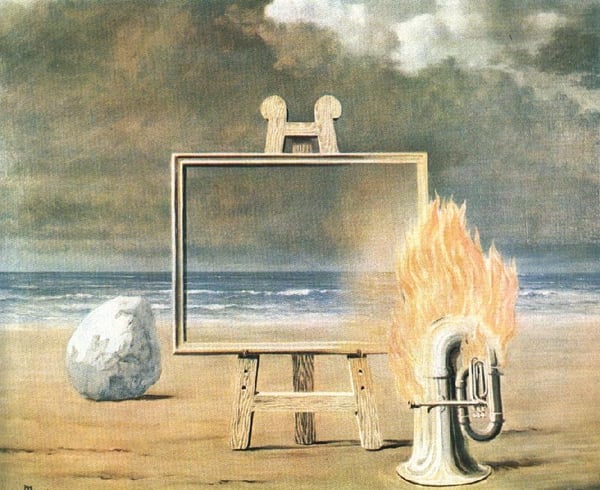
This painting, The Fair Captive (often translated as The Fair Captive or La Belle Captive), was created during René Magritte’s provocative Vache Period (1948–1949). This short-lived but highly significant phase marked a deliberate rupture from his polished, illusionistic Surrealist style. Instead of meticulous realism, Magritte adopted a crude, deliberately ugly, and almost cartoonish technique—thick, slashing brushstrokes, garish colors, and distorted forms. The Vache Period was a direct response to the art establishment’s embrace of his earlier work; Magritte sought to shock and rebel, aligning himself with the raw, anti-art energy of the CoBrA group and the expressive force of Fauvism.
The Fair Captive embodies this aesthetic aggression. The figure—a nude or female form—is rendered with aggressive, clumsy lines, her face a mask-like simplification. The background is flattened, the perspective deliberately broken. Typical Magritte motifs (the apple, the bowler hat, the window) may appear, but they are stripped of their polished enigma and rendered with a brutal, almost juvenile hand. The title itself is ironic: “fair” and “captive” suggest a beautiful imprisonment, yet the execution is anything but fair. This tension between title and image underscores Magritte’s critique of illusion and beauty.
Significance: Within Surrealism and Magritte’s own oeuvre, The Fair Captive is crucial for demonstrating the artist’s refusal to be confined by his own success. It challenges the notion that Surrealism must rely on meticulous technique to unlock the unconscious. Here, the unconscious emerges through raw, unfiltered mark-making—a visual equivalent of automatic drawing. The Vache Period, with works like this one, serves as a vital reminder that Magritte was not merely a painter of cool, intellectual puzzles, but a provocateur willing to sacrifice beauty for authenticity. This painting stands as a deliberate act of iconoclasm against both academic and Surrealist conventions.
Genere
Stile
Visivamente simili
20 opere con composizione e palette affini
The human condition
Rene Magritte
The discovery of fire
Rene Magritte
The flood
Rene Magritte
Threatening Weather
Rene Magritte
The Rights of Man
Rene Magritte
The heart of the matter
Rene Magritte
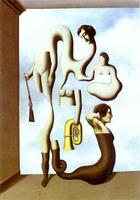
The Acrobat's Exercises
Rene Magritte
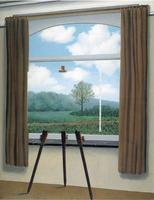
The Human Condition
Rene Magritte
Token
Paul Nash
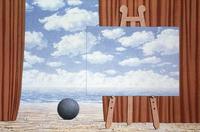
The fair captive
Rene Magritte
Caspar David Friedrich en su estudio
Georg Friedrich Kersting
Interior with the Artist's Easel
Vilhelm Hammershoi
Page de Musique
Jean Helion
Portrait of the Artist as an Old Man
Eric Fischl
Lake
Nicholas Roerich
Artist and 3 D Model
Alexander Roitburd
Studio Interior
Dale Hickey
Egry József, A Festő
Egry József
Las Meninas (The Maids-in-Waiting)
Salvador Dali
The Double Dream of Spring
Giorgio de Chirico