
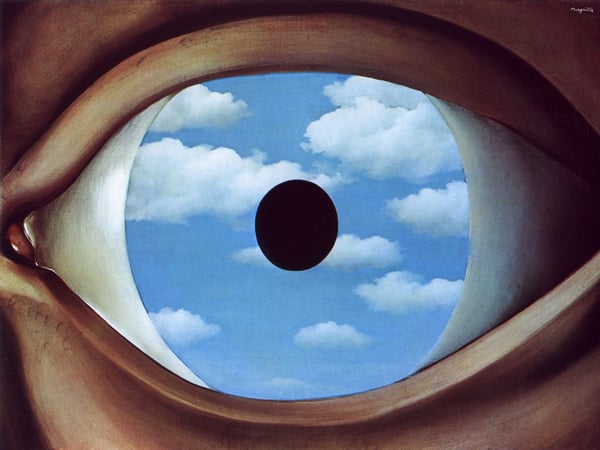
The false mirror
Details
Expert analysis of Rene Magritte’s The false mirror
Style: Surrealism · Genre: allegorical painting
Expert Analysis of "The False Mirror" by René Magritte
As a defining work of Magritte’s Surrealist Paris years, The False Mirror (1928) stands as a quintessential allegorical painting that interrogates the very nature of sight and representation. Executed in the most fertile period of Surrealism, when the movement was consolidating its philosophical and visual language in the French capital, this piece encapsulates the Surrealist obsession with the slippage between perception and reality.
Significance within Surrealism: The painting’s genius lies in its subversion of the most fundamental tool of observation: the human eye. Magritte presents a close-up of an eye, but replaces the iris with a luminous, cloud-filled sky—a paradoxical fusion of interior (the eye) and exterior (the sky). This visual paradox is central to Surrealist practice, which sought to collapse the boundaries of waking reality and dream logic. By turning the eye into a false mirror—something that traditionally reflects the world yet here contains a world—Magritte challenges the viewer’s trust in visual evidence. The title itself is an allegorical indictment of sight: the eye does not merely reflect; it constructs, distorts, or even invents reality.
Allegorical Depth: As an allegory, The False Mirror functions as a meditation on the limits of human knowledge. The sky in the eye evokes infinity and the unconscious—key Surrealist themes—while the dark pupil at the center suggests an unseeing void. This tension between clarity (the blue sky) and blindness (the black pupil) mirrors the Surrealist belief that true understanding lies beyond rational sight, accessible only through dreams, chance, and the irrational. The image is both intimate and cosmic, personal and universal.
Stylistic Context: Magritte’s meticulous, almost academic precision (a hallmark of his Surrealist period) amplifies the uncanny effect. The hyper-real depiction of the eyelashes and skin contrasts with the impossible, flat sky, creating a trompe-l’œil that deceives even as it reveals a deception. This technique aligns with Surrealism’s use of dépaysement—the unsettling displacement of familiar objects into strange contexts.
Historical Importance: Painted during Magritte’s most experimental years in Paris (1927–1930), when he was fully engaged with the Surrealist group and its leader André Breton, The False Mirror embodies the movement’s core ambition: to make visible the hidden forces of the psyche. It has since become an iconic representation of how Surrealism challenged the authority of direct observation, insisting that reality is always mediated by the mind—an idea that echoes through later developments in art, philosophy, and visual culture.
In short, The False Mirror is significant not merely as a striking image, but as a fundamental statement of Surrealist doctrine: the eye does not show us the world as it is; it shows us the world as we are.
Museum / Gallery
Visually similar
20 works with related composition and palette
Eye Colour
M.C. Escher
Olhares
Mathenovê
Les Tableaux (assurance) 063
DIDIER DOIGNON
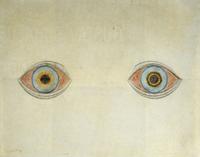
My Eyes in the Time of Apparition
August Natterer
Musas
Martin Pereira
L'oeil de nuit
Enrico Donati
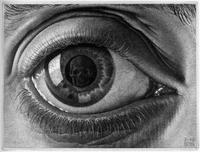
Eye
M.C. Escher
Galería esquizofrénica nº4
Martin Pereira
Bipolar
Martin Pereira
Café y tinta china Nº2
Martin Pereira
Le Regard-gouffre
Rene Duvillier
The Eye
Salvador Dali
what if we were born without eyes!
Houssam Eddine Hafdi
Eye of God
Forrest Bess
The Eye of the Angelus
Salvador Dali
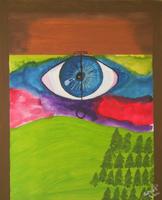
Atardecer psicodélico detrás de la ventana
Martin Pereira
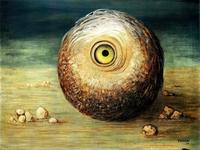
Objekt-fantom
Toyen
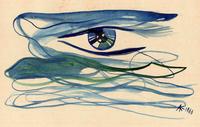
Wave
Oleksandr Aksinin
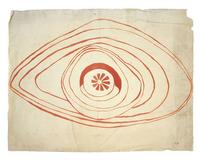
Untitled
Louise Bourgeois
Paese amato
Enzo Cucchi