Expert analysis of Enzo Cucchi’s Paese amato
Style: Neo-Expressionism · Genre: figurative
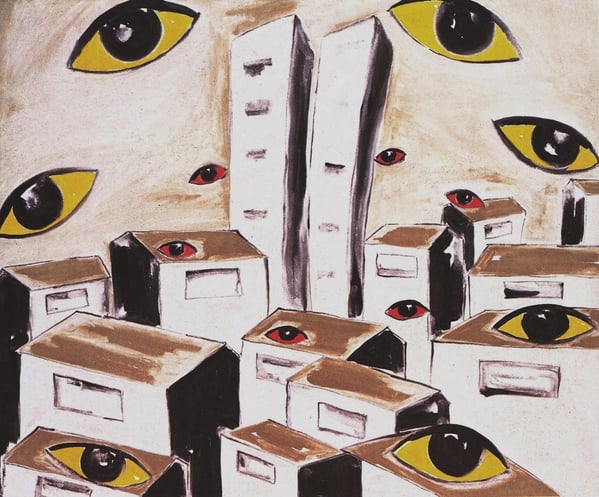
As an expert art historian, I can provide the following analysis of Enzo Cucchi's "Paese amato".
Artwork: "Paese amato" Artist: Enzo Cucchi Style: Neo-Expressionism Genre: Figurative
Analysis and Significance
Enzo Cucchi’s "Paese amato" (Beloved Country) is a quintessential example of the Italian Transavanguardia (the Italian branch of Neo-Expressionism), a movement that emerged in the late 1970s as a reaction against the cerebral austerity of Conceptual Art and Arte Povera. Cucchi, alongside artists like Francesco Clemente and Sandro Chia, championed a return to figurative painting infused with raw emotion, personal mythology, and a deep connection to cultural memory.
What makes "Paese amato" significant within Neo-Expressionism is its fusion of the primitive and the poetic. The work is figurative, but its figures are not naturalistic; they are archetypal, often distorted, emerging from a charged, almost hallucinatory space. True to the Neo-Expressionist ethos, Cucchi uses a deliberately crude, gestural brushstroke and a somber, earthy palette to evoke a sense of ancient, chthonic power. The title, "Beloved Country," suggests a personal, spiritual landscape rather than a literal depiction of Italy. Cucchi often drew from the rugged, mystical terrain of his native Marche region, but here the "country" becomes an internal, psychological territory.
The significance of "Paese amato" lies in its defiance of both avant-garde abstraction and postmodern irony. Cucchi reinstates painting as a vehicle for metaphysical and existential inquiry. The work embodies the Neo-Expressionist conviction that art should be expressive, urgent, and tied to the artist's subjective, even irrational, experience. In the context of the late 20th century, "Paese amato" stands as a powerful statement that figurative painting could still carry immense emotional and symbolic weight, linking the personal vision of the artist to timeless narratives of land, belonging, and the sacred.
Visually similar
20 works with related composition and palette
Olhares
Mathenovê
Les Tableaux (assurance) 063
DIDIER DOIGNON
Café y tinta china Nº2
Martin Pereira
La Boda
Martin Pereira
Eyes
Michael Hafftka
Galería esquizofrénica nº4
Martin Pereira
L'oeil de nuit
Enrico Donati
My Eyes in the Time of Apparition
August Natterer
Stop Clock
David Michael Hinnebusch
Orakel
Ernst Wilhelm Nay
Place signs
Paul Klee
Untitled
Joan Ponc
Untitled
Thomas Riesner
The Kiss
Mihnea Cernat
The false mirror
Rene Magritte
Musas
Martin Pereira
The Eye of the Lord
Georgiana Houghton
Eye of God
Forrest Bess
The Eyes
Jindrich Styrsky
The Eye of the Angelus
Salvador Dali