Rene Magritte sanatçısının The good season eseri hakkında uzman analizi
Tarz: Surrealism · Tür: landscape
Expert Analysis: "The Good Season" by René Magritte
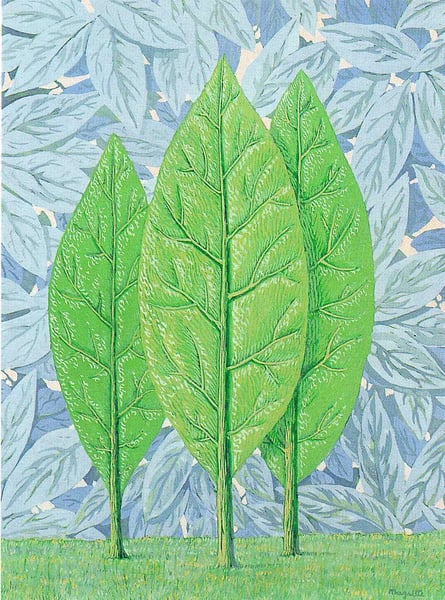
René Magritte’s The Good Season (c. 1964) exemplifies the mature phase of his Surrealist practice, where the everyday becomes a site of philosophical rupture. As a landscape from his Later Period, the work is significant for its refined subversion of natural expectations—a hallmark of Magritte’s enduring contribution to Surrealism.
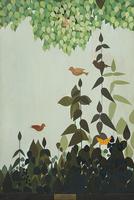
The painting presents a seemingly bucolic scene: a tree, perhaps an oak or chestnut, set against a placid sky. Yet Magritte replaces the foliage with a cluster of giant, carefully painted words—the phrase “la bonne saison” (the good season) repeated in a stylized, placard-like script. This substitution transforms the tree into a signpost for language itself, forcing a collision between the visual and the verbal. The effect is both witty and disorienting: the landscape is no longer a window onto nature but a canvas for conceptual play.
This work is significant for several reasons. First, it encapsulates Magritte’s later obsession with word-image relationships, a theme he explored most famously in The Treachery of Images (“This is not a pipe”). In The Good Season, the painted text does not simply label the tree but becomes the tree—an object that resists easy interpretation. The viewer is caught between seeing a leaf-bearing tree and reading a linguistic assertion. This ambiguity mocks the very idea of representation, a core Surrealist tenet.
Second, the piece exemplifies Magritte’s shift from the overtly dreamlike (of his earlier years) to a more cerebral, almost clinical precision. The Later Period is marked by a deadpan realism—the sky, grass, and trunk are rendered with photographic clarity—which makes the intrusion of text all the more jarring. The calmness of the palette (soft blues, greens, and grays) belies the irrational substitution, creating a tension that is uniquely Magrittean.
Finally, The Good Season reaffirms Surrealism’s power to find the extraordinary within the ordinary. By turning a seasonal landscape into a riddle, Magritte challenges the viewer to question not just what we see, but how we assign meaning. It is a landmark of the Later Period, showing a master at the height of his conceptual clarity—where every brushstroke serves the paradox, and the familiar world unravels into pure, poetic enigma.
Görsel olarak benzer
İlişkili kompozisyon ve renk paletine sahip 20 eser
The fire
Rene Magritte
Plain of Air
Rene Magritte
Untitled
M.F. Husain
Forest of Paimpont
Rene Magritte
The blank page
Rene Magritte
Les arbres
Victor Brauner
Feuilles
Seraphine Louis
Textile Design
Vasyl Yermylov
Sanctuary
Mihnea Cernat
Blooming Cherry Tree
Janos Mattis-Teutsch
Olivenwald
Otto Mueller
The Tree
Henri Matisse
Sparse foliage
Paul Klee
Waiting
Marcel Marien
Life Cycle of a Leaf
Morris Graves
Still life composition leaf
Fernand Leger
The natural graces
Rene Magritte
The natural graces
Rene Magritte
PRZED WIECZOREM
Kazimierz Mikulski
March-April
Jagdish Swaminathan