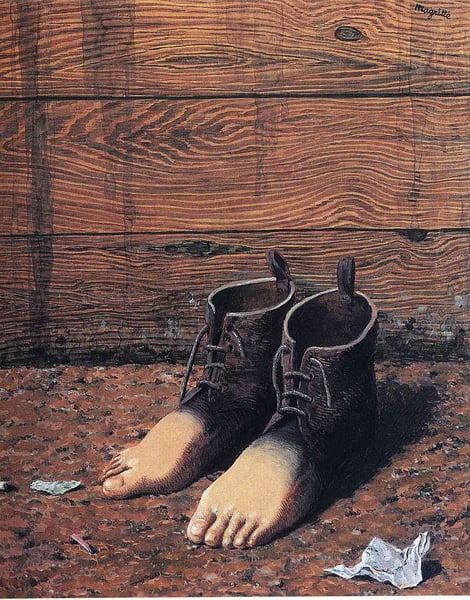
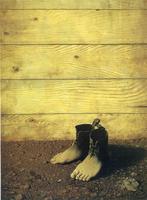
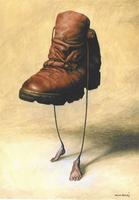
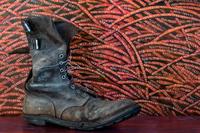
The Red Model (1935) stands as a quintessential example of René Magritte’s mature Surrealist vocabulary, created during his Brussels pre-war and war years. In this symbolic painting, Magritte presents a pair of worn leather boots that seamlessly transform into human feet—flesh and shoelaces, skin and sole, merge into a single, uncanny hybrid. This metamorphosis is the crux of the work’s significance: it enacts Surrealism’s core ambition to collapse the boundary between the familiar and the strange, between object and body.
By grafting organic matter onto an everyday manufactured item, Magritte challenges the viewer’s assumptions about reality and representation. The boots are both functional objects and living appendages, creating a visual paradox that refuses resolution. This unsettling fusion speaks to Magritte’s broader concerns with the arbitrariness of language and perception—a theme he explored throughout his career, from The Treachery of Images to The Son of Man. The red-brown palette and meticulous realism further heighten the disorientation, grounding the impossible in a world that looks almost plausible.
Within the Brussels pre-war and war context, The Red Model also reflects a period of psychological tension and existential questioning. The motif of the foot-boot suggests a deep entanglement between human identity and the things we use, perhaps hinting at the way war dehumanizes or the surreal nature of everyday life under looming threat. For these reasons, the painting remains a landmark of Surrealism: a quiet, masterful subversion of certainty that continues to provoke thought about where the self ends and the object begins.